From Elements to Compounds (part 1 - 2nd video)
 Call Kai
 Learn
 Practice Test
 Spaced Repetition
 Match
 Flashcards
 Knowt Play
1/35

Earn XP
Description and Tags
Module 5 part 1 - 2nd video
36 Terms
VSEPR Theory
A model used to predict the shapes of compunds
Valence Shell Electron Pair Repulsion Theory
What does “VSEPR” stand for?
They tell us which atoms are physically connected to which
Lewis structures give atomic connectivity: they tell us?
bond angles
The shape of a molecule is determined by its _______
109.5o
What are the bond angles of Cl-C-Cl in CCl4 ?
covalent
Is Cl-C bond covalent or ionic?
repel
In order to predict molecular shape, we assume the valence electrons _______ each other.

Linear
VSEPR Model shape
AB2

Bent
VSEPR Model shape
AB2U2 or AB2U
*(U is lone pair)

Trigonal planar
VSEPR Model shape
AB3

Trigonal pyramidal
VSEPR Model shape
AB3U

T-shaped
VSEPR Model shape
AB3U2

Square planar
VSEPR Model shape
AB4U2

Trigonal bipyramidal
VSEPR Model shape
AB5
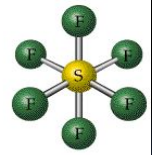
Octahedral
VSEPR Model shape
AB6

AB2U2 - Bent
Molecular shape of H2O?

AB3U2 - T-shape
Molecular shape of ClF3?
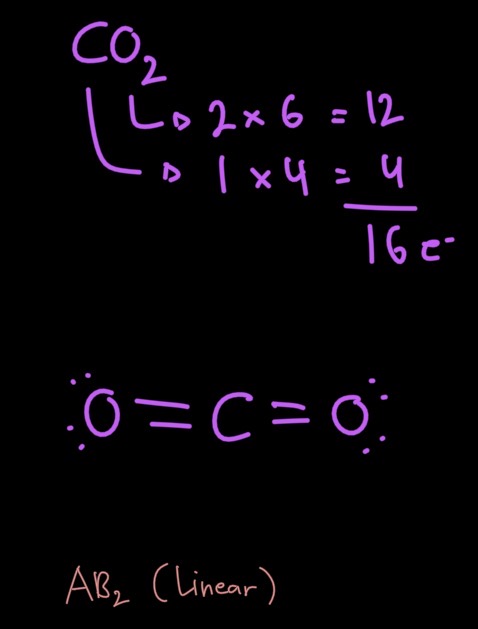
AB2 - Linear
Molecular shape of CO2?

AB3U - Trigonal Pyramidal
Molecular shape of NH3?

AB5 - Trigonal Bipyramidal
Molecular shape of PF5?
Rows/Period 3 below
What rows can follow the expanded octet rule or sum
109.5o
H - C - H bond angle?
107o
H - N - H bond angle?
104.5o
H - O - H bond angle?
decreases
By experiment, the H-X-H bond angle (increases/decreases?) on moving from C to N to O.
Polarity
_______ means having dipoles, a positive and negative end
Polar molecules
What type of molecules have dipoles?
False, their dipole moments do not add up to zero/ do not cancel out.
T or F
Polar molecules have dipole moments that add up to zero.
Water (H2O) and carbon monoxide (CO)
Examples of polar molecules?
Non-polar
Are Methane (CH4) and Carbon tetrachloride (CCl4) polar or non-polar?
Ionic Bond
If difference of electronegativity > 2.0, then it is?
Nonpolar Covalent Bond
If difference of electronegativity < 0.4, then it is?
Polar Covalent Bond
If difference of electronegativity 0.5 - 1.7, then it is?
Nonpolar molecules
_______ molecules do not have positive or negative ends.
a) structure or shape
b) polarity of the individual bonds present in the molecule
We can tell if a molecule is polar or nonpolar based on: (2)
HF, NaBr, NaCl
What molecules are exceptions?