Plants - Unit 2 BSCI207
 Call Kai
 Learn
 Practice Test
 Spaced Repetition
 Match
 Flashcards
 Knowt Play
1/83

Earn XP
Description and Tags
Plants and Multicellularity
Name | Mastery | Learn | Test | Matching | Spaced | Call with Kai | Chat |
|---|
No analytics yet
Send a link to your students to track their progress
84 Terms
Benefits of Multicellularity
Can overcome diffusion in some ways
How can Multicellular organisms overcome Diffusion? (2)
Link separate cells together by adhesion
Task division (cells differentiate into different types)
How To Reproduce As Multicellular
Binary Fission/Budding
Produce single-celled spore or gamete
Binary Fission/Budding is _____ reproduction
Asexual
Producing a single-celled spore or gamete is ____ reproduction
Sexual
Produce a single-celled spore or gamete (How do they differ?)
Single-celled spore will grow up into a whole individual by itself
Gamete will fuse with another gamete cell and form a diploid individual

How can reproduction work in Multicellular organisms?
Some cells that must completely give up opportunity to pass on genes
Some cede function of reproduction
Needs to be tight control of mitotic and meiotic potential
Does an organisms need to have sex organs to have sex?
No!
Does an organism need to even be multicellular to have sex?
No!
What does an organism NEED to have sex?
Diploid phase of life cycle
Meiosis to form haploid gametes
Union of haploid meiotic products (“'syngamy” or “fertilization”)
Syngamy
Synthesis of two gametes (fusing together)
Sexual Life Cycles (3)
Haplontic life cycle
Haplo-diplontic life cycle
Diplontic life cycle
Haplontic life cycle
Most time is spent as haploid cell
Sometimes turns into gametes and are fertilized by other gametes
Brief diploid phase

Haplo-diplontic life cycle
Multicellular individual that is both haploid and diploid in life cycle

Diplontic life cycle
Animals and many plants do this
Most of adult life cycle spent as diploid cells
Two copies, one from each parent (result of fertilization)
Brief period as a haploid cell (formation of gametes that form next generation)

____ life cycle is typical for unicellular eukaryotes
Haplontic

Animals have ____ sexual life cycles
Diplontic

Male and Female Gametes defined by their _____
Size
Female gamete is bigger (Egg) than male gamete (Sperm)
Haploid
Cell or organism that contains a single, complete set of chromosomes (n)
Half the number of chromosomes found in normal body cells

Diploid
Contains two complete sets of homologous chromosomes
One set from each biological parent

______ are the origin of agriculture and civilizations
Plants

Colonization of terrestrial environments: FIRST
First: plants evolved as a new monophyletic lineage with novel adaptations for surviving on the land
Colonization of terrestrial environments: LATER
Later: plants made terrestrial environment more survivable, existing lineages of animals able to colonize
What are some challenges of living on land for a plant?
Aquire oxygen differently
Weather
Lack of water
Gravity
Reproduction
Direct Sunlight
Plants In Water (Characteristics)
Bathed in nutrients
Supported against gravity
Extensive transport often not necessary (Moving water from one part of body to other, because surrounded by water instead)
Gametes, offspring transmitted by water
No problem with desiccation
Reasons Plants Became Terrestrial? (3)
More direct sun for photosynthesis (sufficient ozone for UV protection)
Inorganic nutrients available on land
Initially, absence of herbivores
Challenges to become terrestrial (Plants)
Ways to transfer gametes
Protect vulnerable stages (Zygotes)
Withstand gravity
Conserve water
Transport nutrients
Zygotes
Single, diploid cell formed when a sperm cell and an egg cell (ovum) combine during fertilization

Great Moment in plant evolution was when
Plants “crawled” onto land
Grow closer and closer to shore
Also fungi
Plants are able to get more water and nutrients when grown together with ____
Fungi
Tree of Plants
Algal-like multicellular or on steps to becoming multicellular
Green algae (Called green algae because are green and multicellular or grow in mats)
Land plants: embryophytes

Embryophytes have ____
A protective embryo
Plants didn’t evolve photosynthesis, they captured a _______
Cyanobacteria
Cyanobacteria
Commonly known as blue-green algae, are a group of photosynthetic, gram-negative bacteria
Characteristics of Plants living on land (5)
Protected embryo
Cuticle
Multicellular sporophyte
Gametangia
Thick-walled spores
*Traits help plants not lose water

4 major plant groups
Bryophytes
Pteridophytes
Gymnosperms
Angiosperms

4 groups are defined by
Traits that they have or don’t have
(Ex. Bryophytes don’t have vascular tissue)
Bryophytes
Nonvascular

Pteridophytes
Vascular Seedless

Gymnosperms
Seeded Non-flowering
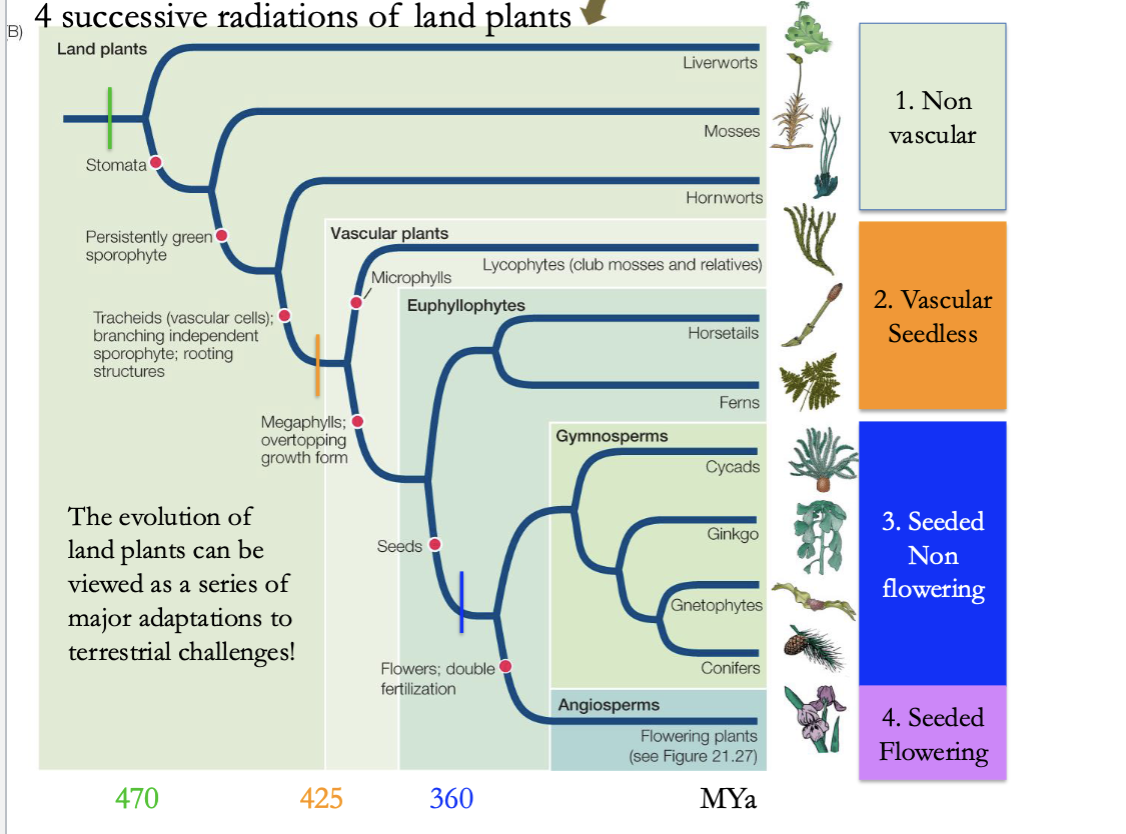
Angiosperms
Seeded Flowering

4 Successive radiations of land plants/The evolution of land plants can be seen as ____
A series of major adaptations to terrestrial challenges for plants to live on land
Plant Life Cycle
Haploid generation = Gametophyte generation
Diploid generation = Sporophyte generation

Bryophyte life cycle
Haploid cells for most of life cycles

Plant Life Cycle (Haploid)
Gametophyte generation
Plant Life Cycle (Diploid)
Sporophyte generation
Bryophytes Traits
Need to live near water or in a very wet environment
Rely on water for fertilization
Abundant in moist habitats
Persistent gametophytes protect the short-lived sporophytes
Zygotes develop into diploid embryos (young sporophytes)

Bryophytes Traits that allow them to live on land
Waxy cuticle (around leaves - reduces amount of evaporation of water)
Enclosed Embryo
Stomates
*All land plants have these traits, but these are the ONLY traits Bryophytes have

Stomates
Special cells that form pores
Open and close depending on water and gas needs of plants
Allow plant to regulate opening of body to get more CO2 and close so they don’t evaporate water
Pteridophytes Evolutionary Traits
Evolved Vascular Tissue
Xylem and Phloem
Xylem fortified with lignin
Small free-living gametophytes without vascular tissue
Have vascular tissue but NOT seeds

Xylem is fortified with _____ so can increase in ____size
Lignin
Size
Can get large sporophytes with vascular tissue

Xylem transports _____
Water and Ions
Phloem transports ____
Sugars
Xylem and Phloem in Pteridophytes
Organized in little bundles
Vascular bundles (Xylem cells in middle, Phloem cells on outside of bundle)

Xylem in Pteridophytes
Long, wide cells with no cytoplasm
Form tubes

Phloem in Pteridophytes
Long, narrow cells with limited cytoplasm
Not as wide

Pteridophytes are limited by ____ (2)
Requirement for water to accomplish fertilization
Presence of a vulnerable gametophytes (phase)

Fern Life Cycle

Sporangium
Where sporophyte is made

Bryophyte
Mostly gametophyte (haploid)
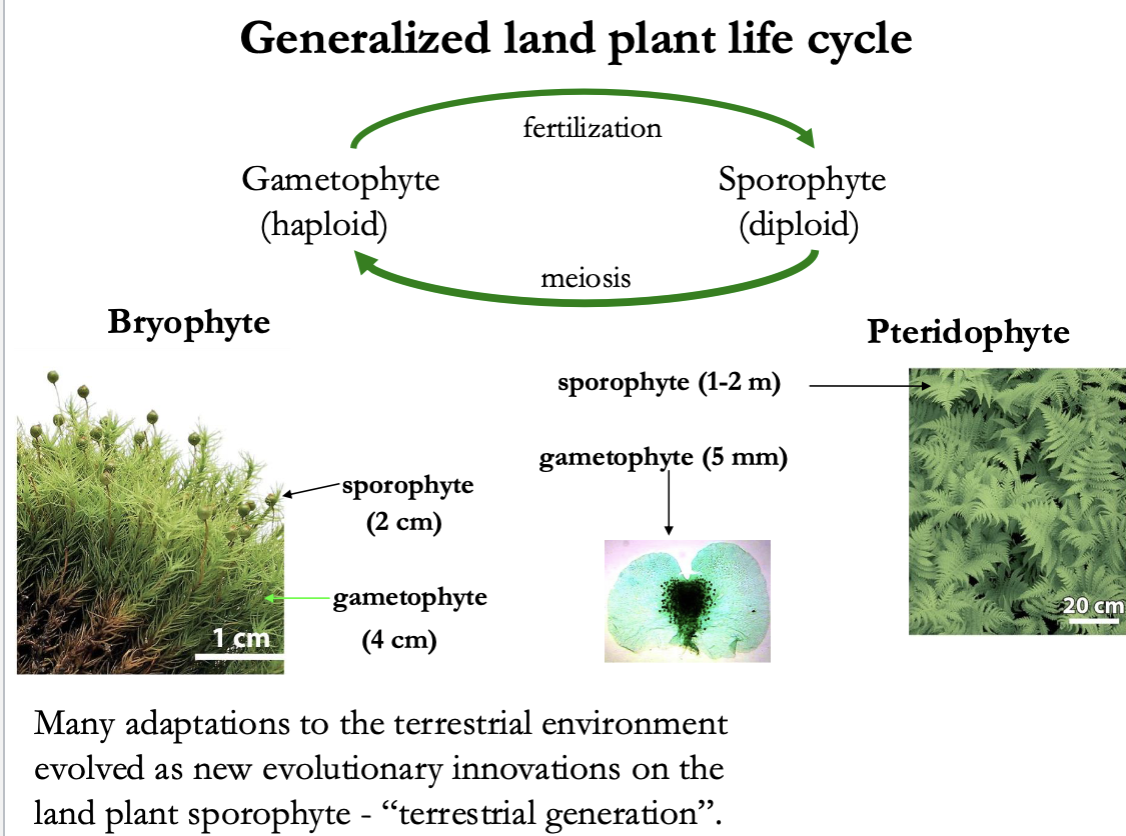
Pteridophyte
Mostly sporophyte

Gymnosperms are ___
Vascular plants with naked seeds
Gymnosperms have two major innovations: ___ and ____
Seeds
Pollen
4 Major Gymnosperms:
Cycads
Ginkgoes
Conifers
Gnetophytes
Gymnosperms are ___
Heterosporous
Megaspore = ____
Egg
Microspore = _____
Sperm
Ex. Pollen
Anisogamous
Not same size gametes
Gymnosperms are ____
Anisogamous
Parts of A Seed (4)
Seed coat
Spore wall
Food Supply
Embryo

“In situ” means
In that location (In that situation)
Evolution of Seed
Megaspore → Female Gametophyte (egg) retained on sporophyte
Egg fertilized in situ
Embryo supplied with food
Seed (fertilized ovule) - a three generation package deal
Germination can wait for favorable conditions!
Germination favorable conditions include (2)
Carried by wind
Carried by animals
(Seed) Seed Coat
Derived from integument
Part of the mother plant
1st Generation
(Seed) Spore Wall
Surrounded by megasporangium remnant
(Seed) Food Supply
Haploid Female Tissue
Supply food to the egg
Female Gametophyte tissue (n)
(Seed) Embryo
2nd Generation
New sporophyte (2n)
Do Gymnosperms need water for reproduction?
No
Now free from water for reproduction
Drawbacks of wind pollination:
Inefficient (must produce a lot of pollen)
No reliable
Pine cone
