8.2 The Nature of Light
 Call Kai
 Learn
Learn Practice Test
 Spaced Repetition
 Match
Match Flashcards
 Knowt Play
1/52

There's no tags or description
Looks like no tags are added yet.
Name | Mastery | Learn | Test | Matching | Spaced | Call with Kai | Chat |
|---|
No analytics yet
Send a link to your students to track their progress
53 Terms
electromagnetic radiation
a form of energy embodied in perpendicular oscillating waves, one for the electric field and one for the magnetic field

magnetic field
region of space where a magnetic particle experiences a force
electric field
a region of space where an electrically charged particle experiences a force
electric, magnetic
In a vacuum, waves of oscillating, mutually perpendicular ________ and _________ fields moves at a constant speed of 3.00 × 10^18 meters per second.
amplitude
vertical height of a crest (or depth of a trough) of a wave; a measure of wave intensity

wavelength (λ)
distance between adjacent crests of a wave (or any two analogous points)

frequency (v)
for waves, the number of cycles (or complete wavelengths) that pass through a stationary point in one second
directly
Frequency and the speed at which a wave is traveling are ________ (directly/inversely) proportional.
inversely
Frequency and wavelength are _________ (directly/inversely) proportional.
v = c/λ
frequency and wavelength relation
electromagnetic spectrum
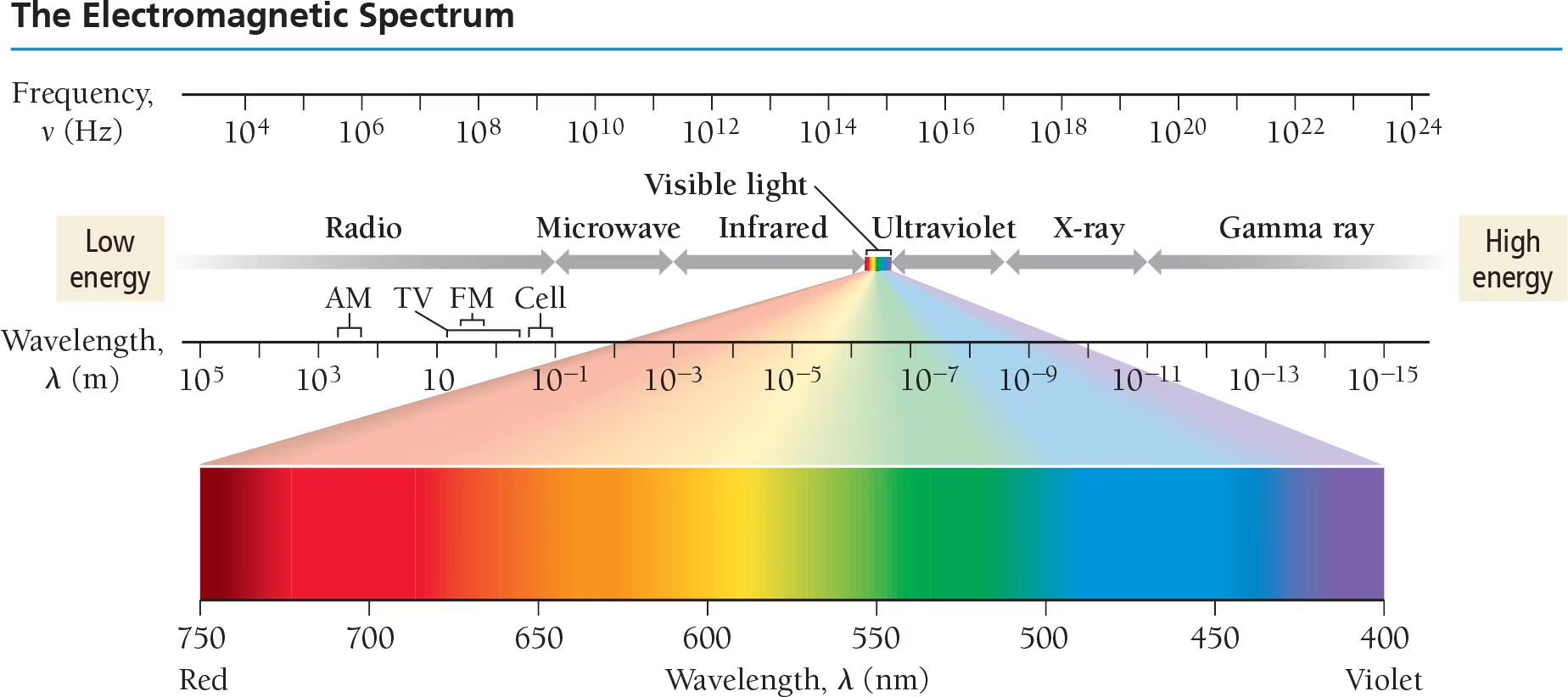
range of wavelengths of all possible electromagnetic radiation, including (in order from lowest to highest energy) radio waves, microwaves, infrared radiation, visible light, ultraviolet radiation, x-rays, and gamma rays
greater
Short-wavelength light inherently has ________ (lesser/greater) energy than long-wavelength light due to particle nature of light.
gamma ray (γ)
form of electromagnetic radiation with the shortest wavelength and highest energy, produced by stars and certain unstable atomic nuclei,
X-rays
electromagnetic radiation with wavelengths slightly longer than those of gamma rays; used to image bones and internal organs
ultraviolet radiation (UV)
electromagnetic radiation with slightly smaller wavelengths than visible light
visible light
those frequencies of electromagnetic radiation that can be detected by the human eye where wavelength or frequency determines color (ROYGBIV)
reflected
When a substance absorbs some colors while reflecting others, it appears the color that is being ________ (absorbed/reflected).
infrared radiation (IR)
electromagnetic radiation emitted from warm objects, with wavelengths slightly larger than those of visible light; can be detected by infrared sensors for night vision technology
microwaves
electromagnetic radiation with wavelengths slightly longer than those of infrared radiation; used for radar and in microwave ovens, efficiently absorbed by water and can heat substances that contain water
radio waves
longest wavelengths on the electromagnetic spectrum, used to transmit signals for radio, cell phones, TV, other communication
interference
the superposition of two or more waves overlapping in space, resulting in either an increase in amplitude (constructive interference) or a decrease in amplitude (destructive interference)
constructive interference
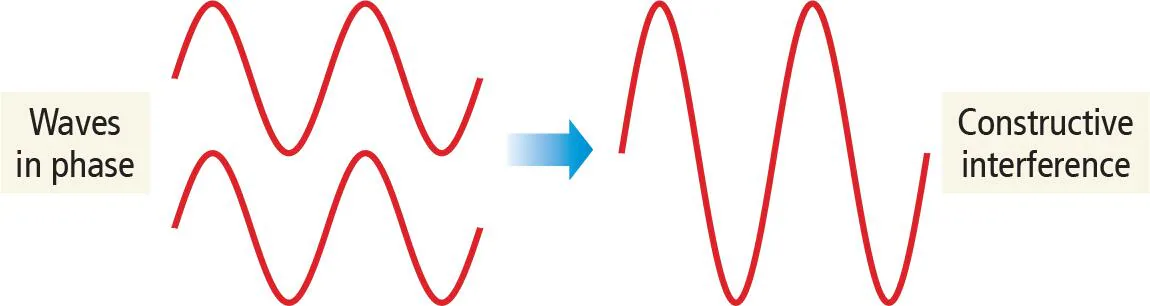
the interaction of in-phase waves from two sources that align with overlapping crests, resulting in a wave of greater amplitude

in phase
waves align with overlapping crests
destructive interference
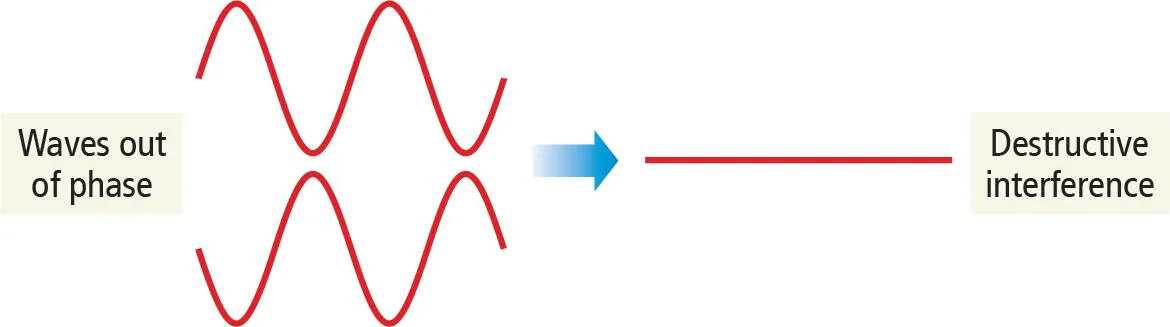
the interaction of out-of-phase waves from two sources that are aligned so that the crest of one overlaps the trough of the other, resulting in cancellation

out of phase
waves align so that the crest from one source overlaps with the trough of the other source
diffracts
When a wave encounters an obstacle or a slit that is comparable in size to its wavelength, it __________ around it.

interference pattern
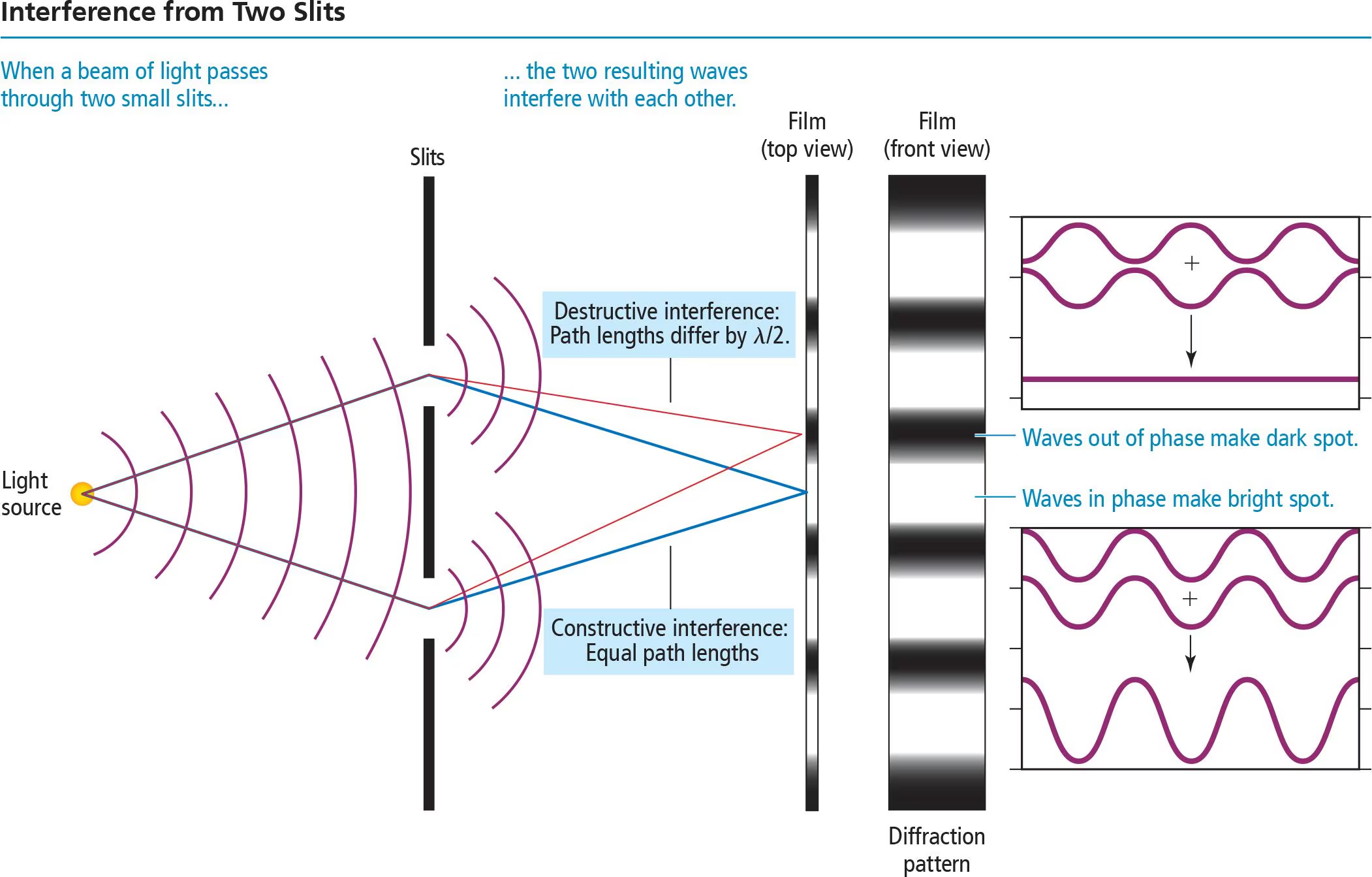
The diffraction of light through two slits separated by a distance comparable to the wavelength of light, coupled with interference, results in an ________________________, a series of bright and dark lines that can be viewed on a screen.

slit
In the creation of an interference patter, each ____ acts as a new wave source, causing two new waves to interfere with each other.
dark
At the point where difference in distance is ½ of one wavelength (waves are out of phase), interference is destructive and a ____ (bright/dark) line appears on screen.

bright
At the point where the difference in distance between the paths is 1 whole wavelength (waves are in phase), interference is constructive and a ______ (bright/dark) line appears on screen.
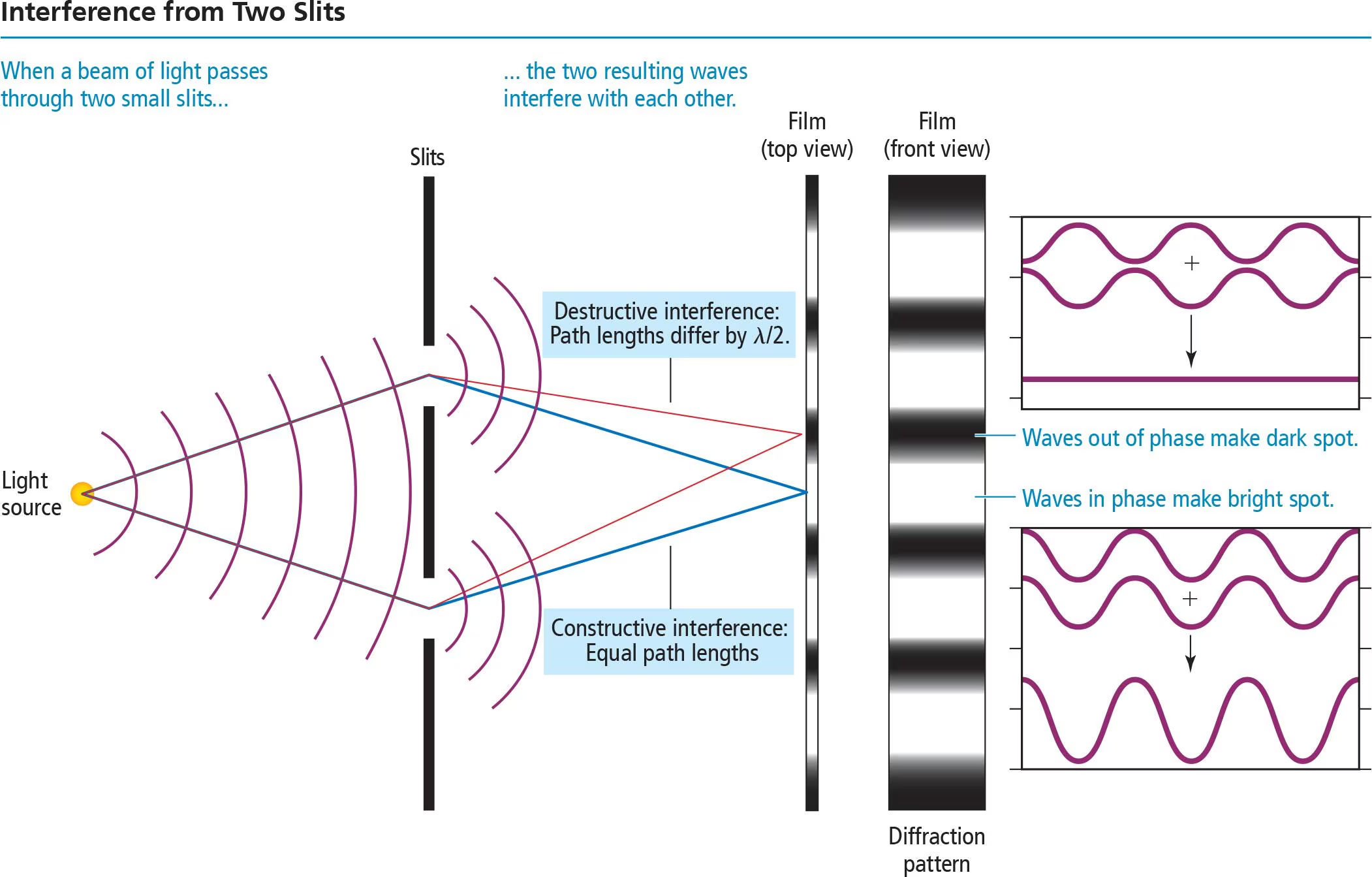
waves
Interference results from the ability of electromagnetic radiation to diffract through two slits — an inherent property of _____ (waves/particles).

classical
refers to descriptions of matter and energy before the advent of quantum mechanics
photoelectric effect
observation that many metals emit electrons when light shines upon them
classical electromagnetic theory
______________________________ assumes that increasing amplitude (intensity) of the light affects the rate at which electrons are dislodged from metal, and that a dim light will result in lag time between initial shining of light and subsequent emission of electron.
lag time
classical electromagnetic theory’s predicted minimum amount of time required for the dim light to transfer sufficient energy to the electron to dislodge it
did not support
Experimental results ________________ (supported/did not support) the classical prediction.
without
Scientists found that a high-frequency, low-intensity light produces electrons _______ (with/without) the predicted lag time.
threshold frequency
The light used to dislodge electrons in the photoelectric effect exhibits a ____________________, below which no electrons are emitted from the metal, no matter how long the light shines on the metal.
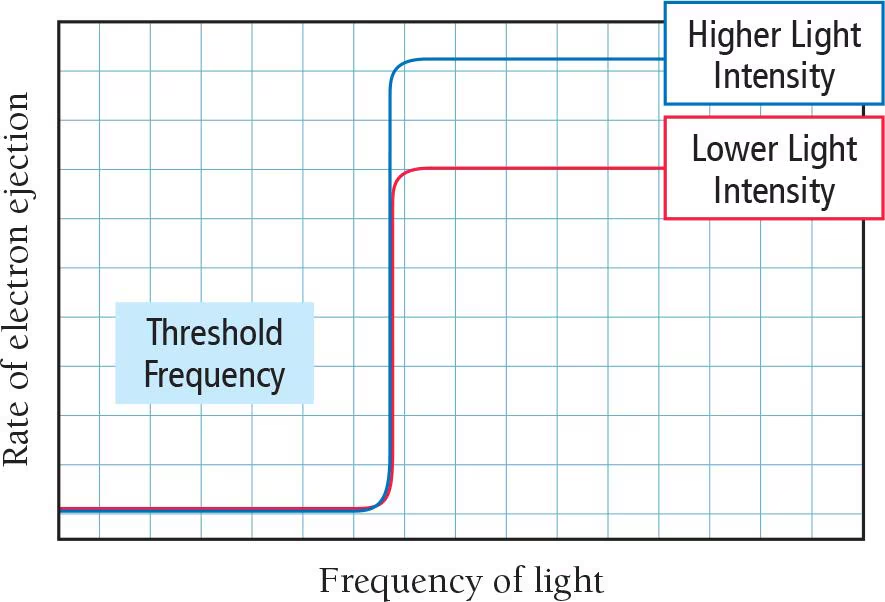
does not
Increasing the intensity of the light ________ (does/does not) change the threshold frequency.

does not
Low-frequency (long-wavelength) light _________ (does/does not) eject electrons from a metal regardless of its intensity or duration.

does
High frequency (short-wavelength) light ____ (does/does not) eject electrons, even if its intensity is low.

E = hv = hc/λ
energy in relation to frequency or wavelength
Planck’s constant
h = 6.626 × 10^(-34) J * s
photon
aka quantum, the smallest possible packet of electromagnetic radiation with an energy equal to hv
photons
Unlike classical magnetic theory, in which light was viewed purely as a wave whose intensity was continuously variable, Einstein suggested that light was lumpy. From this perspective, a beam of light is not a wave propagating through space but a shower of particles called ________, each with energy hv.
photon
Einstein’s idea that light is quantized elegantly explains the photoelectric effect. The emission of electrons from the metal depends on whether or not a single _______ has sufficient energy (as given by hv) to dislodge a single electron.
binding energy
ϕ
hv = ϕ
threshold frequency condition
energy
Low-frequency light does not eject electrons because no single photon has the minimum ______ (hv) necessary to dislodge the electron.
frequency
Increasing the __________ (amplitude/wavelength/frequency) of the light, even at low intensity, increases the energy of each photon.
kinetic
As the frequency of the light increases past the threshold frequency, the excess energy of the photon (beyond what is needed to dislodge the electron) transfers to the electron in the form of _______ energy.
KE = hv - ϕ
kinetic energy in relation to energy of the photon and binding energy
wave-particle duality of light
principle that sometimes light appears to behave like a wave, at other times like a particle, depending on the circumstances of particular observation