ATM S 301: Introduction to Atmospheric Sciences Review
 Call Kai
 Learn
 Practice Test
 Spaced Repetition
 Match
 Flashcards
 Knowt Play
1/15

Earn XP
Description and Tags
Vocabulary flashcards covering key concepts, equations, and atmospheric principles from ATM S 301 Introduction to Atmospheric Sciences.
16 Terms
Measurement types (direct, indirect), key variables and how to measure them
Direct measurements (in-situ) must be taken AT the location (rain gauge, anemometer). Indirect measurements use radiation (existing or created) to estimate measurements.
Key variables include temperature, pressure, humidity, and wind speed.
Direct measurements are more accurate. However, coverage is limited. Indirect measurements can cover larger areas but may introduce estimations and uncertainties.
Direct measurements are usually taken every few hours. Indirect measurements can be taken much more frequently.
Scales of atmospheric motion
Microscale - Think eddies and wind gusts
Mesoscale - Think tornadoes and thunderstorms
Synoptic Scale - Think mid-latitude cyclones and anticyclones
Global Scale - Think hadley cell and the jet stream
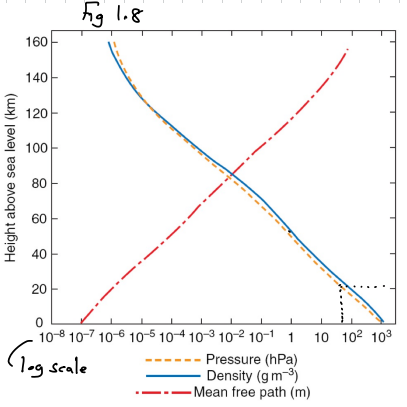
Vertical distribution of pressure and density
Pressure and density both overall decrease with height, exponentially. Temperature is the one that is a bit more complex.
To find pressure scale height, use p = p0e-z/h, where p0 is the sfc. pressure, H is the height at which the pressure falls to 1/e (37%) of the sfc value (usually about 8), and Z is the height above sea level (km). Density follows same formula, but with Ro instead of p. (This all assumes temperature is constant with height, which isn’t exactly the case in the real world)
Major atmospheric gases, conversion from fraction by mass to fraction by volume
78% Nitrogen, 21% Oxygen, 0.9% Argon, 0-5% Water Vapor (very variable). Everything else is ppm. That’s the fraction by volume, but to convert to the fraction by mass, you must divide (volume*mass)/(the sum of all gas*volume for all gases in the atmosphere). Use percentages, for example, Argon has 0.9% by volume, so use (0.009×40)/(0.78×28)+(0.21×32)+(0.009×40)… = 1.3% by mass.

Wind structure and general circulation
Westerly wind belts at the mid-latitudes (meandering jet streams) (tropopause)
Northeasterly (NH) trade winds in sub-tropics
Baroclinic waves feed upon temp gradients, become unstable, and form mid-latitude cyclones (responsible for most mid-lat precip)
In the NH, cyclones rotate CCW (cyclonic) around low-pressure centers, and CW (anticyclonic) around high-pressure centers

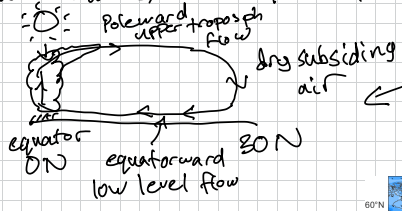
Hadley Cell
Warm, moist air rises near the equator, cools and forms clouds, flows toward the poles, sinks and warms in the subtropics, and returns toward the equator near the surface.
Chapman reactions for production/loss of ozone in stratosphere; importance of ozone (O3) on stratospheric temperature profile; importance of catalytic reactions for O3 loss
Chapman Reactions: Describe the natural production and loss of ozone in the stratosphere. UV radiation breaks apart oxygen molecules (O₂) into individual oxygen atoms, which can combine with O₂ to form ozone (O₃). UV radiation can also break apart ozone, and oxygen atoms can react with ozone to destroy it. The balance between production and loss determines ozone concentration.
Importance of Ozone: Stratospheric ozone absorbs much of the Sun's harmful UV radiation, protecting life from cellular and DNA damage. This absorption also heats the stratosphere, explaining why temperature generally increases with altitude there.
Catalytic Reactions: Catalysts accelerate ozone destruction without being consumed themselves, allowing them to repeatedly destroy ozone. Some occur naturally, while others, such as chlorine radicals released from human-produced CFCs, contribute to additional ozone depletion.
Key atmospheric trace gases (CO2, ozone, sulfur gases)
Hydroxyl Radical [·OH] - Forms from the reaction of ozone with sunlight. Very short lifetime. Really only present during daytime. Has intense oxidizing power.
Carbon Dioxide [CO2] - Major greenhouse gas, concentrations steadily increasing YOY with a seasonal cycle. Emitted biologically (plant respiration) and anthropogenically (fossil fuel burning). Consumed by photosynthesis, dissolves in ocean water. Lifetime in atmos is 3-4 years, but lasts in oceans for much longer. Causes ocean acidification.
Ozone [O3] - Important pollutant in the troposphere, can have health impacts. However, very important for human life in the stratosphere.
Sulfur Gases - An essential element for life. Sulfur gases are emitted by biological processes, volcanic activity, and human activities such as fossil fuel burning. DMS participates in atmospheric aerosol formation.
Aerosols: sizes, sources, key types, sinks, residence time
Aerosols are suspensions of solid or liquid particles in air. They have very small terminal velocity. They range in size 5 orders in diameter and 15 orders in mass. Diameter ranges from 10-3 micrometers to 100 micrometers.
Sources include Biological (animals, plants, forest fires, biomass burning), Sea Salt (breaking waves), Solid Earth (dust from soils, deserts, clay), Anthropogenic (dust from roads/soils, biomass burning for agriculture, combustion of fossil fuels), and In-Situ Formation (gas to particle conversion)
Sinks include Coagulation (ONLY a sink for number, not mass), Dry Deposition, Wet Deposition (biggest sink)
Residence time varies. For Aitken particles, very short. For Large particles, they have the longest. (days to weeks). For Giant Particles, somewhere in the middle (hours to days)
Very small particles collide and coagulate relatively efficiently. Very large particles fall out of the atmosphere because of gravitational settling.
But intermediate-sized particles are relatively resistant to both processes, so they can remain suspended longer.
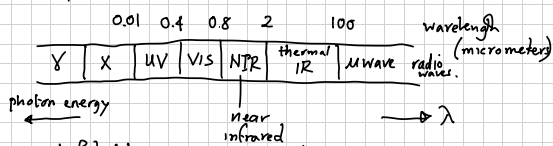
EM spectrum, key bands for atmospheric radiation
Ultraviolet (UV): High-energy, short-wavelength radiation from the Sun. Much is absorbed by stratospheric ozone, protecting life and heating the stratosphere.
Visible (VIS): The Sun's radiation peaks in the visible spectrum. Much of this radiation passes through the atmosphere and heats Earth's surface.
Near Infrared (NIR): Also emitted strongly by the Sun. Part of incoming solar radiation, with some absorption by atmospheric gases, especially water vapor.
Thermal Infrared (IR): Primarily associated with radiation emitted by Earth and the atmosphere. Absorbed and emitted by greenhouse gases, important for the greenhouse effect.
Microwave: Longer-wavelength radiation, particularly useful for atmospheric observations such as weather radar and satellite measurements.
Qualitative difference between radiance (directional) and irradiance (nondirectional)
Radiance (Intensity): Radiation traveling in a specific direction, measured per unit area (W/m-²) + solid angle. Can be described at individual wavelengths (monochromatic intensity) or integrated across a range of wavelengths.(spectral intensity)
Irradiance (Flux Density): Total radiation received per unit area of a surface, accounting for radiation arriving from different directions and the orientation of the surface (W/m²).
Blackbody radiation: general form (qualitative) of the Planck function, dependence on wavelength (Wien’s law) and temperature (Stefan-Boltzmann)
Blackbody: An idealized object that absorbs all incoming radiation and emits radiation according to its temperature.
Planck Function: Describes the intensity of blackbody radiation at different wavelengths for a given temperature, producing a continuous spectrum with a distinct peak.
Wien's Law: As temperature increases, the peak wavelength decreases (shifts to shorter, more energetic wavelengths). λpeak = b/T
Stefan–Boltzmann Law: As temperature increases, the total radiation emitted increases. E=σT4
Stefan-Boltzmann law (EQ)
A physical law stating that the total energy radiated per unit surface area of a black body is proportional to the fourth power of its absolute temperature. It is expressed mathematically as E=σT4 , where E is energy, T is temperature, and σ is the Stefan-Boltzmann constant.
Emissivity and absorptivity, Kirchoff’s law
Emissivity is the actual irradiance divided by the black body irradiance. (ε)
Absorptivity is the actual absorption divided by the max absorption. (α)
Kirchoff’s Law is absorptivity = emissivity. Bodies with α = ε < 1 are gray bodies.
Quantitative radiative balance of a planet (incoming solar vs outgoing terrestrial), albedo, emission temperature
Radiative Balance: At equilibrium, the solar radiation absorbed by a planet equals the terrestrial radiation it emits to space.
Albedo (α): Fraction of incoming solar radiation reflected back to space. Earth's albedo is approximately 0.3, meaning 30% is reflected and 70% is absorbed.
Planetary Energy Balance: Earth intercepts solar radiation over a circular area (πR²), but emits terrestrial radiation over its entire spherical surface (4πR²). This produces the factor of 4 in the energy balance equation.
S₀(1 − α) / 4 = σTₑ⁴
Emission Temperature: The temperature a blackbody would need to emit the same amount of radiation as the planet. Earth's emission temperature is approximately 255 K (−18°C), considerably colder than its actual average surface temperature (~290 K) because of the greenhouse effect.
Greenhouse species (clouds, CO2, water vapor) and the physical principles behind the greenhouse effect
Greenhouse Species: Clouds, water vapor (H₂O), and greenhouse gases such as CO₂ and CH₄ contribute to the greenhouse effect by absorbing and emitting infrared radiation.
Greenhouse Effect: Earth's surface absorbs incoming solar radiation and emits thermal infrared radiation. Greenhouse species absorb some of this outgoing IR and re-emit radiation both upward and downward. The downward emission contributes to warming Earth's surface.
Importance: The greenhouse effect helps explain why Earth's average surface temperature (~290 K) is warmer than its emission temperature (~255 K).