AP 2 Exam 3
 Call Kai
 Learn
 Practice Test
 Spaced Repetition
 Match
 Flashcards
 Knowt Play
1/83

Earn XP
Description and Tags
Immune and Respiratory
84 Terms
What occurs during pulmonary ventilation and gas exchange?
Pulmonary ventilation moves air into and out of the lungs. Pulmonary gas exchange diffuses O₂ and CO₂ between the lungs and blood.
Identify the major organs of the upper and lower respiratory tract.
Upper tract: nose, paranasal sinuses, and pharynx. Lower tract: larynx, trachea, bronchi, lungs, and alveoli.
Where are the general locations of the upper and lower respiratory systems?
Upper respiratory system: outside the thoracic cavity and mediastinum. Lower respiratory system: inside the thoracic cavity, flanked by the mediastinum.
What is the function of the paranasal sinuses, and which bones contain them?
The ethmoid, frontal, sphenoid, and maxillary bones contain the paranasal sinuses. They lighten the skull, warm, moisten, and filter incoming air, and secrete mucus.
What is the importance of surfactant?
It is a detergent-like complex of lipids and proteins that decreases surface tension in alveolar fluid to prevent alveolar collapse.
What are the functions of cilia?
They sweep contaminated dust and particles trapped in mucus toward the pharynx.
What is the role of the nasal conchae, and what effects do they have during inhalation?
They increase the mucosal area exposed to air and enhance turbulent airflow. They filter, heat, and moisten incoming air and reclaim heat and moisture.
Compare and contrast the true and false vocal cords and their functions.
False vocal cords do not produce sound; they help close the glottis during swallowing. True vocal cords vibrate as air passes through to produce sound.
What causes voice production changes in speech, pitch, loudness, sound quality, and phonation?
Speech uses expired air. Pitch depends on the length and tension of the vocal folds. Loudness depends on forced airflow. Resonating chambers amplify sound and enhance sound quality, while phonation produces voice and helps shape language.
What is the flexible tube of the trachea called, and what is its function?
The windpipe (trachea) has C-shaped cartilage rings that maintain an open airway and prevent collapse.
What are the health benefits and timeline of smoking cessation?
Ciliary function can begin to recover within a few weeks.
What can you do if someone is choking on a piece of food lodged in the windpipe?
Administer the Heimlich maneuver (abdominal thrusts) to dislodge the obstruction from the trachea, when appropriate.
Identify the bronchi and subdivisions of the conducting and respiratory zones, including their cells and functions.
Conducting zone: trachea, bronchi, lobar bronchi, segmental bronchi, and terminal bronchioles; mainly columnar and cuboidal cells; conducts airflow. Respiratory zone: respiratory bronchioles, alveolar ducts, alveolar sacs, and alveoli; simple squamous cells support gas exchange.
What is the difference between the three cells found in the alveoli?
Type I alveolar simple squamous cells form gas-exchange surfaces. Type II alveolar cuboidal cells secrete surfactant. Alveolar macrophages engulf foreign particles.
Where can you find simple squamous epithelium?
Lining the walls of the alveoli.
Compare the right and left lungs.
The right lung has three lobes and is broader, with horizontal and oblique fissures. The left lung has two lobes, a cardiac notch, and an oblique fissure.
What is the difference between bronchial and pulmonary circulation?
Pulmonary circulation carries blood to the lungs for gas exchange. Bronchial circulation supplies blood to nourish lung tissue.
What is the difference between parietal and visceral pleura?
Visceral pleura covers the external lung surface and dips into the fissures. Parietal pleura lines the inner surface of the thoracic wall.
What causes air to move in and out of the lungs in relation to negative and positive respiratory pressures?
Negative pressure: lower than atmospheric pressure (760 mmHg), allowing air to move into the lungs. Positive pressure: higher than atmospheric pressure (760 mmHg), pushing air out.
Recall the numerical pressures for atmospheric, transpulmonary, intrapleural, and intrapulmonary pressures.
Atmospheric pressure is approximately 760 mmHg. Intrapleural pressure is approximately −4 mmHg relative to atmospheric pressure. Intrapulmonary pressure fluctuates around atmospheric pressure, and transpulmonary pressure is the difference between intrapulmonary and intrapleural pressures.
Compare and contrast atelectasis and pneumothorax.
Atelectasis is the collapse of all or part of a lung, potentially caused by plugged bronchioles. Pneumothorax is the presence of air in the pleural space, causing lung collapse.
What is the definition of Dalton’s law and Boyle’s law?
Dalton’s law states that the total pressure of a gas mixture is the sum of its partial pressures. Boyle’s law describes the inverse relationship between gas pressure and volume at constant temperature.
What influences the ease (or work) of ventilation?
Lung compliance, alveolar surface tension, and airway resistance.
Identify the pulmonary volumes and capacities on a spirographic record.
Volumes: tidal volume, inspiratory reserve volume, expiratory reserve volume, and residual volume. Capacities: inspiratory capacity, vital capacity, functional residual capacity, and total lung capacity.
What are the normal pulmonary volumes and capacities?
IRV: 3,100 mL; TV: 500 mL; ERV: 1,200 mL; RV: 1,200 mL; IC: 3,600 mL; VC: 4,800 mL; FRC: 2,400 mL; TLC: 6,000 mL.
Which volume is named for normal breathing?
Tidal volume (TV).
Who coined the clinical law used for the hyperbaric chamber?
Henry’s law.
Understand the mechanism of ventilation-perfusion coupling.
Decreased PO₂ and increased PCO₂ cause pulmonary arterioles to constrict, decreasing blood flow to poorly ventilated alveoli. Increased PO₂ and decreased PCO₂ cause pulmonary arterioles to dilate, increasing blood flow to functional alveoli.
What are the effects of temperature on the oxygen-hemoglobin dissociation graph?
Higher temperatures shift the curve to the right, reducing oxygen affinity and enhancing oxygen delivery to metabolically active tissues.
Understand the transport and exchange of CO₂ into the blood plasma.
CO₂ is transported dissolved in plasma, converted into bicarbonate ions (HCO₃⁻) by carbonic anhydrase, and bound to hemoglobin as carbaminohemoglobin.
What happens when you breathe into a paper bag during hyperventilation?
Re-inhaling carbon dioxide can retain CO₂ in the blood. Paper-bag rebreathing is not recommended as a first-aid treatment because it can be dangerous.
What do hyperventilation and hypoventilation result in?
Hyperventilation causes respiratory alkalosis due to low CO₂. Hypoventilation causes respiratory acidosis due to high CO₂.
How does pH affect the factors influencing breathing rate and depth?
Changes in CO₂, O₂, and H⁺ affect breathing. Increased acidity stimulates central and peripheral chemoreceptors and can increase breathing to expel CO₂.
How do emotions and pain affect the respiratory centers, and at what locations?
Hypothalamic and limbic system inputs modify respiratory activity by acting on the medullary and pontine respiratory centers.
What are the key features of the COPD-related diseases emphysema and chronic bronchitis?
Emphysema involves alveolar wall destruction and loss of elasticity. Chronic bronchitis involves airway inflammation and excessive mucus production.
Lung cancer is ranked what among causes of cancer deaths, and about what percentage results from smoking?
According to the provided study material, it is ranked first among causes of cancer deaths, and about 90% of cases result from smoking.
What is the correct order of the three lines of defense?
Surface, innate, adaptive
What does gastric juice do to help defend against pathogens?
HCl and protein-digesting enzymes destroy pathogens
How do lacrimal secretions help defend against pathogens?
Tears and saliva lubricate and clean; they contain lysozyme
How does urine help defend against pathogens?
It cleanses the lower urinary tract as it flushes from the body
How does the immune system counter microbes that hide their surface carbohydrate signatures?
Opsonization
What is the first step of phagocyte mobilization?
Leukocytes
What process involves neutrophils flattening to squeeze through endothelial cells?
Diapedesis
Interferons are a family of immune-modulating proteins produced by various cells. True or false?
True
According to the class activity, when does cell lysis begin?
When Cb3 binds to a target cell
A virus triggers specific lymphocyte antibody production. Which immune defense and immunity type is this?
Adaptive; humoral
What is the main job of B cells, T cells, and antigen-presenting cells (APCs)?
B cells make antibodies; T cells fight; APCs show antigens to T cells
Where do lymphocytes originate, where do B and T cells mature, and what happens when they encounter an antigen?
They originate in bone marrow; B cells mature in bone marrow and T cells in the thymus; they become activated
To form a cell's antigen receptor, gene pieces are mixed and combined uniquely. True or false?
True
What do macrophages do that B cells cannot?
Activate naïve T cells
How long is the lag period of the primary immune response?
3–6 days
What are the effector cells in T lymphocytes, according to the class activity?
All of the above
How long does passive immunity usually provide protection, according to the class activity?
2–3 weeks
Which best describes antibodies (immunoglobulins)?
Proteins secreted by plasma cells that bind specifically to antigens
Which polypeptide chains make up an antibody monomer?
Two heavy chains and two light chains
What is the most abundant antibody, and what percentage of circulating antibodies does it contain?
IgG; 75–85%
IgD is a monomer and functions as a B-cell receptor. True or false?
True
Where is dimeric IgA NOT found in the body, according to the class activity?
Urine
What is the importance of IgM?
It acts as a pentamer in plasma and activates complement
What happens when antibody–antigen complexes cross-link?
Large, insoluble lattices or clumps form (agglutination)
What triggers complement activation, according to the class activity?
Several antibodies binding close together on the same cell
Which antibody process cross-links soluble molecules into large complexes for cells to phagocytose?
Precipitation
CD4 cells become effector cells that help activate which of the following?
All of the above
What are chemical messengers that influence immune-cell development, differentiation, and responses called?
Cytokines
Which cell type can present another cell’s antigens on its Class I MHC protein to activate CD8 T cells?
Dendritic cells
What is secreted by lymphocytes and is the base for more Class I and Class II MHC proteins, according to the class activity?
Gamma cells
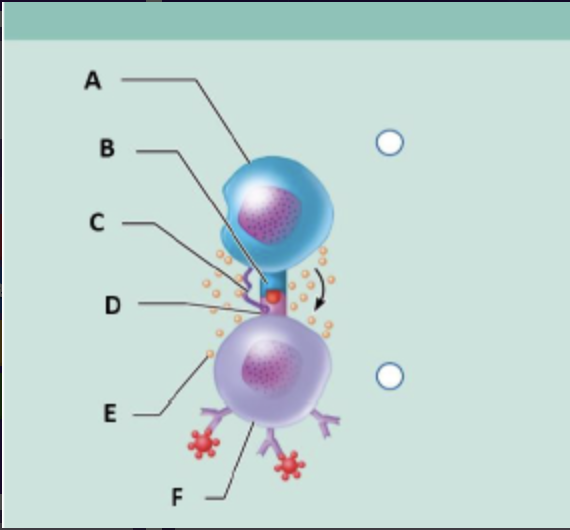
In the diagram question, what is label A?
Helper T cell
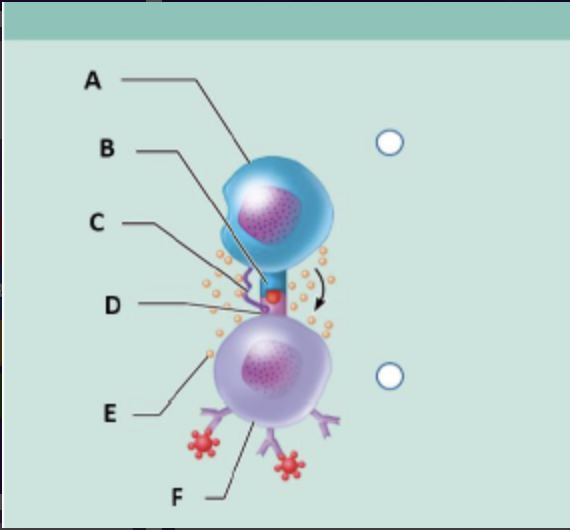
In the diagram question, what is label B?
T-cell receptor (TCR)

In the diagram question, what is label E?
IL-4

In the diagram question, what is label F?
B cell

In the diagram question, what is label A?
CD4 protein

In the diagram question, what is label C?
APC (dendritic cell)
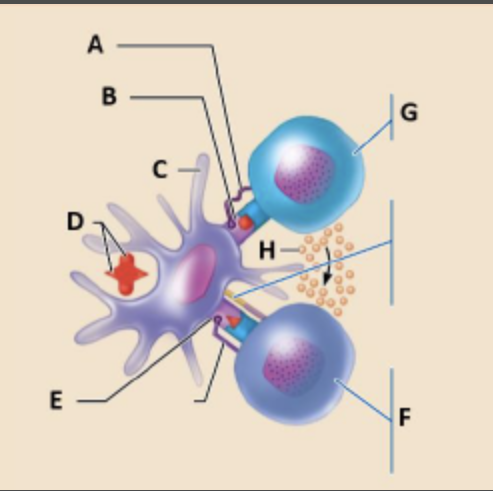
In the diagram question, what is label D?
Antigens
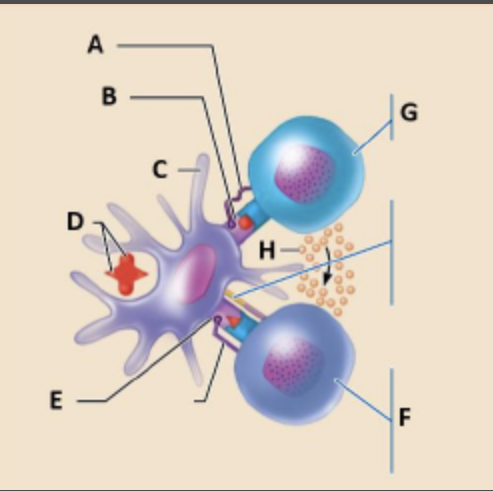
In the diagram question, what is label F?
CD8 T cell
A patient receives a kidney transplant. Which intervention is most important for reducing the risk of transplant rejection?
Match donor and recipient ABO blood types and MHC antigens
What is the function of a helper T cell?
Stimulates cytotoxic cells and plasma-cell production
What is the function of a cytotoxic T cell?
Kills invading body cells and cancer cells
What is the function of a regulatory T cell?
Slows or stops immune activity
What is the function of plasma-cell antibodies?
Produce antibodies
What is the function of a B cell?
Forms plasma cells and memory cells
Which sequence best explains how HIV infection can progress to AIDS?
HIV enters; RNA is converted to DNA; provirus forms; infection progresses to immune-system resistance/failure (as worded in the class activity)
What causes autoimmune disease?
The immune system fails to distinguish self from foreign antigens
During acute (type I) hypersensitivity (allergies), what is stimulated by initial contact with an allergen?
IgE binds to mast cells and basophils, which can secrete histamine
What general changes occur in the immune system as a person ages?
Immune efficiency wanes and the thymus atrophies