11.4 Air Conditioning and Cabin Pressurisation (ATA 21)

0.0(0)
Studied by 0 people
call kaiCall Kai
learnLearn
examPractice Test
spaced repetitionSpaced Repetition
heart puzzleMatch
flashcardsFlashcards
GameKnowt Play
Card Sorting

1/34

encourage image

There's no tags or description

Looks like no tags are added yet.

35 Terms

1
New cards

Pressurised Air

Received to the aircraft from a pneumatic system

2
New cards

Pressurised Air

Outflow valves in the forward and aft areas of the aircraft control the amount of air that goes out of the aircraft and keeps the cabin air pressure within operating limits.

3
New cards

Air Supply from the Engine

Low-pressure air = is used during take-off, climb and cruise conditions


High-pressure bleed air = is used at low engine RPM speeds during descent and anytime the low-pressure air supply is inadequate.


Bleed air from an engine compressor = free of contamination EXCEPT when LEAKAGE - possibility of contamination from oils or fuel.


Only one bleed port is open at a time change - over is automatic

/

Air pressure adjusted by = Pressure Regulating Valve (PRV) or the Bleed Air Valve (BAV).

/

May also function as a shut-off valve through signals from the flight deck, or automatically, by the pneumatic controller.

<p><strong>Low-pressure air =  is used during take-off, climb and cruise conditions</strong></p><p></p><p><strong>High-pressure bleed air = is used at </strong><span style="color: yellow;"><strong><mark data-color="red" style="background-color: red; color: inherit;">low engine RPM</mark></strong></span><strong> speeds during descent </strong><span style="color: yellow;"><strong><mark data-color="red" style="background-color: red; color: inherit;">and anytime the low-pressure air supply is inadequate</mark></strong></span><strong>.</strong></p><p></p><p><span style="color: blue;"><strong><mark data-color="red" style="background-color: red; color: inherit;">Bleed air from an engine compressor</mark></strong></span><strong> = free of contamination </strong><span style="color: blue;"><strong><mark data-color="red" style="background-color: red; color: inherit;">EXCEPT</mark></strong></span><strong> when </strong><span style="color: blue;"><strong><mark data-color="red" style="background-color: red; color: inherit;">LEAKAGE</mark></strong></span><strong> - possibility of contamination from oils or fuel. </strong></p><p></p><p><strong>Only one bleed port is open at a time change - over is automatic </strong></p><p><strong>/</strong></p><p><strong>Air pressure adjusted by = </strong><span style="color: yellow;"><strong><mark data-color="red" style="background-color: red; color: inherit;">Pressure Regulating Valve (PRV) or the Bleed Air Valve (BAV).</mark></strong></span></p><p><strong>/  </strong></p><p><strong>May </strong><span style="color: yellow;"><strong><mark data-color="red" style="background-color: red; color: inherit;">also function as a shut-off valve</mark></strong></span><strong> through signals from the flight deck, </strong><span style="color: yellow;"><strong><mark data-color="red" style="background-color: red; color: inherit;">or automatically, by the pneumatic controller.</mark></strong></span></p>
4
New cards

Engine-Driven Compressors

An increase in fuel efficiency is achieved by a reduction in air temperature and pressure


are driven through an accessory drive gearing or powered by bleed air from an engine compressor. =


  • Positive displacement compressors (Roots-type blower)

  • Centrifugal compressors


5
New cards

Positive Displacement (Root Type) Blower

  • Takes a predetermined volume of air, compresses it, and then delivers it to the cabin duct.


  • Rotors mounted in an airtight casing, on parallel shafts, rotate at the same speed.


  • Air is deposited into the Plenum at the exit.


<ul><li><p><strong>Takes a predetermined volume of air, compresses it, and then delivers it to the cabin duct.</strong></p></li></ul><p></p><ul><li><p><strong>Rotors mounted in an airtight casing, on parallel shafts, rotate at the same speed.</strong></p></li></ul><p></p><ul><li><p><strong>Air is deposited into the Plenum at the exit.</strong></p></li></ul><p></p>
6
New cards

Centrifugal Cabin Compressor

The supercharger requires a variable-ratio drive mechanism, that automatically adjusts, to compensate for changes in the engine’s RPM.


The drive ratio is at a maximum when operating at high altitude with a low engine RPM.


Engine-driven cabin superchargers are mounted in the engine nacelle. / either splined directly to the engine accessory drive or connected to it by a suitable drive shaft.

<p><strong>The supercharger requires a variable-ratio drive mechanism, that automatically adjusts, to compensate for changes in the engine’s RPM.</strong></p><p></p><p><span style="color: yellow;"><strong><mark data-color="red" style="background-color: red; color: inherit;">The drive ratio is at a maximum when operating at high altitude with a low engine RPM.</mark></strong></span></p><p></p><p><span style="color: yellow;"><strong><mark data-color="red" style="background-color: red; color: inherit;">Engine-driven cabin superchargers are mounted in the engine nacelle.</mark></strong></span><strong> / either splined directly to the engine accessory drive or connected to it by a suitable drive shaft.</strong></p>
7
New cards

Turbo Compressors

The turbo compressor provides the compressed air for cabin pressurisation, which means less engine power is removed from the engine compressor


Engine compressor bleed air may be used directly to pressurise aircraft, or alternatively to drive a turbo compressor.


IMPORTANT -

In the turbo compressor system, bleed air from the engine drives a turbine, which directly drives a compressor.

<p><span style="color: yellow;"><strong><mark data-color="red" style="background-color: red; color: inherit;">The turbo compressor provides the compressed air for cabin pressurisation, which means less engine power is removed from the engine compressor</mark></strong></span></p><p></p><p><span style="color: blue;"><strong><mark data-color="yellow" style="background-color: yellow; color: inherit;">Engine compressor bleed air may be used directly to pressurise aircraft, or alternatively to drive a turbo compressor.</mark></strong></span></p><p></p><p><span style="color: yellow;"><strong><mark data-color="red" style="background-color: red; color: inherit;">IMPORTANT - </mark></strong></span></p><p><span style="color: blue;"><strong><mark data-color="yellow" style="background-color: yellow; color: inherit;">In the turbo compressor system, bleed air from the engine drives a turbine, which directly drives a compressor.  </mark></strong></span></p>
8
New cards

Air Supply From The APU

Engine starting and ground air conditioning require high-volume and high-pressure pneumatic air.


Small turbine engine driving a load compressor to supply bleed air for the air conditioning in the cabin for heating, anti-iceing and engine starting.


Bleed air loads generally place the greatest demand on an APU.


in flight, bleed air extraction is normally limited up to a specific flight altitude only, which is approximately 22 000 ft.


The air supply from the APU is activated and controlled in the flight deck using the Systems Display.

<p><strong>Engine starting and ground air conditioning require high-volume and high-pressure </strong><span style="color: yellow;"><strong><mark data-color="red" style="background-color: red; color: inherit;">pneumatic air.</mark></strong></span></p><p></p><p><strong>Small turbine engine driving a load compressor to supply bleed air for the air conditioning in the cabin for heating, anti-iceing and engine starting.</strong></p><p></p><p><span style="color: yellow;"><strong><mark data-color="red" style="background-color: red; color: inherit;">Bleed air loads generally place the greatest demand on an APU.</mark></strong></span></p><p></p><p><strong>in flight, bleed air extraction is normally </strong><span style="color: yellow;"><strong><mark data-color="red" style="background-color: red; color: inherit;">limited up to</mark></strong></span><strong> a specific flight altitude only, which is approximately </strong><span style="color: yellow;"><strong><mark data-color="red" style="background-color: red; color: inherit;">22 000 ft.</mark></strong></span></p><p></p><p><strong>The air supply from the APU is </strong><span style="color: yellow;"><strong><mark data-color="red" style="background-color: red; color: inherit;">activated and controlled</mark></strong></span><strong> in the flight deck </strong><span style="color: yellow;"><strong><mark data-color="red" style="background-color: red; color: inherit;">using</mark></strong></span><strong> the </strong><span style="color: yellow;"><strong><mark data-color="red" style="background-color: red; color: inherit;">Systems Display.</mark></strong></span></p>
9
New cards

Ground Cart Air Supply

A/C = No APU or Engine needs = Pneumatic ground cart.


The connection point is located away from the air conditioning packs.


Cart air is regulated to normal pneumatic system pressure, and can be used for pneumatic system troubleshooting, without the expense of running the APU or main engines.


They can also connect it and run air conditioning through the A/C without running the “air conditioning PACKS“

10
New cards

ACS Physics

  • Adiabatic - Temperature change without the addition or removal of heat.


  • Conduction - Transfer of heat from one object to another due to the physical contact of the two objects.


  • Convection - Process by which heat is transferred by bulk movement of a fluid.


  • Radiation - Transfer of energy between objects without the need for a medium.


  • Latent Heat - Heat that causes a substance to change its state with no change in temperature.


  • Sensible Heat - Heat, when applied causes a temperature change that can be sensed.


  • Super Heat - Heat energy added to a gas after complete evaporation.


  • Humidity - The amount of water vapour present in a volume of air.


11
New cards

Gas Law Application

The expansion of the air as it passes over the turbine creates a temperature drop and is the primary method of supplying cool air to the aircraft.

12
New cards

Air Conditioning System (ACS) Function

Range = 21℃ to 27℃


If the temperature is out of range, heaters or coolers are switched on to alter the air temperature, and the air is mixed to create a uniform temperature within the cabin environment.  


two types of ACS systems used on aircraft:

  • Air Cycle Machine – Used mainly in larger passenger aircraft

  • Vapour Cycle machines – Used mainly used in small and medium-sized aircraft
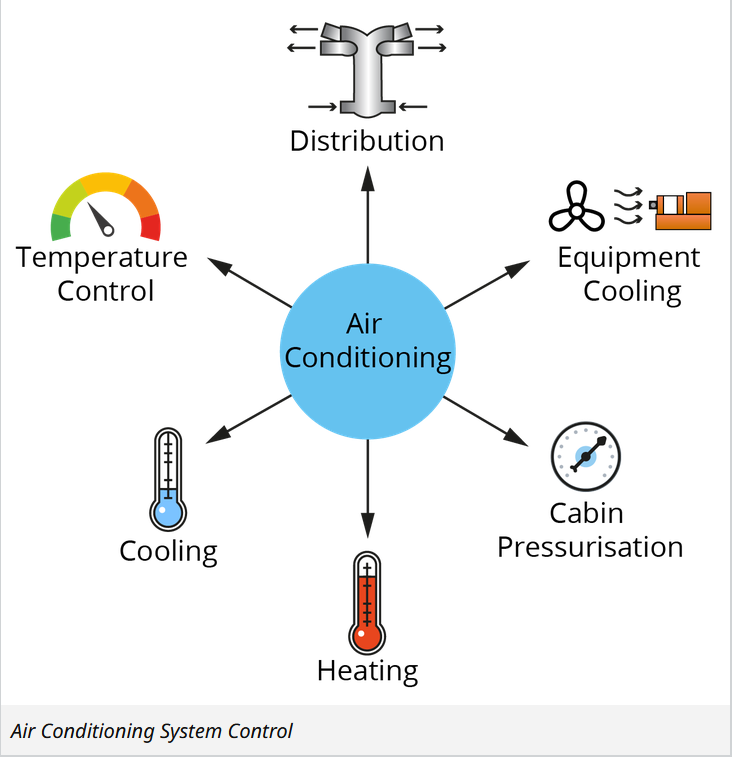

<p><strong>Range = 21℃&nbsp;to 27℃</strong></p><p></p><p><strong>If the </strong><span style="color: yellow;"><strong><mark data-color="red" style="background-color: red; color: inherit;">temperature is out of range</mark></strong></span><strong>, </strong><span style="color: yellow;"><strong><mark data-color="red" style="background-color: red; color: inherit;">heaters or coolers are switched on</mark></strong></span><strong> to alter the air temperature, and the </strong><span style="color: yellow;"><strong><mark data-color="red" style="background-color: red; color: inherit;">air is mixed to create a uniform temperature</mark></strong></span><strong> within the cabin environment. &nbsp;</strong></p><p></p><p><strong>two types of ACS systems used on aircraft:</strong></p><ul><li><p><span style="color: yellow;"><strong><mark data-color="red" style="background-color: red; color: inherit;">Air Cycle Machine – Used mainly in larger passenger aircraft</mark></strong></span></p></li><li><p><span style="color: yellow;"><strong><mark data-color="red" style="background-color: red; color: inherit;">Vapour Cycle machines – Used mainly used in small and medium-sized aircraft</mark></strong></span></p></li></ul><p></p>
13
New cards

Air-Cycle Air Conditioning System

Prepares bleed air to pressurise the aircraft cabin.


It makes use of engine bleed air or Auxiliary Power Unit (APU) pneumatic air during the conditioning process.


The temperature and quantity must be maintained for cabin comfort at all ALT and on Ground

<p><span style="color: yellow;"><strong><mark data-color="red" style="background-color: red; color: inherit;">Prepares bleed air to pressurise the aircraft cabin.</mark></strong></span></p><p></p><p><strong>It makes use of engine bleed air or Auxiliary Power Unit (APU) pneumatic air during the conditioning process.</strong></p><p></p><p><span style="color: yellow;"><strong><mark data-color="red" style="background-color: red; color: inherit;">The temperature and quantity must be maintained for cabin comfort </mark></strong></span><span style="color: red;"><strong><mark data-color="blue" style="background-color: blue; color: inherit;">at all ALT and on Ground</mark></strong></span></p>
14
New cards
<p>Pack or Flow Control Valve (FCV)</p>

Pack or Flow Control Valve (FCV)

Determines the amount of air going to the cabin


/ Electrically controlled with a switch on the air conditioning panel on the flight deck, and pneumatically operated.


For this reason it is Located upstream of the air conditioning packs, so it is also referred to as the supply shut-off valve.

<p><strong>Determines the amount of air going to the cabin </strong></p><p></p><p><strong>/ </strong><span style="color: red;"><strong><mark data-color="yellow" style="background-color: yellow; color: inherit;">Electrically controlled with a switch</mark></strong></span><strong> on the air conditioning panel on the </strong><span style="color: red;"><strong><mark data-color="yellow" style="background-color: yellow; color: inherit;">flight deck</mark></strong></span><strong>, and </strong><span style="color: yellow;"><strong><mark data-color="red" style="background-color: red; color: inherit;">pneumatically operated.</mark></strong></span></p><p></p><p><strong>For this reason it is </strong><span style="color: yellow;"><strong><mark data-color="red" style="background-color: red; color: inherit;">Located upstream of the air conditioning packs</mark></strong></span><strong>, so it is </strong><span style="color: yellow;"><strong><mark data-color="red" style="background-color: red; color: inherit;">also referred to as the supply shut-off valve.</mark></strong></span></p>
15
New cards

Heat Exchangers (HIGH)

  • There are usually two heat exchangers in the system, primary and secondary.


  • A controlled flow of ram air is ducted through the exchanger over the exchanger coils and fins, which reduces the temperature of the air inside the exchanger.


  • A fan draws air through the ram air duct when the aircraft is on the ground, so that the heat exchange is possible when the aircraft is stationary.


  • In flight, ram air doors are modulated to increase or decrease ram air flow to the exchanger.


  • During slow flight, the doors are open.


  • At higher speeds the doors move toward the closed position reducing the amount of ram air to the exchanger.
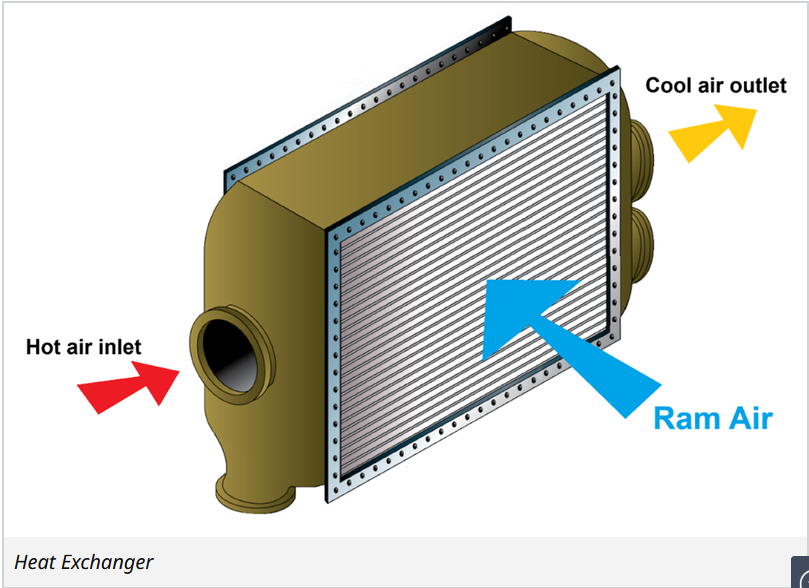

<ul><li><p><strong>There are usually two heat exchangers in the system, primary and secondary.</strong></p></li></ul><p></p><ul><li><p><strong>A controlled flow of ram air is ducted through the exchanger over the exchanger coils and fins, which reduces the temperature of the air inside the exchanger.</strong></p></li></ul><p></p><ul><li><p><span style="color: yellow;"><strong><mark data-color="red" style="background-color: red; color: inherit;">A fan draws air through the ram air duct</mark></strong></span><strong> when the aircraft is </strong><span style="color: yellow;"><strong><mark data-color="red" style="background-color: red; color: inherit;">on the ground, </mark></strong></span><strong>so that the heat exchange is possible when the </strong><span style="color: yellow;"><strong><mark data-color="red" style="background-color: red; color: inherit;">aircraft is stationary.</mark></strong></span></p></li></ul><p></p><ul><li><p><span style="color: yellow;"><strong><mark data-color="red" style="background-color: red; color: inherit;">In flight, ram air doors are modulated to increase or decrease ram air flow to the exchanger.</mark></strong></span></p></li></ul><p></p><ul><li><p><span style="color: blue;"><strong><mark data-color="red" style="background-color: red; color: inherit;">During slow flight, the doors are open.</mark></strong></span></p></li></ul><p></p><ul><li><p><span style="color: yellow;"><strong><mark data-color="red" style="background-color: red; color: inherit;">At higher speeds the doors move toward the closed position reducing the amount of ram air to the exchanger.</mark></strong></span></p></li></ul><p></p>
16
New cards

Air - Cycle Machine

Works like a fridge - takes bleed air compresses it cycles it cools it and then passes via turbine into cold air into cabin

17
New cards

Water Separator / Extractor

As temperatures can reach sub-zero in the cooling packs, any water droplets in the lines and valves can freeze.


corrosion in the cabin and distribution lines. - IF BECOMES FOG AND WATER DROPLETS


used in the cabin air-cycle cooling system

18
New cards

Refrigeration Bypass Valve ( Temperature control valve, anti-ice valve, and similar )

A Temperature sensor in the water separator controls a refrigeration bypass valve designed to keep the air flowing through the water separator above freezing temperature.


Refrigeration bypass valve regulates the temperature of the ACM(AIR CYCLE MACHINE) discharge air so it does not freeze when passing through the water separator. (AIR IS INTRODUCED JUST UPSTREAM OF THE WATER SEPARATOR)

19
New cards

Temperature Control Valve (mixing valve, bypass valve, trim air pressure regulating valve, Trim air valve)

It can also be controlled manually with the cabin temperature selector in manual mode.


It controls the flow of bypassed air and air to be cooled to meet the requirements of the auto temperature controller.


This is accomplished by the electrically operated temperature control valve.

20
New cards

Pack Valve

The pack or flow control valve opens, closes and modulates, to allow the air cycle air conditioning system to be supplied with a predetermined volume of hot, pressurised air.


When an overheat, or any other abnormal condition is detected, the pack or flow control valve is commanded by a signal to close.

21
New cards

Anti - Ice Valve

From the pack valve, the air flows past the anti-ice valve inlet.


The anti - ice valve modulates to allow some hot air to bypass the heat exchangers and air-cycle machine, providing warm air to the water separator intake in order to prevent icing.

22
New cards

Primary Heat Exchanger

Hot pressurised air, arriving from the aircraft Bleed System via the pack valve enters the primary heat exchanger.


Cool, ram air removes heat from the bleed air in the primary heat exchanger.

23
New cards

Turbine Bypass Valve/Temperature Control Valve

Under the control of the automatic temperature control system or direct pilot input


modulates to allow some air from the primary heat exchanger to flow directly to the air-cycle machine turbine outlet.


The more air that flows to the air cycle machine, the more the cooling effect.

24
New cards

Air Cycle Machine – Compressor

Air leaving the primary heat exchanger flows into a compressor, which increases the pressure and the temperature

25
New cards
26
New cards
27
New cards
28
New cards
29
New cards
30
New cards
31
New cards
32
New cards
33
New cards
34
New cards
35
New cards



