VMED 02610: Pathobiology II Systemic Pathology – Respiratory System Lecture 4
 Call Kai
 Learn
 Practice Test
 Spaced Repetition
 Match
 Flashcards
 Knowt Play
1/59

There's no tags or description
Looks like no tags are added yet.
60 Terms
Lung Lobe Torsion occurs rarely in what animal
dogs and cats
But we mentioned that Lung Lobe Torsion rarely occurs in dogs and cats but animal is actually predisposed
Afghan hounds are predisposed
Lung Lobe Torsion leads to what
to infarction, pleural effusion, and dyspnea
What is Hyperemia
Increased blood flow
Hyperemia is associated with what disease
Associated with acute inflammation
Congestion is associated with what
Associated with left-sided heart failure
What does Congestion look like grossly in the lungs
Lung is dark red, but not firm
When do we find congestion in the lungs
Common incidental finding at necropsy
Pulmonary edema results in (in Increased permeability)
Results in leakage of protein-rich fluid
What causes pulmonary edema ( Increased permeability)
Causes include infectious agents, corrosive gasses, and toxins
Pulmonary edema damages what ( Increased permeability)
Damage to type I pneumocytes and/or capillary endothelium
Pulmonary Edema under Increased Hydrostatic Pressure usually occurs when
Usually from left-sided heart failure (cardiogenic edema)
Pulmonary Edema under Increased Hydrostatic Pressure why does it occur what are the causes (under increased hydrostatic pressure)
Generally lower protein content than with edema from increased permeability
Other causes include iatrogenic fluid overload and acute brain injury (neurogenic edema)
Pulmonary Edema under Increased Hydrostatic Pressure why does it occur what are the causes (under decreased osmotic pressure)
Less important the other two mechanisms
From hypoproteinemia
Pulmonary Hemorrhage causes what
Causes include sepsis, ruptured aneurysms, trauma, and clotting abnormalities
Pulmonary Hemorrhage can lead to what in horses
Exercise-induced pulmonary hemorrhage in horses
Pulmonary Emboli does what to eh lungs
Lungs trap emboli from systemic venous circulation
Non-septic emboli includes what
tumors and fat
Septic emboli can arise from (this is under pulmonary emboli)
valvular endocarditis, other sites of infection (liver), or thrombosed vessels
What are the three mechanisms of pulmonary edema (circulatory disturbance)
increased hydrostatic pressure
increased capillary permeability
decreased lymphatic drainage
Thrombi form because of
Virchow’s triad
What are the components of Virchow’s triad
1. Blood Flow Stasis (Slow Circulation)
2. Endothelial Damage (Vessel Wall Injury)
3. Hypercoagulability (Blood Clots Too Easily)
Pulmonary Thrombus Causes include
Dirofilaria immitis in dogs and DIC
Glomerular amyloidosis in dogs leads to
proteinuria and loss of antithrombin III, increasing the risk of thrombosis
Is Pulmonary Infarction rare or common
its rare
Pulmonary Infarction occurs when
Occurs only when lung is already compromised
Pulmonary infarction is most common in what organ system
Most common in caudal lung lobes
Can Pulmonary Infarction be hemorrhagic ?
Yes: Hemorrhagic and often bulge from pleural spaces
What are the two main causes of Pulmonary Hypertension
1. Increased blood flow from the right heart to the lungs (ventricular septal defect)
2. Increased resistance in the pulmonary vascular system
Pulmonary Hypertension leads to what
Leads to arteriosclerosis and potentially to right-sided heart failure
Pulmonary Hypertension occurs due to
High Altitude Disease
Disease of cattle pastured in high altitudes
Also called brisket disease
Chronic hypoxia leads to what
vasoconstriction, chronic hypertension, and right-sided heart failure
Bronchial Tree causes what clinical sign
Sneezing and coughing
Mucociliary apparatus
What Immunoglobulins do bronchial tree produce
Immunoglobulins (esp. IgA)
Alveoli create what
Alveolar macrophages
Alveolar lining liquid contain
IgG, lysozyme, lactoferrin, and complement
Phagocytosis is less efficient than
mucociliary blanket
Which lung is normal: showing the distribution pattern of bronchi and brochides

Which is a suppurative bronchiopneumonia

Which is fibrinous bronchopneumonia

Which one is intersitial (diffuse) pneumonia (viral influenza)

Which one is embolic pneumonia

Which one is granulomatous pneumonia (TB, deep seated mycoses)
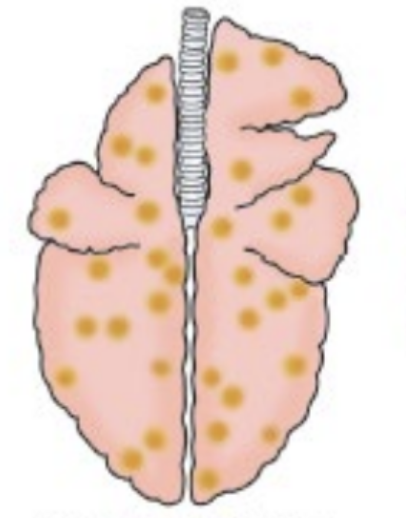
Which one is a tumor metastases from a nonpulmonary primary site

Which one is a primary lung tumor with secondary metastases

Which one is a locally extensive dorsal diaphragimatic pnemonia
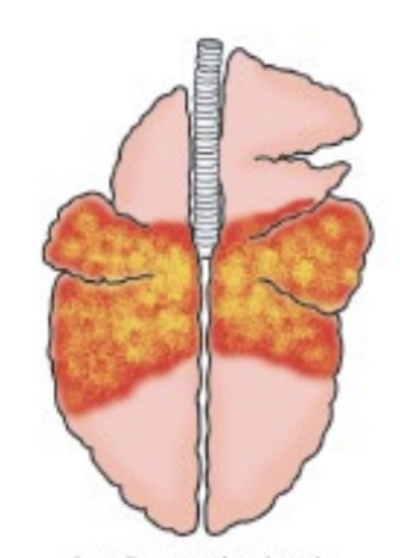
Which one is verminous (parastic) pne

WHat is aspiration pneumonia (improper stomach tubing)

Which one of these photos is the hypostatic congestion (prolonged recumbency)

Bronchopneumonia is usually what bacteria or fungal
Usually bacterial
Mannheimia hemolytica
Pasteurella multocida
Actinobacillus pleuropneumoniae
Streptococcus sp.
Pulmonary defenses must be compromised by
shipping stress, chilling, viral infections, metabolic disorders, etc.
in Bronchopneumonia Inflammation centered on
terminal bronchioles and adjacent alveoli
Bronchopneumonia is described by
Typically suppurative, fibrinous, or necrotizing
What are the gross lesions for Acute Bronchopneumonia
Lung is consolidated, firm, rubbery, dark red (red consolidation) and not depressed
Mucopurulent exudate can often be expressed from airways
Fibrin may be present on pleural surface
What are the histologic lesions of bronchopneumonia
Alveolar spaces contain neutrophils, erythrocytes, fibrin, edema fluid, and a few macrophages
Capillaries are distended with erythrocytes (hyperemia)
Alveolar lining cells may become necrotic
Bronchiolar epithelium may be normal, necrotic, or hyperplastic
Subacute to Chronic Bronchopneumonia what is the gross lesion description
Lung is grey-red to grey (grey consolidation) and very firm
Grey color is due to what (in Subacute to Chronic Bronchopneumonia)
more macrophages and fewer erythrocytes