12 Nervous System
 Call Kai
 Learn
 Practice Test
 Spaced Repetition
 Match
 Flashcards
 Knowt Play
1/93

There's no tags or description
Looks like no tags are added yet.
94 Terms
Nervous System
Receive info (sensory input)
Processes info (integration)
Responds (motor output)
Central Nervous (CNS)
Brain and Spinal Cord
cannot regenerate
Peripheral Nervous (PNS)
Nerves and ganglia outside of CNS
axons may regenerate if cell body remains intact and enough neurilemma survives
Sensory
Afferent
carries info to the CNS
Mostly unipolar
Motor
Efferent
carries commands from the CNS to muscles or glands
Mutlipolar
Somatic sensory
Detects things u consciously feel
touch, pain, temperature
Visceral sensory
Detects internal conditions
signals from organs
Somatic motor
Controls skeletal muscles voluntarily
Autonomic motor
Involuntary control of heart, smooth muscle, and glands
Sympathetic and parasymphatic
Sympathetic
prepare body for action or stress
Parasympathetic
supports resting, digestion, and recovery
Neurons
Send signals
Excitability, Conductivity, Secretion, extreme longevity and amitotic
Extreme longevity
neurons can live throughout your lifetime
Amitotic
most neurons cannot divide after fetal development
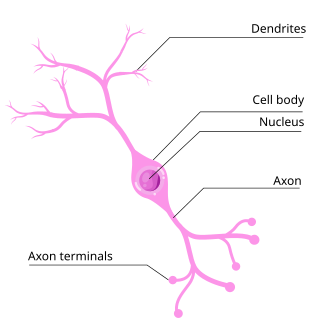
Cell body (soma)
contains the nucleus and maintains the cell (parts of neuron)
contains perikaryon (cytoplasm)
Dendrites
receive incoming signals (parts of neuron)
unmyelinated
Axon
Carries electrical signals away from cell body (parts of neuron)
Axon terminals (synaptic knobs)
Release neurotransmitters to communicate with the next cell (parts of neuron)
Anterograde
moves materials away from cell body toward axon terminals
Retrograde
moves materials back toward cell body for recycling or breakdown
Multipolar
Many dendrites, 1 axon
most common

Bipolar
1 dendrite, 1 axon
found in retina
Unipolar (Pseudounipolar)
1 process that splits into 2
common sensory neuron structure
2 branches: peripheral process, and central process

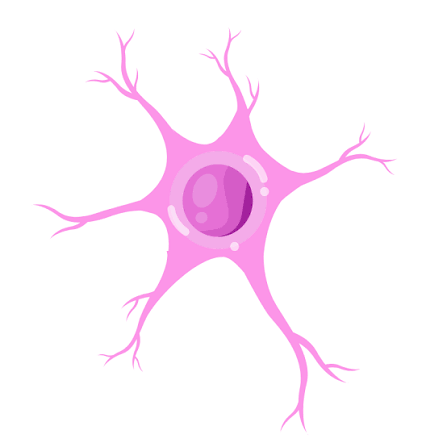
Anaxonic
Dendrites but no axon
communicates locally
Interneurons
process info and connect sensory and motor neurons
located in the CNS
99% of neurons
generally multipolar
Nerve
bundle of axons in the PNS
Epineurium
entire nerve
Perineurium
bundle of axons (fascicle)
Endoneurium
individual axon
Mixed nerves
contain both sensory and motor fibers
Synapse
neuron communicates with another neuron or an effector
Electrical synapse
cells connect thru gap junctions; signals pass very quickly
Chemical synapse
A neuron releases neurotransmitters that communicate with the next cell
electrical signal reaches axon terminal
neurotransmitters are released from vesicles
they cross the synaptic cleft
they bind to receptors on the next cell
the next cell develops a graded potential
Glial Cells
support, protect, and nourish neurons
can divide by mitosis
nonexcitable
Astrocytes
support neurons and help form blood-brain barrier
CNS
Ependymal Cells
Line brain and spinal cord cavities; help produce and circulate cerebrospinal fluid (CSF)
CNS
Microglia
Remove germs, damaged cells, and debris
CNS
Phagocytosis - cell eating
Oligodendrocytes
Form myelin around CNS axons
Satellite Cells
Support neuron cell bodies in ganglia and regulate their environment
PNS
Schwann cells (neruolemmocytes)
Form myelin around PNS axons
Myelin sheath
fatty insulating layer around certain axons
make electrical signals travel faster
Nodes of Ranvier
gaps btwn myelin-covered sections
Pumps
use energy to move substances against their concentration gradients
Leak channels
remain open, allowing ions to diffuse
Chemically gated channels
open when a chemical, such as a neurotransmitter, binds
Voltage-gated channels
Open when membrane’s electrical charge changes
Modality-gated channels
open in response to another type of stimulus, such as pressure
Sodium-potassium pump
-use energy
-moves 3 Na+ out of the neuron
-moves 2 K+ in
-maintains the ion concentration gradients needed for neuron function
Resting Membrane Potential (RMP)
resting neuron is not sending an action potential
approximately -70 mV
inside is more negative than outside
more K+ inside
more NA+, CL-, and Ca2+ are outside
Depolarization
Na+ enter
inside becomes less negative
Repolarization
K+ leaves
Hyperpolarization
K+ continues leaving temporarily
inside becomes more negative
Effectors
Muscles and Glands
Nissl bodies
chromatophilic substance
free and bound ribosomes
Neurofilaments
Intermediate filaments in neurons
Neurofibrils
neurofilaments combine into bundles
Fast Axonal Transport
400 mm/day
uses microtubules
uses motor proteins
requires ATP
can move in both directions
Slow Axonal Transport
0.1-3 mm/day
results from flow of axoplasm
moves only away from cell body
carries enzymes, cytoskeletal components, new axoplasm
Presynaptic Neuron
neuron sending message
Postsynaptic Neuron
cell receiving message
PNS Axon Regeneration
axon is severed
proximal portion; seals off and swells, distal portion; degenerates
neurilemma and endoneurium form a regeneration tube
axon begins growing again
axon reconnects with its original muscle, gland, or sensory receptor
Channels
tiny protein openings in cell membrane
ions move down their concentration gradients; high > low
Voltage
difference in electrical charge btwn 2 locations
higher = more current
Current
movement of charged particles
opening channels lowers it
Resistance
anything that makes it harder for charged particles to move
higher = less current
Ohm’s Law
Current = Voltage/Resistance
Excitatory Postsynaptic Potential
EPSP
makes neuron more likely to fire action potential
usually causes depolarization
Inhibitory Postsynaptic Potential
IPSP
less likely to fire an action potential
causes hyperpolarization
Spatial Summation
Multiple neurons send messages to different locations on the receiving neuron at approximately the same time
Temporal Summation
1 presynaptic neuron repeatedly sends messages very quickly
Threshold
Mininum electrical lvl required to trigger an action potential
-55mV
neuron needs to become less negative
All or None Law
Action potential either happens completely or doesn’t happen at all
Action Potential
Rapid electrical signal that travels down the axon
Refractory Period
the time after an action potential begins when it is difficult to create another action potential
Absolute Refractory Period
Lasts aprox. 1 milisec
no stimulus can trigger another action potential
sodium channels r open and then become inactivated
1 direction
Relative Refractory Period
Happens immediately after the absolute refractory period
another action potential is possible
but a stronger-than-normal stimulus is required
some K+ channels remain open
Continuous Conduction
Happens in unmyelinated axons
electrical signal travels step by step
Saltatory conduction
Happens in myelinated axons
signal appears to jump btwn Nodes of Ranvier
Faster and uses less ATP
Neurotransmitter Release
Action potential reaches synaptic knob
Calcium channels open
calcium enters
Vesicles release neurotransmitters thru exocytosis
Neurotransmitters enter the synaptic cleft
Thicker axon and Myelination
Faster signals to action potential
Neuromodulation
change how strongly neurons respond
Facilitation and inhibition
Facilitation
Makes response stronger
inhibition
Makes response weaker
Nitric Oxide
May help strengthen memory
helps dilate blood vessels
Endocannabinoids
Affect neurotransmitter release
influence memory and appetite
Removing Neurotransmitters
Enzymes, reuptake, diffusion
Acetylcholinesterase
break down ACh into Acetate and Choline
Neurotransmitters
Acetylcholine, Biogenic amines, Amino acids, and Neuropeptides
Direct
Opens chemically gated channels
Indirect
Uses G-proteins and second messengers
Receptive Segment
Dendrite and cell body
chemically gated channels
Initial Segment
Axon hillock
Voltage-gated Na+ channels and Voltage-gated K+ channels
Conductive segment
Axon and its branches
Voltage-gated Na+ channels and Voltage-gated K+ channels
Transmissive Segment
Synaptic knobs
Voltage-gated Ca2+ channels and pumps