6.1 Enzyme Kinetics: Substrate Concentration & Reaction Rate
 Call Kai
 Learn
 Practice Test
 Spaced Repetition
 Match
 Flashcards
 Knowt Play
1/9

There's no tags or description
Looks like no tags are added yet.
10 Terms
Enzyme Kinetics
Enzyme Kinetics: rate of a chemical rxn can be measured by the appearance of product (or disappearance of substrate)
enzymes DONT affect thermodynamics
overtime [product] will increase until equilibrium
For a simple isomerization rxn:

→ rate of product appearance will depend on [enzyme:substrate complex]
rate: v = k [ES]
under steady state conditions: [ES] is relatively constant
after substrate binds to enzyme the [ES] doesn’t change much, THUS theres a steady state after initial binding
substrate can dissoc. or be converted to product after binding to enzyme

note:

Rxn rate at start of Reaction: Initial Velocity (V0)
Initial velocity (V0) = rxn rate (rate of product formation) at the START of a rxn
rate at the beginning, BEFORE product accumulates - thus NO reverse rxn is occurring form product buildup
rate is dependent on [substrate]
adding more [substrate] increase initial velocity of rxn (1st order

→ described by the Michaelis-menten equation
Ligand Binding vs. Enzyme system for Kinetics
Ligand Binding: focus on Kd (dissoc constant)

Enzyme System: includes 4 rate constants
focus on:
k1 = association of E + S
k-1 = breakdown of ES to E + S
k2/Kcat = formation of products from ES
has assumptions

Assumptions of the Enzyme System

steady state conditions apply: [ES] is UNchanging overtime → rate of making ES = rate of breaking ES
NO [product] at beginning of rxn
initial conditions: [P] = 0, thus we can ignore k-2
relative concentrations: always more [substrate] than enzyme, so we’re only concerned with substrate in solution
[S] » [E] , thus we can ignore the change in [S] with formation of ES complex
formation of product: v0 = k2 [ES]
1st order rate equation
k2 = kcat

Michaelis-Menten Kinetics
M-M Kinetics = derives a relationship b/w [ES] & [S] to find the rate of product formation
says initial velocity (v0) depends on [ES]
v0 = kcat [ES]
says rate of [ES] formation must equal rate of breakdown to be at steady state

thus at steady state: [ES] is unchanging so

→ total enzyme (E Total) = [E] + [ES]
can be used to find [ES]
Derivation of Michaelis-Menten equation
defines [ES] by [S]

defines michale’s constant (Km) to simply the rate constant of the rxn

replaces rate constants with Km, so the rate of rxn (V0) equals:
this is the equation at actual [ES]

defines maximum rate (Vmax) at the max [ES]

simples Kcat x [E total] to Vmax in equation to get the final M-M equation
→ Final Michaelis-Menten equation: for the rate of rxn

Michaelis-Menten Equation Components
M-M equation: V0
Vmax ISNT a constant, it changes w amount of enzyme present
Km is a constant
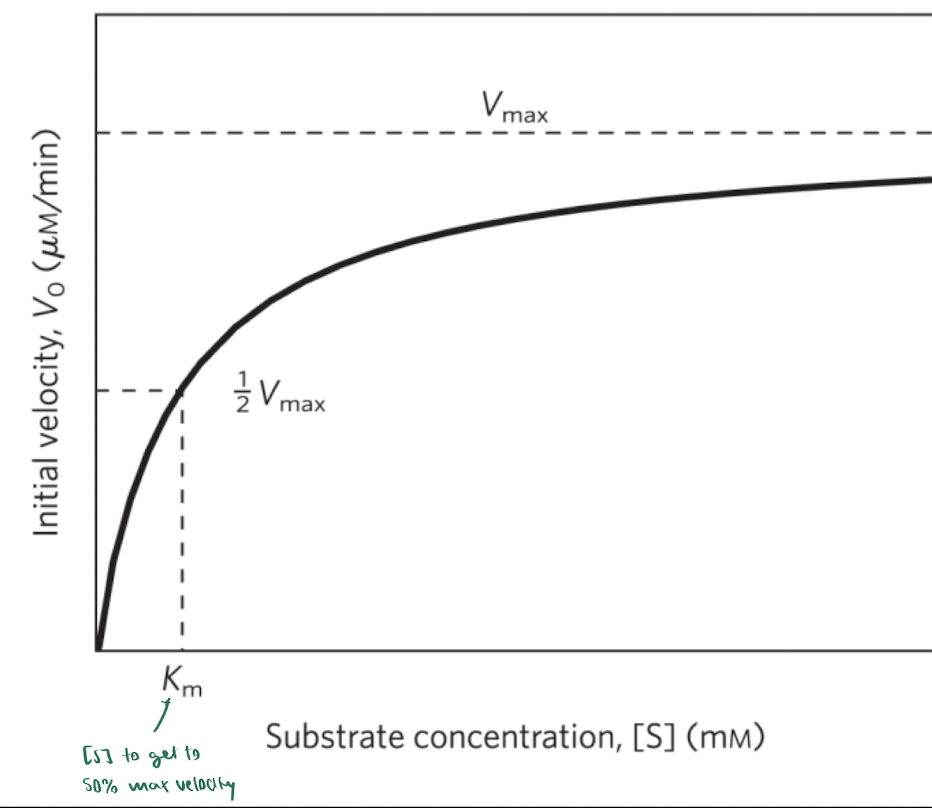
M-M enzymes have a hyperbolic curve
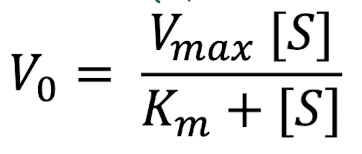
→ Max velocity (Vmax) = determined by the total amount of enzyme in the system
NOT a constant

→ Michaelis constant (Km) = reflects the balance b/w formation & breakdown of the ES complex

k1 = association of E + S
k-1 = breakdown of ES to E + S
k2/Kcat = formation of products from ES
M-M Kinetics: Hyperbolic Curve
for: Km, [S], V0, Vmax
measures initially velocity (V0) against [substrate]
M-M equation generates a hyperbolic relationship b/w [S] & V0
Km = [Substrate] to get to 50% max velocity of enzyme rxn
increase Km = pushes curve to right, thus need MORE [S]
decreased Km = pushes curve to left, thus need LESS [S]
note: this ISNT when 50% of substrate is bound, as [S] » [E]
Q. Considering the Michaelis-menten equation, what is the [S] (in terms of Km) when the velocity of the reaction is 80% of Vmax?
M-M equation


multiply 0.80 by (Km + [S])

isolate for [S] again

answer: [S] = 4Km
Km = [Substrate] to get to 50% max velocity of enzyme rxn
thus at 4Km, the enzyme is operating at 80% of max velocity
note: if rate/velocity is greater than 50%, then its greater than Km

sorta like: [S] for M-M equation = km x (V0/ 1- V0) → _Km
Rearranging the M-M equation so its linear: Lineweaver-Burk Plots
→ hyperbolic curves are bad at going to infinity, thus we can rearrange the equation so its linear (create reciprocal)
get Double-Reciprocal plot


slope:

y-int:

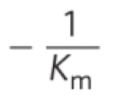
x-int: