FSU Acoustic Exam II
 Call Kai
 Learn
 Practice Test
 Spaced Repetition
 Match
 Flashcards
 Knowt Play
1/45

There's no tags or description
Looks like no tags are added yet.
46 Terms
What is the source?
vocal folds
What is the filter?
vocal tract
What are the parameters for source filter theory?
1. main tongue constriction/place of articulation
2. lip protrusion/rounding
3. cross sectional diameter of the vocal tract/tongue height
What does changing the vocal tract/filter do?
Changes the output/changes what frequencies resonate
What is the point of source filter theory?
Speech production as an interaction between a sound source and a filter

What are the 2 kinds of aperiodic waves?
continuous and transients
Continuous wave sounds
fricatives

Transient wave sounds
stops

Transient + continuous wave sounds
affricates

Sawtooth waves
odd and even harmonics, voice signal
Square waves
odd harmonics only, speech signal
Waveform view
how different frequencies and amplitudes change over time/how sound changes over time

FFT (Fourier)
different frequencies all contained within a graph that tells their respective amplitudes - frequency components

Low-pass filter
allows low frequencies and blocks high

high-pass filter
allows high frequencies and blocks low
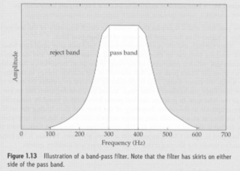
reject band
what is blocked
pass band
what is allowed
band-pass filter
specific range of frequencies allowed to pass
band-stop filter
specific range of frequencies blocked
bandwidth
range around f0 that is 1/2 area of the graph

Narrowband
breaks down more to see individual harmonics, see intensity of the individual harmonics amplified

Narrowband characteristics
tuning fork
f0/harmonics
FFT
Wideband
looks at how formant transitions change, can clearly see darker areas of greater intensity = a better representation of formants

Wideband characteristics
vocal tract
formants
LPC
Periodic waves
continuous or repeating wave pattern
Aperiodic waves
a wave that does not repeat at regular intervals, lacking a consistent, predictable pattern
Simple waves
1 frequency
Complex waves
2 or more frequencies
Simple periodic wave
a one component frequency (pure tone) that follows a specific pattern
Complex periodic wave
2 or more frequencies that are harmonically related (related to f0 à odd multiples of f0 like H3, H5, H7)
Complex aperiodic wave
2 or more frequencies that are not harmonically related (do not follow the odd multiples pattern), noise
How are periodic and aperiodic waves different?
a periodic wave follows a set pattern that is continuous and repeats while aperiodic does not repeat at regular intervals and does not have a predictable pattern
Nodes
destructive interference, standing still
Antinodes
constructive interference, moving back and forth
Nodes: pressure and velocity
high pressure and low velocity (closed end)
Antinodes: pressure and velocity
low pressure and high velocity (open end)
Higher frequency = shorter wavelength
more harmonics = more nodes + antinodes = more interferences = more interaction between frequencies = more pressure changes
Resonance
amplifying a frequency/sound --> opposite of dampen
Fundamental frequency (f0)
lowest frequency of a complex periodic sound, the first harmonic
acoustic resonators
vocal tract & ear canal, resonances of bodies of air
natural resonant frequency
frequency that vibrates when set into motion, based on mass and elasticity
lowest natural resonant frequency (LNRF)
lowest frequency at which vocal folds vibrate at
harmonics
whole number multiples of f0 (H3, H5, H7)
What are clinical applications of acoustics?
1. visually identify something you cannot perceptually pick up - abnormal phonation
2. Aperiodicity may indicate vocal fold pathology
3. Can be used to identify speech sound disorders, like misarticulation
What is the parameter of natural resonant frequency?
mass and elasticity have to be equal --> then it can be the frequency an object vibrates at
Relate labs to acoustic analysis tools
we generated waves on audacity, measured the relative frequencies using waveform analysis, this was an example of descriptive research