CHEM 3500 / Topic 4: Chromatography
 Call Kai
 Learn
 Practice Test
 Spaced Repetition
 Match
 Flashcards
 Knowt Play
1/51

Earn XP
Description and Tags
Mobile phase: → solvents, carrier gas, polarity stuff ; Driving force: → pumps, pressure, flow rate ; Stationary phase: → columns, types of separation, equilibrium / Kc / retention ; Detector: → ECD, UV/DAD, RI, etc. ; Signal: → chromatograms, peaks, resolution, N, van Deemter
52 Terms
What is chromatography, and how does it work? (L12 s4)
> Sample goes → the stationary phase (the stuff that stays put)
> Driving force (pump/pressure) pushes the mobile phase (the stuff that flows)
> Mobile phase flows THRU the stationary phase, in intimate contact
> Sample keeps going back + forth between the two phases = equilibrium
> Detector senses the sample as it comes out (elutes); it can be its own instrument, like a spectrometer!
∴ Different equilibrium between phases → different exit times → separation
What is HPLC?
> High Performance Liquid Chromatography = column chromatography with HIGH PRESSURE applied to MP
> Types: normal phase, reverse phase, size exclusion, ion exchange, UHPLC (ultra high performance)
Mobile phase: What is longitudinal diffusion (B/u term), and how does flow rate affect it?
> X diffuses from band centre → edges (both directions along column)
> B/u = 2γDm / u (Dm = diffusion coefficient in MP)
> ↑ u → ↓ time in column → ↓ B/u broadening
> Big deal in GC (gas → fast diffusion), small deal in LC (liquid → slow diffusion)
∴ Slow flow + fast-diffusing MP → more longitudinal broadening

Mobile phase HPLC: How does MP polarity index P′ change the retention factor k? (L13 s13–14)
> Goal → adjust MP polarity so k lands in 2–10
> Reverse phase (non-polar SP): log(k₂/k₁) ≈ +(P′₂ − P′₁)/2 → ↑ P′ → ↑ k
> Normal phase (polar SP): log(k₂/k₁) ≈ −(P′₂ − P′₁)/2 → ↑ P′ → ↓ k
> 1 = current MP, 2 = new MP; ΔP′ of 2 → tenfold change in k
> Solve for P′₂ → no single solvent? → mix: P′ = φ₁P′₁ + φ₂P′₂
∴ Tune MP polarity → control how long X stays on SP (k)
Mobile phase HPLC: What is the purpose of a degasser in HPLC, how does it work, and why is it necessary? (L13 s19–20, Chrom exercises)
> Purpose → removes dissolved gases from MP
> Why → large pressure drop (e.g. across column) → gas comes out as bubbles → interferes with measurement
> How 1 → He (inert gas) displaces dissolved gases from MP
> How 2 → vacuum + semi-permeable membrane pulls gases out of MP
∴ No dissolved gas in MP = no bubbles = clean signal
Driving force HPLC: What does the HPLC pump do, and what are its requirements? (L13 s21)
> Job → produces high pressure → pushes MP through the column
> Requirements → solvent resistant, free of contamination, low pulsing, high flow reproducibility
> Reciprocating pump → motor-driven piston + 2 ball check valves (open/close alternately → one-way flow)
> Piston = pulsed flow → baseline noise → pulse damper smooths it
∴ Pump = steady, high-P, reproducible MP flow
Driving force HPLC: Why does HPLC need high pressure? (L13 s11 + Skoog 28B–C)
> Cm ∝ (particle diameter)² → smaller particles → ↓ H → sharper peaks
> HPLC packing = tiny particles (~1–10 μm)
> Tiny particles → MP hard to push through (high back-pressure)
> Pump → several hundred atm (up to 400–500 bar) → reasonable flow rate
∴ High P = tiny particles (↑ efficiency) + usable flow rate
Driving Force HPLC: What are the components of an HPLC instrument and what does each do? (L13 s10)
> MP → degasser → high-pressure pump → injector → column → detector
> MP = solvent (mixture); degasser removes dissolved gases
> Pump maintains pressure (up to 400–500 bar)
> Injector introduces sample into MP
> Column contains SP; detector = signal transducer

Driving force HPLC: What is the general elution problem, and how do HPLC and GC solve it? (L14 s26–27)
> Complex mix → k range too large → A + B overlap OR C takes forever (>100 min)
> HPLC fix → gradient elution → MP composition changes linearly with time
> Reverse phase: start water-rich → Xs stick to SP (↑ k) → early Xs slow down → separate
> Then ↑ MeOH → Xs leave SP more easily (↓ k) → late Xs elute sooner

Driving GC: What are the components of a GC, in order? (L14 s14)
> Inert carrier gas (MP) → flow/pressure regulator → sample injection (vaporization chamber)
> → GC column → detector → flow meter
> Injection + column + detector → inside oven
∴ Carrier gas pushes vaporized Xs through heated column → detector

Driving force GC: What are the requirements for a GC carrier (g), and how is its flow controlled? (L14 s15)
> Requirements → inert (over whole T range), pure, low boiling point
> Typical → He, H₂, N₂
> Flow controllers → based on heat conduction
> Heater on gas line → flowing gas carries heat downstream → T sensors on each side
> ↑ flow → ↑ T difference between sensors → read as flow rate → controller keeps flow steady
controller = sets and holds the flow, meter = confirms it

Driving force GC: What does the GC sample injector do, and how is it set up? (L14 s16)
> Purpose → introduce specified amount of sample + vaporize it
> Microliter syringe (or autosampler) → through septum → heated vaporization chamber
> Split → capillary columns; splitless → packed columns or trace analysis on capillary
> T = bp of least volatile component + ~50 °C
∴ Inject small amount → flash vaporize → carrier gas sweeps it onto column

Driving force GC: How does a temperature program solve the general elution problem in GC, and does T increase or decrease? (L14 s6, s9, s27–28)
> GC separation → by vapor P → ↑ vapor P → more time in gas MP → elutes sooner
> ↑ T → ↑ KE → more X escapes (l) SP → ↑ vapor P → ↓ k
> Start at low T → early Xs stay in SP longer → separate
> ↑ T during the run → late Xs' vapor P ↑ → elute sooner
Driving force GC: How do GC and HPLC compare, and when would you pick each? (L14 s31)
> Both → separation techniques → combine with many detectors (hyphenated)
> GC → elevated T → X must be T-stable + volatile → ≠ high-bp cpds
> HPLC → room T / slightly elevated → X must be soluble in MP
> GC → fast, gas-liquid / gas-solid equilibria, ↓ cost + complexity
> HPLC → usually slower, liquid-liquid / liquid-solid equilibria, ↑ cost + complexity
Stationary phase: What’s the principle of chromatography, and what is the distribution constant Kc?
> Analyte keeps hopping between the two phases = equilibrium ([A]s ⇌ [A]m)
> Kc = [A]s / [A]m = how much of A sits in the stationary phases vs. flows in the mobile phase
> Only mobile phase moves → analyte only travels while in mobile phase
> Different Kc → different travel speed → compounds separate → separate peaks

Stationary phase: What is the Van Deemter equation, and what does it explain?
H = A + B/u + (Cs + Cm)u; explains WHY peaks broaden by adding up every cause
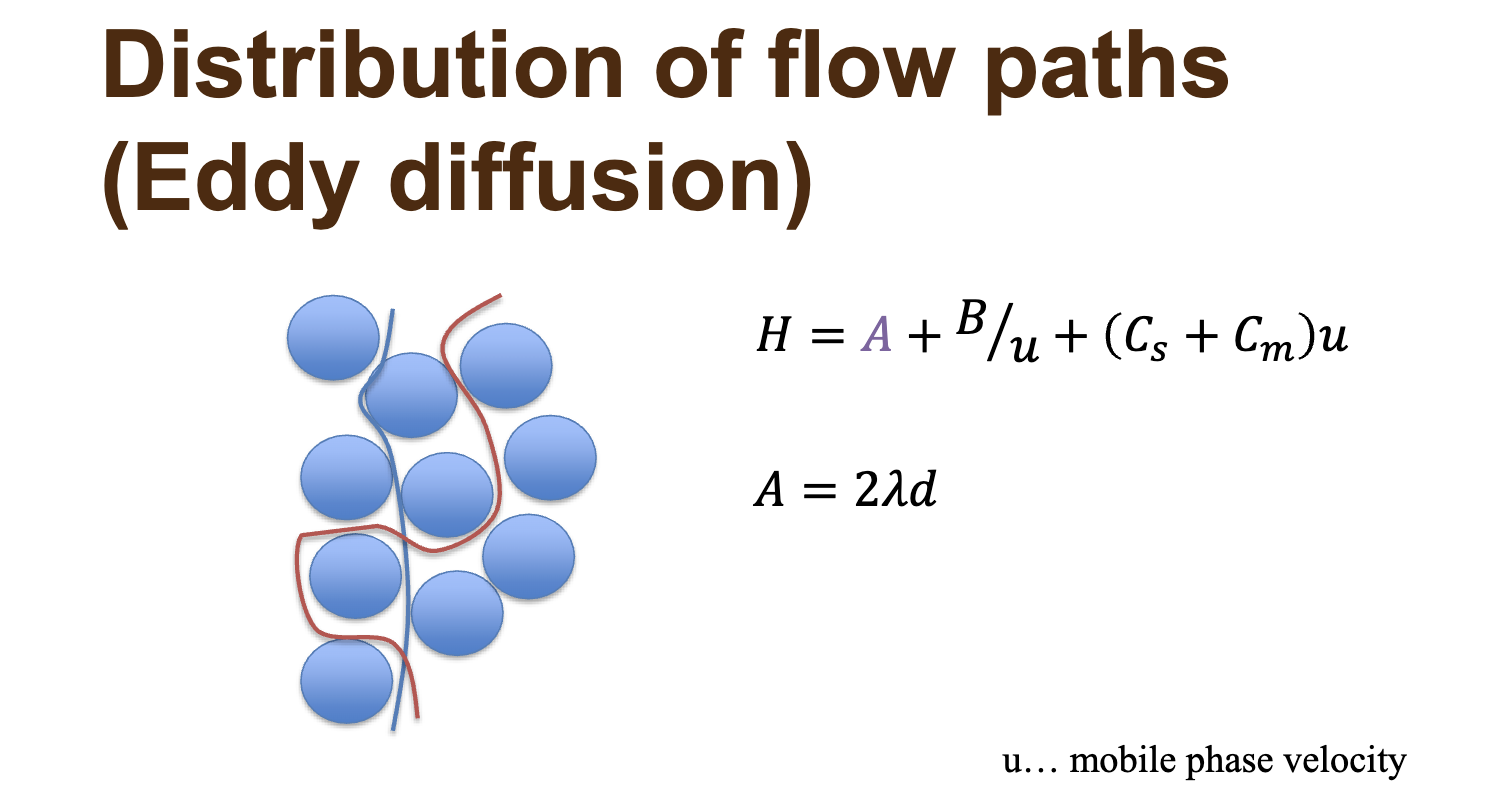
Stationary phase: What’s Eddy diffusion (A term) → what + why it broadens peaks? (L12 s15)
> Paths have different lengths → same cpd, diff arrival times → band broadens
> A = 2λd → d = particle diameter
> ↓ particle size → ↓ A → ↓ H → ↑ N
∴ Smaller particles → narrower peaks
Stationary phase: What is M transfer (Cs u + Cm u), and how does flow rate affect it?
> Cs u (SP): X has to diffuse into and out of the film → Cs u = (f(k)df2u / Ds) → df = film thickness, Ds = diffusion coefficient in the film → thick film → ↑ Cs
> Cm u (MP): X has to diffuse thru the MP to reach the particle → Cm u = (f’(k)dp2u / Dm) → dp = particle diameter
> Both are × u → ↑ flow → ↑ broadening; molecules that got stuck in the film fall behind while the rest get swept ahead → band smears

Stationary phase HPLC: What’s the difference between normal and reverse phases?
> Normal phase → polar SP + non-polar MP → polar Xs
> Reverse phase → non-polar SP + polar MP → non-polar Xs
> X more similar to SP → retained longer → elutes later
Stationary phase HPLC: How does ion exchange chromatography separate analytes? (L13 s8)
> SP surface is charged
> Charged analytes → ionic interactions with surface → retained
> Used for analytes with charged functional groups
∴ Ion exchange separates by charge (ionic interaction with stationary phase)
Stationary phase HPLC: How does size exclusion (gel permeation) chromatography separate molecules? (L13 s7)
> Stationary phase = solid/gel with defined pore size distribution
> Large molecules → can't enter pores → short path → elute first
> Small molecules → enter pores → longer path → elute last
> Used for polymers, macromolecules (separation + size determination)
> Gel permeation = organic solvent; gel filtration = aqueous solvent
∴ Separation by molecule size → big out first, small out last
Stationary phase HPLC: How does ion exchange chromatography separate analytes, and what SP materials are used? (L13 s9 + s26)
> SP surface is charged (ionic surface functions)
> SP materials → zeolites/clays, ionomers
> Charged Xs → ionic interactions with surface → retained
> Used for Xs with charged functional groups
> Anion exchange SP → + charged surface → holds anions (e.g. R–COO⁻)
> Cation exchange SP → − charged surface → holds cations (e.g. R–NH₃⁺)
Stationary phase HPLC: How do ion exchange and gel permeation chromatography differ in separation principle? (L13 s8–9, past exam Q26)
> IEX → charged SP → ionic interactions → separates by charge
> Gel permeation → pores of defined sizes → small molecules enter pores → longer path → separates by size
> Ion exchange → for charged analytes
> Gel permeation → for polymers / macromolecules
∴ Ion exchange = charge; gel permeation = size
Stationary phase HPLC: What SP materials are used for size exclusion columns, and when is each used? (L13 s7 + s25)
> Gel permeation (organic MP) → styrene-divinylbenzene polymer gels
> Gel filtration (polar/aqueous MP) → sulfonated divinylbenzene polymers or polyacrylamides
> Gel filtration → water-soluble Xs of varying, typically large molar masses
> Pores → small Xs stay longer → big Xs elute first
∴ Pick the gel to match the MP; separation = by size
Stationary phase HPLC: How does an HPLC injection valve work, and what are its requirements? (L13 s22, Chrom exercises)
> Job → introduces sample into MP
> Requirements → ambient P → high-P environment, highly reproducible sample volume
> Load → syringe fills sampling loop (fixed volume), MP → straight to column
> Inject → rotate valve → MP flows through loop → pushes sample onto column
> Loop fixed volume → reproducible; loading off the high-P path → no depressurizing
∴ Fill loop at ambient P → rotate → MP sweeps sample onto column

Stationary phase HPLC: What is the column and SP like in HPLC partition chromatography, and why use small packing particles? (L13 s23)
> Column → 5–25 cm long, N ~ 10k
> Packing → porous silica (alumina, polymer) particles, 1–10 μm, with surface coating (= SP)
> Liquid-liquid → SP adsorbed on substrate
> Bonded SP → chemically immobilized via silanization: Si–OH + Cl–SiR₃ → Si–O–SiR₃
> Why small particles → A = 2λdp ↓ (narrower distribution of flow paths) + Cm ∝ dp² ↓ (lower mass transport limits)
> ↓ A + ↓ Cm → ↓ H → ↑ N → ↑ Rs
> Catch → ↓ dp → ↑ back-pressure → needs high-P pump

Stationary phase HPLC: How does an adsorption chromatography column differ from a partition column? (L13 s23–24)
> Partition → silica/alumina particles + surface coating (adsorbed or bonded SP)
> Adsorption → same particles, NO surface coating
∴ Adsorption = bare particle surface does the separating
Stationary phase HPLC: What is a precolumn for in HPLC, and why control column temperature? (L13 s26)
> Precolumn 1: conditioning → saturates MP w/ silicic acid → prevents SP dissolving
> Precolumn 2: column guard → same SP as column → binds contaminants (esp. strongly binding components)
> Temp control → ↑ reproducibility → water cooling/heater → key for UHPLC (friction)
> Partition column selection → SP polarity similar to X
∴ Precolumn protects the main column; temp control keeps runs reproducible
Stationary phase GC: What is the separation principle of GC, and how do intermolecular forces affect elution time? (L14 s6, Midterm review)
> Equilibrium → X gas in MP (xA) ⇄ X dissolved in liquid SP (yA)
> Separation primarily by vapor pressure
> ↑ IMF → ↓ vapor pressure → ↓ X in gas phase → longer in SP
> → longer elution time
∴ GC separates by volatility: ↑ IMF = ↓ volatility = elutes later
Stationary phase GC: What are the 4 types of GC capillary columns, and how do WCOT and SCOT compare? (L14 s7 + s17)
> WCOT → liquid SP coated directly on inner wall (thin layer)
> PLOT → solid porous SP layer on inner wall
> SCOT → wall lined w/ ~30 μm support film (e.g. diatomaceous earth) → liquid SP on support
> SCOT → several times more SP → ↑ sample capacity
> Packed capillary → whole tube filled with solid porous SP particles
> WCOT, PLOT, SCOT = open tubular (hollow center); packed = filled
> Efficiency → WCOT > SCOT > packed
∴ WCOT = sharper peaks; SCOT = more capacity; packed = SP fills tube

Stationary phase GC: What does the dissolution of a gas in a liquid depend on, and how does it relate to GC? (L14 s8)
> ↑ X–SP attraction → ↑ X dissolved → ↑ in SP → ↑ tR
> ↑ X–X attraction → X holds onto itself → ↓ vapour P → harder to be (g) → ↑ tR
> ↑ T → ↑ energy to escape into the (g) → ↓ tR
> Partial P → how much X is in the (g) pushing to dissolve
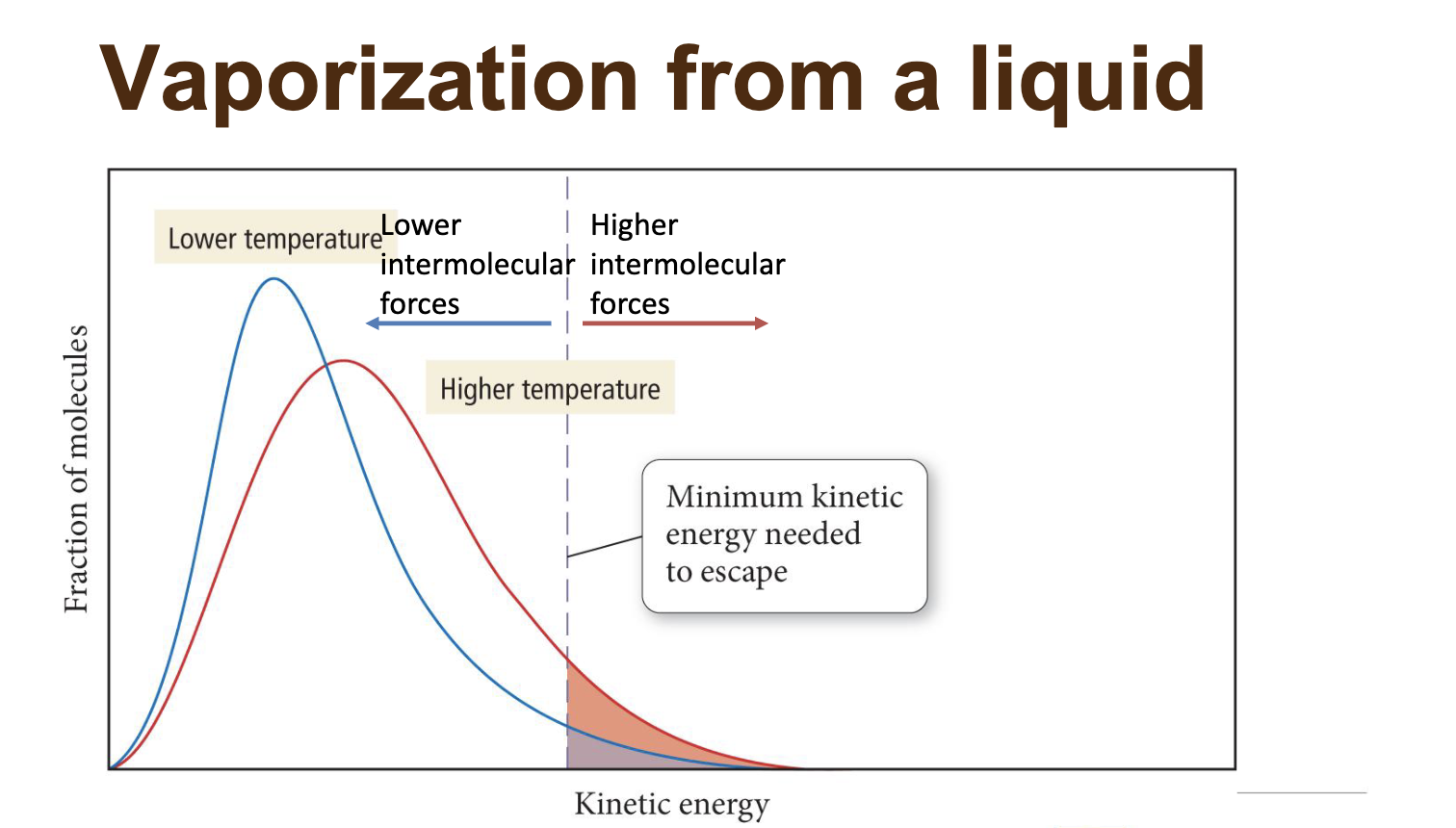
Stationary phase GC: How do temperature and IMFs affect vaporization of X from the liquid SP in GC? (L14 s9)
> Molecules have a spread of KE; only those above minimum KE can escape
> ↑ T → more molecules above minimum KE → ↑ vaporization → ↑ vapor P
> ↓ IMF → minimum KE needed ↓ → easier to escape → ↑ vapor P
> ↑ IMF → minimum KE needed ↑ → harder to escape → ↓ vapor P
> ↑ vapor P → X spends more time in gas MP → elutes earlier
∴ ↑ T or ↓ IMF = faster elution; ↓ T or ↑ IMF = slower
Stationary phase GC: What does Raoult's law say about retention in GC? (L14 s10–11)
> Raoult: pA = pA° · xA → X in gas = volatility of pure X × amount of X in liquid SP
> Kc ≈ p/pA° → K_c ≈ 1 ÷ vapor P of X
> Volatile X (↑ vapor P) → ↓ K_c → leaves SP → elutes first
> Non-volatile X (↓ vapor P) → ↑ K_c → stays in SP → elutes later
> Ideal mixture → SP chemistry doesn't matter → only vapor P decides
∴ Ideal GC = Xs sorted by volatility
Stationary phase GC: Why does SP chemistry matter in GC for non-ideal solutions? (L14 s12)
> Non-ideal → non-equal interactions between X (solute) and SP (solvent)
> Henry's law: cA = pA · k → dissolved X ∝ partial P
> Low xA → follows Henry; near pure X → follows Raoult
> Ideal → only vapour P matters; non-ideal → X–SP interactions also change retention

Stationary phase GC: How do you tell if a mixture shows positive or negative deviation from Raoult's law? (L14 s12–13)
> Mixed interactions weaker than pure ones → molecules escape more easily → positive deviation (↑ vapor P)
> Mixed interactions stronger than pure ones → molecules held tighter → negative deviation (↓ vapor P)
> e.g. water + ethanol → ethanol breaks water's H-bond network → weaker mixed interactions → positive
∴ Weaker mix = ↑ vapor P (+); stronger mix = ↓ vapor P (−)
Stationary phase GC: What is gas-solid chromatography, and when is it used? (L14 s19)
> SP = high-surface-area solid (not liquid)
> Gases adsorb onto the solid surface
> Used for low-retention species → e.g. low-boiling-point gases
> Gas-liquid = X dissolves in SP; gas-solid = X adsorbs on SP
Very volatile gases barely dissolve in a liquid SP, so they’d shoot straight through. A solid with tons of surface area gives them something to stick to → enough retention to separate them.
Detector HPLC: What does a diode array absorbance detector add to HPLC? (L13 s28)
> Combines UV/Vis spectroscopy + chromatography
> Records full UV spectrum repeatedly as Xs elute → absorbance vs λ vs time
> Each peak → tR + spectrum → helps ID the X
> Sensitivity depends on strength of absorbance of X
∴ DAD = chromatogram + spectrum for every peak

Detector HPLC: How does a refractive index detector work in HPLC, and what are its pros and cons? (L13 s29)
> Differential → compares RI of pure MP (reference) vs eluent (sample)
> Same RI → beam straight → no signal
> X elutes → RI changes → beam bends → shifts on detector → signal
> Pro → generally applicable (responds to nearly all solutes, e.g. sugars)
> Con → less sensitive than other detectors (LOD ~1 ng)
∴ RI = universal but weak; signal = RI difference
Detector GC: How does a flame ionization detector (FID) work in GC? (L14 s20)
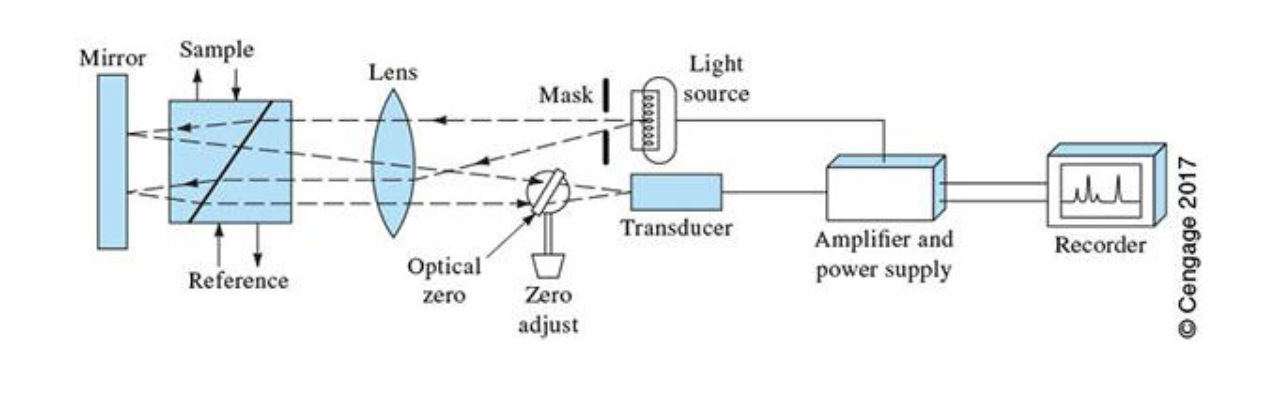
> Column effluent → H₂/air flame
> Organic cpds burn (pyrolyze) in flame → ions + e⁻
> Few hundred volts (≈300 V) between burner tip + collector electrode → pulls charges to electrode
> Moving charges = current = signal
> More C → more ions → bigger current → peak ∝ C content (mass sensitive)
∴ FID = burn organics → collect ions → current ∝ carbon
Detector GC: What is a thermal conductivity detector (TCD), and how does it work? (L14 s21, Chrom exercises)
> Heated wire/thermistor in gas flow → resistance depends on T
> Its T = balance of Joule heating vs heat carried away by gas (thermal conductivity)
> Pure He (↑ thermal conductivity) → wire cools efficiently → baseline
> X elutes → ↓ thermal conductivity → wire stays hotter → resistance changes
> Constant current → resistance change → ΔV = signal → peak
> Concentration-dependent, non-destructive, universal, but low sensitivity
∴ TCD = X changes how well gas cools the wire → ΔV
Detector GC: How does an electron-capture detector (ECD) work, and what is it good for? (L14 s22)
> Radioactive β emitter (usually ⁶³Ni) → high-energy e⁻ → ionize carrier gas
> e⁻ collected at electrodes → steady current = baseline
> Electronegative groups (halogens, peroxides, quinones, nitro) capture e⁻
> Fewer e⁻ reach electrode → current drops = peak
> Non-destructive, highly sensitive, selective for specific functional groups
∴ ECD = X steals e⁻ → ↓ current → peak
Detector GC: Name and describe a GC detector with elemental specificity. (L14 s23, Chrom exercises, Skoog Fig 27-13)
> Atomic (plasma) emission detector (AED)
> Each X elutes → plasma → atomized + electronically excited
> Relaxation → each element emits at its own λ
> Emitted light → grating → diode array → several element λ's watched at the same time
> Each element λ → its own chromatogram (signal vs t)
> X with C + Cl → peak at the same tR in the C plot AND the Cl plot
> Next X (e.g. C + O only) → peak at a later tR in the C + O plots, nothing in the Cl plot
> Plots lined up on the same time axis → read which elements are in each peak
∴ AED → tells you which elements are in each peak ≠ the exact cpd identity
Detector GC: What are the advantages of GC-MS, and why does a packed column need skimming? (L14 s25, Skoog 27)
> Gas coming off the GC → goes straight into the MS
> Capillary column → low flow, so it can feed right into the MS
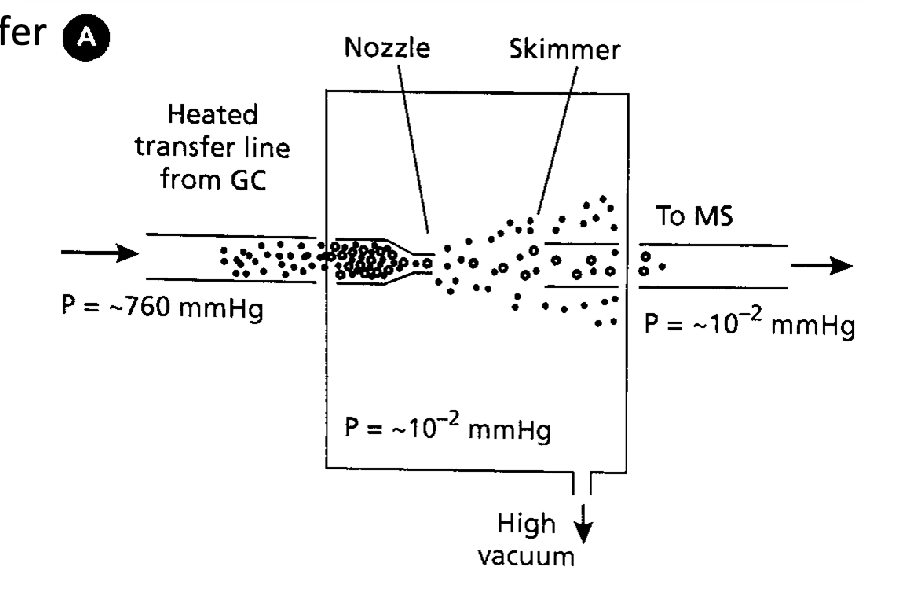
> Packed column → way too much carrier gas… the MS needs high vacuum!
> Fix = skimming: gas sprays out a nozzle, most of the carrier gas gets pumped away, and the skimmer lets the middle of the jet through to the MS
> These separators also lost a lot of X → now capillary columns are basically always used
Detector GC: Why is GC-MS highly sensitive and highly selective? (L14 s25, L13 s27, Skoog Fig 27-15)
> ↑ Sensitivity → MS LOD <1 pg (vs absorbance 10 pg, RI 1 ng)
> MS counts X ions one by one → ↓ background noise → tiny signals still seen
> ↑ Selectivity → each cpd → ions at specific m/z
> Watch only one m/z (selected-ion monitoring) → only cpds giving that m/z show up
> Overlapping GC peaks → still distinguishable by m/z
∴ MS = sees tiny amounts + picks out your X by its mass
Signal: What does a chromatogram look like? (L12 s9)
> y-axis = signal → whatever the detector measures
> x-axis = transport → how far/long the MP has moved
> Each cpd → shows up as a peak when it exits

Signal: What’s retention time, dead time, and the retention factor k? (L12 s13)
> tm = dead time = time for an unretained species to pass through MP
> tr = retention time = total time from injection to the peak apex of X.
> tr’ = tr - tm = time X spends actively retained on SP, showing how long X was actually delayed by the column packing
> k = [(tr - tm) / tm] = time stuck / time flowing ≈ kc
∴ ↑ k → ↑ time in SP → elutes later

Signal: What is band broadening? How do you measure column efficiency?
> Peaks broaden while travelling → wide peaks overlap → ↓ resolving power
> W = base width (tangents t baseline); FWHM = width @ half height
> N = 16 (tR/W)2 = 5.54 (tR/FWHM)2 = # of theoretical plates
> H = L / N = plate height (L = column length)
∴ ↑ N OR ↓ H = narrower peaks = better separation

Signal: Quick definition time! What is resolving power, and what are theoretical plates?
> Resolving power = how well column separates two compounds that elute close together → two distinct peaks
> N = imaginary thin layers that the column is pretend-sliced into where X equlibrates (X hops plate to plate, re-equilibrating each time)
Signal: What does a Van Deemter plot show, and where is the optimum? (L12 s18)
> H = A + B/u + (Cs + Cm)u → ↑ H = more band spread = wider peaks
> A → different path lengths around particles → independent of u
> B/u → diffusion from band centre → edges → needs time → ↓ u = ↑ B
> (Cs + Cm)u → slow move in/out of stationary phase → ↑ u = ↑ C
> Low u → B big; high u → C big; middle u → lowest H
∴ Optimal u = bottom of U-curve = min H = narrowest peaks

Signal: What is the resolution Rs equation, and what do its values mean? (L12 s19)
> Rs = 2ΔZ / (WA + WB)
> ΔZ = difference in retention times/peak centres; W = peak base widths
> ↑ peak gap → ↑ Rs; ↑ peak width (broadening) → ↓ Rs
> Rs 0.75 → not separated; 1.0 → ~4% overlap; 1.5 → ~0.3% (complete)
∴ Band broadening widens peaks → ↓ Rs → peaks overlap

Signal: What are the three factors controlling Rs? (L12 s20)
> √N / 4 → efficiency → more plates → narrower peaks
> (α − 1) / α → selectivity → α = kB / kA → how differently the 2 compounds stick. α = 1 → identical → Rs = 0, no separation possible
> kB / (1 + kB) → retention → how long they’re held overall (kB = the slower one)
> If kA ≈ kB = k → simplifies to: Rs = (√N / 4)(α − 1)(k / (1 + k))