Rock id quiz
 Call Kai
 Learn
 Practice Test
 Spaced Repetition
 Match
 Flashcards
 Knowt Play
1/65

There's no tags or description
Looks like no tags are added yet.
66 Terms
Hardness
Resistance of a mineral to scratching. Measured using the Mohs Hardness Scale
1 = Talc
Human Fingernail: ~ 2.5
Copper Wire: ~ 3
Iron / Wire Nail: ~ 4
7= quartz
10 = Diamond
Cleavage
The tendency of a mineral to break along flat planes of weakness in its crystal structure.
Fracture
Irregular breakage when a mineral does not have cleavage planes.
concoidal fracture in obsidian and quartz
Twinning
An intergrowth of two or more crystals in a symmetrical arrangement. Common in feldspars. Useful for identifying plagioclase feldspar
Quartz
Colour: Clear, white, grey
Hardness: 7
Cleavage: None
Fracture: Conchoidal
Twinning: Rare
Weathering Resistance: Very high
felsic
Orthoclase (K-feldspar)
Colour: Pink, cream, white
Hardness: 6
Cleavage: 2 directions at ~90°
Twinning: Common
Weathering Resistance: Moderate
felsic
Plagioclase Feldspar
Colour: White to grey → can be clear
Hardness: 6
Cleavage: 2 directions at ~90°
Twinning: Distinct parallel striations
Weathering Resistance: Moderate
felsic
Biotite
Colour: Black to dark brown
Hardness: 2.5-3
Cleavage: Perfect in one direction
Twinning: Rare
Weathering Resistance: Low
mafic
Muscovite
Colour: Colourless to light brown
Hardness: 2-2.5
Cleavage: Perfect in one direction
Splits into thin sheets
felsic
Hornblende (Amphibole)
Colour: Dark green to black
Hardness: 5-6
Cleavage: 2 directions at 60° and 120°
Weathering Resistance: Moderate
mafic
Pyroxene
Colour: Dark green to black
Hardness: 5-6
Cleavage: 2 directions at ~90°
Common in mafic igneous rocks
Olivine
Colour: Olive green
Hardness: 6.5-7
Cleavage: Poor
Fracture: Irregular
Weathering Resistance: Low
mafic
Colour Index
A measure of how dark an igneous rock is. Darker rocks contain more mafic minerals while lighter rocks contain more felsic minerals.
Granite
Colour Index: Low (light coloured)
Composition: Felsic (>63% SiO₂)
Minerals: Quartz, K-feldspar, plagioclase, biotite
Texture: Coarse-grained
Cooling History: Intrusive
Formation Environment: Slow cooling deep underground

Rhyolite
Colour Index: Low
Composition: Felsic
Minerals: Quartz, feldspars
Texture: Fine-grained
Cooling History: Extrusive
Formation Environment: Rapid cooling at surface
Note: Quartz-rich magmas tend to be explosive

Diorite
Colour Index: Intermediate
Composition: Intermediate (52-63% SiO₂)
Minerals: Plagioclase, amphibole
Texture: Coarse-grained
Cooling History: Intrusive
Formation Environment: Slow cooling underground
note: grano-diorite is more felsic than diorite + has more white

Andesite
Colour Index: Intermediate
Composition: Intermediate
Minerals: Plagioclase, amphibole
Texture: Fine-grained
Cooling History: Extrusive
Formation Environment: Volcanic arcs and volcanoes
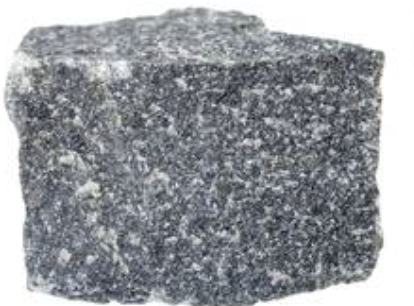
Gabbro
Colour Index: High (dark)
Composition: Mafic (45-52% SiO₂)
Minerals: Pyroxene, plagioclase
Texture: Coarse-grained
Cooling History: Intrusive
Formation Environment: Slow cooling beneath surface

Basalt
Colour Index: High
Composition: Mafic
Minerals: Pyroxene, plagioclase, olivine
Texture: Fine-grained
Cooling History: Extrusive
Formation Environment: Lava flows, oceanic crust

Peridotite
Colour Index: Very High
Composition: Ultramafic (<45% SiO₂)
Minerals: Olivine, pyroxene
Texture: Coarse-grained
Cooling History: Intrusive
Formation Environment: Upper mantle

dacite
Rock Type: Igneous
Composition: Intermediate to felsic
Colour Index: Low to Intermediate (~15–40% dark minerals)
Main Minerals: Plagioclase feldspar, quartz, biotite, hornblende
Texture: Usually aphanitic or porphyritic
Colour: Light grey with scattered dark crystals ("salt and pepper" appearance)
Cooling History: Extrusive (rapid cooling at the surface)
If Porphyritic: Indicates two-stage cooling:
Slow cooling underground forms phenocrysts
Rapid cooling at the surface forms fine-grained groundmass
Formation Environment: Common at volcanic arcs above subduction zones
Extrusive Equivalent of: Granodiorite

Porphyritic Texture
Large crystals (phenocrysts) surrounded by fine groundmass
Indicates two-stage cooling
Slow cooling underground followed by rapid cooling near the surface
Phenocrysts formed first at depth
Phenocryst
large crystal that forms during slow cooling deep underground before the remaining magma cools rapidly
Groundmass
Fine-grained material surrounding phenocrysts that forms during rapid cooling
How do sedimentary rocks form?
Form from weathered rock fragments, chemical precipitates, or biological materials through deposition, compaction and cementation (diagenesis).
High-Energy Depositional Environment
Fast-moving water or waves transport and deposit coarse sediments such as conglomerates.
Examples: beaches, alluvial fan
Low-Energy Depositional Environment
Calm environments where fine sediments settle.
clay and silt
Examples: Lakes, deep marine settings, floodplains.
moderate energy depositional environments
medium environment → sand, ooids, sand sized skeletal matter
River channels, coral reefs
Conglomerate
Grain Size: >2 mm
Clasts: Rounded
Energy: High-energy environment
Depositional Environment: Rivers, beaches
Texture: Coarse clastic rock
paraconclomerate = gravel in fine matrix
orthoconglomerate = gravel touch each other and interlock
Breccia
Grain Size: >2 mm
Clasts: Angular
Energy: Very high energy, little transport
Depositional Environment: Fault zones, landslides, debris flows
Texture: Coarse clastic rock
Sandstone
Grain Size: 64 μm-2 mm
Environment: Moderate-energy
Depositional Environment: Rivers, beaches, deserts
Texture: Medium-grained clastic rock
Mudstone
Grain Size: Too fine to see
Environment: Low-energy
Depositional Environment: Lakes, floodplains, deep marine basins
Texture: Fine-grained clastic rock
silt, clay
Sorting
Well Sorted = grains mostly same size
Poorly Sorted = grains of many sizes
Indicates transport history and depositional environment
Chemical Maturity
A rock containing mostly resistant minerals (especially quartz) after intense weathering.
Textural Maturity
Well-rounded grains indicating long transport and extensive weathering
angular grains = less transport
Calcirudite (fine to coarse)
Rock Type: Biochemical/Chemical sedimentary limestone
Grain Size: > 2 mm
Equivalent Clastic Rock: Conglomerate/Breccia
Components: Large shell fragments, fossils, carbonate clasts
Energy Environment: High-energy
Depositional Environments:
Reef environments
Wave-swept shallow marine settings
Nearshore marine environments
Identification: Large visible fossil or shell fragments cemented together.
Calcarenite (fine to coarse)
Rock Type: Limestone
Grain Size: 0.0625-2 mm (sand-sized carbonate grains)
Equivalent Clastic Rock: Sandstone
Components: Sand-sized carbonate particles, shell fragments, ooids
Energy Environment: Moderate energy
Depositional Environments:
Beaches
Shoals
Shallow marine shelves
Identification: Feels and looks like a sandstone but reacts with dilute HCl because it is made of calcite.
Calcilutite
Rock Type: Limestone
Grain Size: < 0.0625 mm (mud-sized carbonate particles)
Equivalent Clastic Rock: Mudstone
Components: Micrite (carbonate mud)
Energy Environment: Low energy
Depositional Environments:
Lagoons
Deep marine settings
Quiet shelf environments
Identification: Very fine-grained limestone with no visible grains.
types of biogenic vs clastic sed roc
conglomerate = calcirudite
sandstone = calcarenite
mudstone = caliculite
Contact Metamorphism
Caused by heat from nearby magma
High temperature, low pressure
Localised around intrusions
Example rock: Hornfels
marble → protolith is limestone (calcite)
no foliation
Regional Metamorphism
Caused by mountain building and compression
High temperature and pressure
Large-scale process
Produces foliated rocks
foliation = repetitive layering, planar structures, or parallel alignment of mineral grains and bands within a rock
due to stress
squishes grains in one direction
Slate
Parent Rock: Mudstone/Shale
Metamorphism: Regional
Grade: Low
Texture: Foliated → WEAK, slaty cleavage

Phyllite
Parent Rock: Slate
Metamorphism: Regional
Grade: Low-Medium
Texture: Wavy foliation → phyllitic foliation

Schist
Parent Rock: Phyllite / mudstone
Metamorphism: Regional
Grade: Medium-High
Texture: Visible mica crystals → schistocity → developed foliation
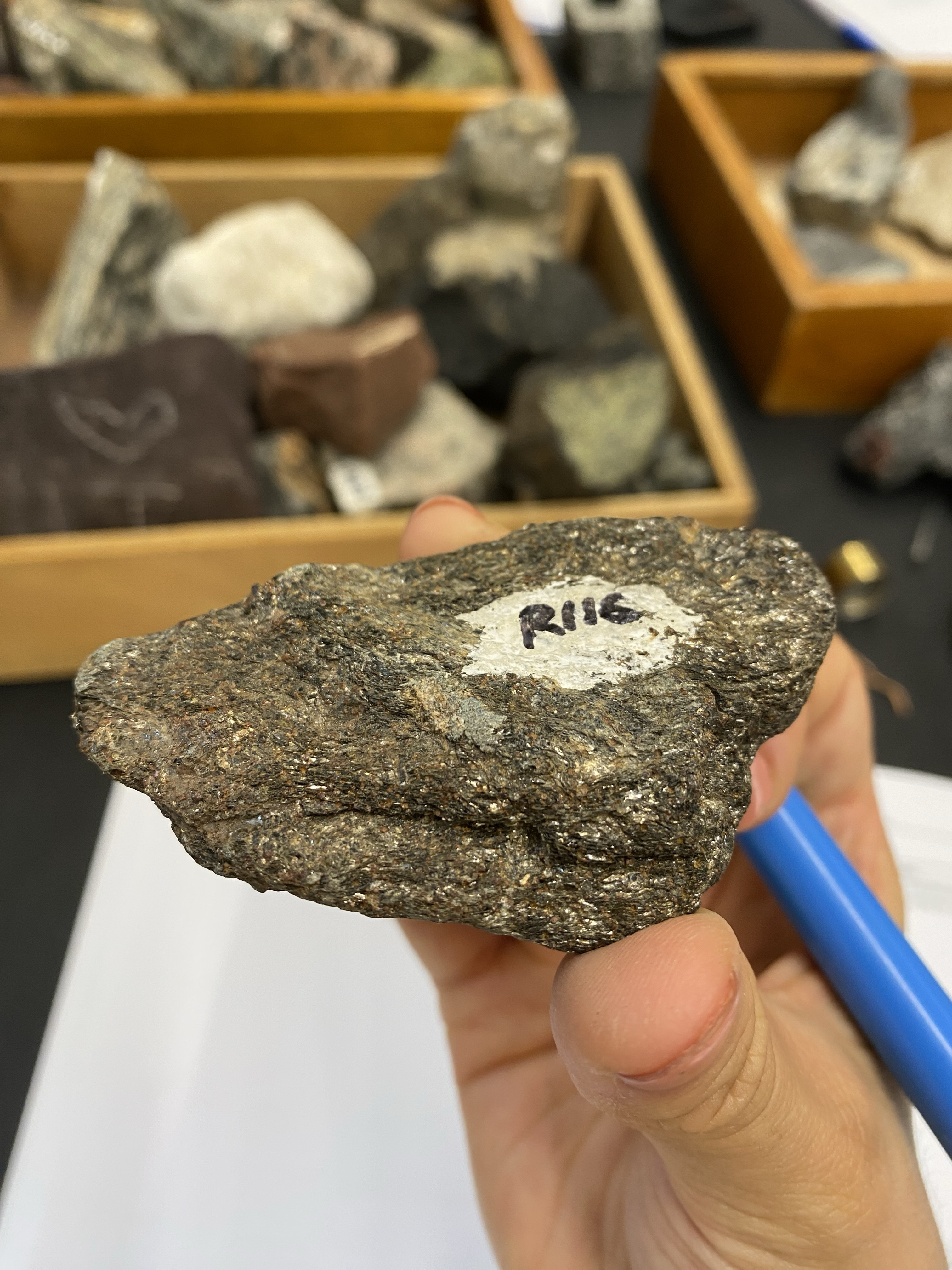
Gneiss
Parent Rock: Schist/mudstone or Granite
Metamorphism: Regional
Grade: High
Texture: Light (Felsic) and dark (mafic) bands → gneissic banding

Marble
Parent Rock: Limestone
Metamorphism: Contact or Regional
Major Mineral: Calcite
Texture: Non-foliated

Quartzite
Parent Rock: Quartz Sandstone
Metamorphism: Contact or Regional
Major Mineral: Quartz
Texture: Non-foliated

Quick Identification Checklist:
Igneous
Colour index?
Visible crystals?
Intrusive or extrusive?
What minerals are present?
Any porphyritic texture?
Quick Identification Checklist:
Sed
Grain size?
Sorting?
Rounding?
Composition?
Depositional environment?
Quick Identification Checklist:
metamorphic
Foliated or non-foliated?
Metamorphic grade?
Parent rock?
Contact or regional metamorphism?
Porphyritic Texture
Large crystals (phenocrysts) surrounded by fine groundmass.
Indicates:
Two-stage cooling
Slow cooling underground first
Rapid cooling at surface second
Phaneritic Texture
Coarse-grained, visible crystals.
Indicates:
Slow cooling
Intrusive igneous rock
Aphanitic Texture
Crystals too small to see.
Indicates:
Rapid cooling
Extrusive igneous rock
intrusive igneous rock textures
porphyritic
phaneritic
aphanitic
Fossiliferous Limestone
Contains visible fossils
Biogenic sedimentary rock
Marine depositional environment
Chalk vs limestone
Biogenic limestone
Made from microscopic marine organisms
Deposited in low-energy marine environments
Coal
Lithified plant material
Organic sedimentary rock
Environment:
Swamps
Wetlands
Red Mudrocks
Red colour indicates iron oxides.
more chemically mature due to weathering
Dark Brown or Black Mudrocks → why that colour
Contain abundant organic material.
Foliation
Alignment of minerals due to directed pressure.
Common minerals:
Micas
Kyanite (blueish grey)
silliminate (fibrous, greasy, white)
Actinolite
sedimetnary rock texture
clast = phenocrysts but for sed rocks
matrix = groundmass
metamorphic rock textures
foliation
porphyroblasts = phenoctrysts for metamorphic rocks → usually garnet
Garnet
Mineral Type: Silicate mineral
Colour: Red to reddish-brown (can also be green, orange, yellow, or black)
Hardness: 6.5-7.5
Cleavage: None
Fracture: Irregular to conchoidal
Crystal Habit: Often forms dodecahedral (12-sided) crystals
Twinning: Rare
Formation Environment
Commonly forms during regional metamorphism
Indicates medium to high metamorphic grade
Often found in:
Schist
Gneiss
Garnet-mica schist
laminations
Very thin layers of sediment or rock, typically less than 1 cm thick.
parallel lines of sediment
Rock Type: Most common in sedimentary rocks, but can also occur in some metamorphic rocks.
Formation: Produced by successive deposition of fine sediment over time.
Environment: Usually forms in low-energy depositional environments where fine particles can settle out of suspension.
Examples of Depositional Environments:
Lakes
Lagoons
Floodplains
Deep marine environments
holocrystalline, hypocrystalline, holohyalline
holocrystalline = all crystals
hypocrystalline = some crystals some glass
holohyalline = all glass
metamorphic vs igneous
Foliation = metamorphic
Sugary crystals / grains not interlocking but more suspended / baked appearance = metamorphic
non foliated and grains are less sugary = igneous