Chemistry 102: Chapter 18: Thermodynamics
 Call Kai
 Learn
 Practice Test
 Spaced Repetition
 Match
 Flashcards
 Knowt Play
1/53

Earn XP
Description and Tags
Entropy
54 Terms
what is thermodynamics?
the study of heat and other forms of energy involved in physical and chemical reactions. it also deals with how energy transforms
what is the first law of thermodynamics?
states that energy cannot be created or destroyed, only transformed from one form to another. This law implies that the total energy of an isolated system is constant.
What does the internal energy U equation represent?
The internal energy U equation represents the total energy contained within a system, including kinetic and potential energy of its particles. It is represented by DU = Uf – Ui.
The formula means final energy - initial energy
What are the two ways that a system and surroundings exchange energy?
heat represented by the (Q) variable and work represented by the (W) variable.
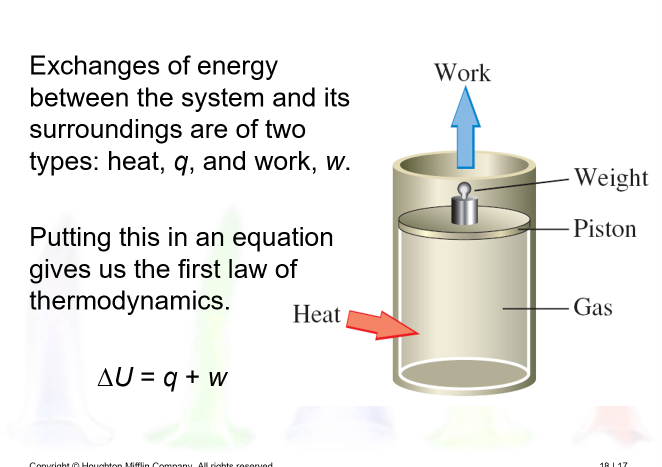
Rewrite the internal energy U equation in terms of q and w
The internal energy U equation can be rewritten as dU=q+w, where q represents the heat added to the system and w represents the work done on the system.
what does it mean when heat is evolved in thermodynamics?
It means that the system is releasing energy in the form of heat to the surroundings, typically indicating an exothermic process. This results in a decrease in the internal energy of the system.
Slide #18
Fill in the blank
When q is ___ the reaction is exothermic and the system’s energy is decreasing by releasing it to its surroundings
negative
Slide #18
Fill in the blank
When heat is absorbed the by the system q is ___.
positive
work can further be expanded into another formula. What is the other formula?
Work can also be defined as the product of pressure and change in volume, represented as W=−P×ΔV .This relationship expresses that work done by or on a system changes its energy depending on the pressure and volume change during the process.
In respect to the formula w=-PΔV Describe what happens when ΔV is positive. what will the result be positive or negative?Is the system doing work on the surroundings or vice versa?
When ΔV is positive, the volume of the system is increasing, resulting in work being done by the system on the surroundings. Thus, W will be negative, indicating that the system is expending energy.
In respect to the formula w=-PΔV Describe what happens when ΔV is negative. what will the result be positive or negative?Is the system doing work on the surroundings or vice versa?
When ΔV is negative, the volume of the system decreases, resulting in work being done on the system by the surroundings. Thus, W will be positive, indicating that energy is being transferred into the system.

According to the picture is ΔV positive or negative, is work + or -
When the picture shows an increase in volume, ΔV is positive, resulting in work W being negative. This indicates work is done by the system on the surroundings.
what is the formula for the first law of thermodynamics?
The first law of thermodynamics is expressed as ΔU=Q+W where ΔU is the change in internal energy, Q is the heat added to the system, and W is the work done by the system. expanded is ΔU = ΔH – PΔV
what is a spontaneous process?
is a physical or chemical change that occurs by itself. It does not require any outside force, and it continues until equilibrium is reached.
Slide #27
true or false
Higher molecular mass = more entropy
Higher molecular mass generally results in more disorder, leading to increased entropy.
what is entropy?
Entropy is a measure of the disorder or randomness in a system.
Slide # 29
Fill in the blank
Entropy is a ___ function. It depends on variables, such as temperature and pressure, that determine the state of the substance.
state
A state property (also called a state function or state variable) in chemistry and thermodynamics is a property whose value depends only on the current condition or state of the system, and not on the path or history used to reach that state
Slide # 29
Fill in the blank
Entropy is an ___ property. it depends on the amount of substance
extensive
An extensive property is a physical or chemical characteristic of matter that depends on the amount of substance present in a system
Slide #30
What are the units of entropy?
The units of entropy are typically joules per kelvin (J/K) per mole.
Slide #31
what is the equation that calculates entropy changes?
ΔS = Sf – Si
What is sublimination?
Sublimation is the process in which a substance transitions directly from a solid to a gas without passing through the liquid phase.
Slide #32
Fill in the blank
The total ___ of a system and its surroundings increases for a spontaneous process
entropy
Slide #32
True or energy
entropy is a measure of energy itself and not its dispersal
False, entropy is a measure of energy dispersal in a system. not the energy itself
Read
For a spontaneous process:
ΔS > q/t
Slide #36
The entropy of a molecular system may be concentrated in a few energy states and later dispersed among many more energy states. The energy of such a system increases.
Slide #36
true or false
Entropy increases when 2 molecules become 1
False, entropy means disorder. More molecules = more disordrer
Slide #39
true or false
when molecules change state from solid to liquid entropy increases, dispersing energy more widely
True, as heat is absorbed during the phase change, leading to increased disorder.
Slide #41
Read
At equilibrium very close to a phase change ΔS= q/t
Slide #42
What does this symbol ΔHf°,stand for?
The standard enthalpy of formation, which is the heat change associated with the formation of one mole of a compound from its elements in their standard states.
what is enthalpy?
Enthalpy is the total heat content of a system, typically measured at constant pressure, and is used to determine the heat changes during chemical reactions.
Slide #42
In what units is ΔHf°?
Typically measured in kJ/mol.
what are the units for entropy?
The units for entropy are typically joules per kelvin (J/K), reflecting the amount of energy dispersed per unit temperature.
what is 25 degrees celcius in kelvin?
The temperature in Kelvin is calculated by adding 273.15 to the Celsius value, so 25 degrees Celsius is 298.15 K.
Read
In a phase transition process that occurs very close to equilibrium, heat is very slowly absorbed or evolved. Under these conditions, no significant new entropy is created.
DS =q/t
This concept can be applied to melting using DHfus for q and to vaporization using DHvap for q.
Slide #45
what is the third law of thermodynamics?
A substance that is perfectly crystalline at zero kelvin (0 K) has an entropy of zero.
Slide #49
Read
when there is entropy of fusion/ vaporization temperature does not change during a phase change. Only entropy changes
Slide #51
The opening of Chapter 6, on thermo-chemistry, describes the endothermic reaction of solid barium hydroxide octahydrate and solid ammonium nitrate:
Ba(OH)2 8H2O(s) + 2NH4NO3(s) → 2NH3(g) + 10H2O(l) + Ba(NO3)2(aq)
Predict the sign of DS° for this reaction.
ΔS is positive.
3 moles of reactants produces 13 moles of products. Solid reactants produce gaseous, liquid, and aqueous products.
so an increase in entropy equals a positive entropy

Slide #52
what does this equation mean?
sum total of moles of products - sum total of moles of reactants.
Slide #53
When wine is exposed to air in the presence of certain bacteria, the ethyl alcohol is oxidized to acetic acid, giving vinegar. Calculate the entropy change at 25°C for the following similar reaction:
CH3CH2OH(l) + O2(g) → CH3COOH(l) + H2O(l)
Refer to slide #54 for a step-by- step process
ΔS = –136 J/K, it is not a spontaneous reaction because is negative
Remember for a reaction to be spontaneous it must be ΔS must be positive
Slide #55
what is free energy?
Free energy, often denoted as G, is a thermodynamic potential that measures the maximum reversible work obtainable from a closed system at constant temperature and pressure. It is used to predict the spontaneity of a reaction.
Slide #55
what is the equation of free energy?
The equation for free energy is given by G=H−TS, where G is the Gibbs free energy, H is the enthalpy, T is the temperature in Kelvin, and S is the entropy.
Slide #60
Read
The standard free energy of formation is the free-energy change that occurs when 1 mol of substance is formed from its elements in their standard states at 1 atm and at a specified temperature, usually 25°C.
Read
this is the standard free energy change reaction equation


Realization
ΔG can be calculated with either the gibbs free energy equation or the sum of reactants and products eqn
Slide #63
Calculate the free-energy change, DG°, for the oxidation of ethyl alcohol to acetic acid using standard free energies of formation.
CH3CH2OH(l) + O2(g) → CH3COOH(l) + H2O(l)
ΔG° = –454.9 kJ
Slide #66
Fill in the blank
A reaction is spontaneous if ΔG is less than ___
-10kj
Slide #66
A reaction is not spontaneous if ΔG is more than ___
+10jk
Slide #66
If ΔG is between -10 and +10 kj then the reaction is ___
at equilibrium.
Slide # 71
Theoretically, spontaneous reactions can be used to perform useful work. In fact, we use reactions such as the combustion of gasoline to move a vehicle.
We can also use spontaneous reactions to provide the energy needed for a nonspontaneous reaction.
Slide # 72
Read
The thermodynamic equilibrium constant is the equilibrium constant in which the concentrations of gases are expressed as partial pressures in atmospheres and the concentrations of solutes in solutions are expressed in molarities.
If only gases are present, K = Kp.
If only solutes in liquid solution are present, K = Kc.
Slide #73
What is the equation that relates the standard free energy to thermal equilibrium constants?
The equation is ΔGo=−RTln(K) , where ΔGo is the standard free energy change, R is the gas constant, T is the temperature in Kelvin, and K is the equilibrium constant.
What are the units for the R constant in the following equation ΔGo=−RTln(K) ?
The units for the gas constant R are typically 8.314mol×KJ.