Antigens and Antibodies.
 Call Kai
 Learn
 Practice Test
 Spaced Repetition
 Match
 Flashcards
 Knowt Play
1/10

Earn XP
Description and Tags
https://www.youtube.com/watch?v=cYRe5ftY8pI
11 Terms
What are antigens
Molecules that are recognised as foreign by the immune system, they are often found on the surface of pathogens, often leads to immune response.
What happens during an immune reponse
Antibodies are produced which specifically bind to the antigen.
Why do antigens on the surface of ur cells not trigger immune response
The immune system identified these antigens as self.
What are antibodies
Glycoproteins consisting of four polypeptide chains, 2 long heavy chains which are identical to each other, and 2 shorter light chains which are identical to each other
The chains are held to each other by disulfide bridges
Heavy chain contains site at which the antibody can bind to a cell.
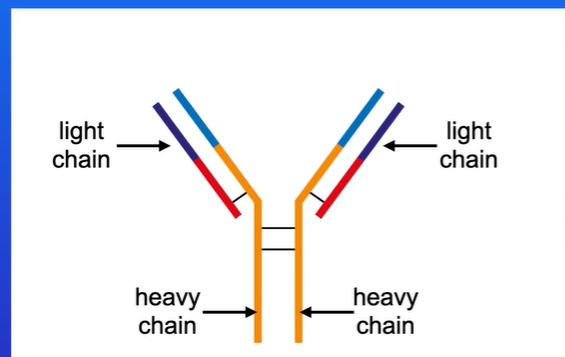
How many antigen binding sites are on an antibody
Two antigen binding sites. This means one antibody molecule binds to two antigen molecules like this
When antigens bind, it is called an antigen-antibody complex.

What is the hinge region
It is flexible, allows the distance between two antigen binding sites to vary

What is the constant region
Has the same structure for every antibody, no matter which B lymphocyte produced it.

What the variable region
The ends of the antibodies are different, and it is called the variable regions . Different on different antibodies so that its complementary to antigen.

What are the 3 types of antibody
Opsonins, Agglutinins and anti toxins.
What are agglutinins
Bind to antigens, and cause clumping which prevents them from entering the body cells so they can be engulfed by phagocytes.
What are anti toxins
They bind to toxins to prevent harm to human cells. Phagocytes then engulf the ‘toxin antibody’ complexes.