L46 & L49- Canine pregnancy and disorders of pregnant and post-partum dog
 Call Kai
 Learn
 Practice Test
 Spaced Repetition
 Match
 Flashcards
 Knowt Play
1/113

There's no tags or description
Looks like no tags are added yet.
114 Terms
what are the different options to diagnose pregnancy
-transabdominal palpation
-relaxin
-ultrasound
-rads
what are the advantages of transabdominal palpation
-Cheap and no equipment needed
-Can feel 2cm swellings by day 30
what are the disadvantages of transabdominal palpation
-Small window of accuracy
-Inaccurate
when can you get false positives with relaxin
-
true or false: relaxin is not an assessment of fetal health and is not predictive of fetal number
true
What is the preferred method for diagnosing pregnancy in dogs?
Ultrasound

When can a fetal heartbeat be seen on ultrasound?
At 25 days.
What can late-pregnancy ultrasound assess?
Fetal viability, stress, maturity, age and placental disease.
true or false: puppy counts are accurate with ultrasound
false
What is the best method for late gestation counting puppies?
radiographs
When does fetal mineralization occur in dogs?
After 45 days.

what do radiographs during late stage gestation assess
gestational age, fetal death, feto-maternal disproportion
What are the advantages of transabdominal palpation?
It is inexpensive and requires no equipment.
What limits the accuracy of transabdominal palpation?
Its accurate diagnostic window is small.
When can relaxin testing produce false-negative results?
-Before 28 days of gestation
-after abortion or whelping
is progesterone useful for diagnosing pregnancy?
NO! It is nondiagnostic for pregnancy.
what are some things a dog might do prior to whelping
-lactate up to 2 weeks pre-whelping
-nesting 1 week pre-whelping
When is whelping expected relative to LH peak?
65 d +/- 1 day
When is whelping expected relative to ovulation?
63 days, plus or minus one day.

When is whelping expected relative to D1 diestrus?
57 d +/- 2
When is whelping expected relative to last breeding?
55 to 72
can you tell fetal maturity on rads
yes
if you are taking rads about 4 days before whelping, what do you expect to see mineralized on the rads
teeth
What progesterone change occurs within 24-28 hours of parturition?
It drops below 2 ng/mL.
What rectal temperature change suggests whelping within 8-24 hours?
A temperature below 99°F or a 1.6°F drop.
How long does stage 1 canine labor normally last?
6 to 12 hours.
what occurs during stage 1 labor
-Uterine contractions
-Pelvic ligament and cervix relaxation
-Placental separation
What discharge may accompany placental separation during stage 1 labor?
Green to black vulvar discharge.
what are some signs of stage 1 labor
-Obsessive nesting
-Anorexia 12-24 hours before whelping
-Restlessness
-Panting
-Shivering
What occurs during stages 2 and 3 of canine labor?
Fetal and placental expulsion.
What is the normal interval between puppies?
30-60 minutes.
how long should stage 2 and 3 of labor last
complete in 6 hrs
true or false: during stage 2 and 3 of labor, fetal membranes should pass with pup or within 5-15 minutes
true
How long can normal postpartum lochia (or uterine discharge) persist?
Up to 3 weeks
how long does uterine involution take
up to 3 months
Which dogs are predisposed to dystocia?
Brachycephalic breeds.
what is the most common dystocia presentations
primary uterine intertia
what are some causes of dystocia
-Primary uterine inertia → common
-Feto-maternal disproportion
-Singletons
-Maternal abnormalities, like vaginal strictures, pelvic fractures, neoplasia
-Secondary uterine inertia (large litters)
what is the presentation of dystocia
-Failure to initiate parturition (prolonged gestation)
-Failure to progress to stage 2
-Maternal illness, like hypocalcemia, septicemia, colic
What is primary uterine inertia?
lack of uterine contractions.
what are the causes of primary uterine inertia
-Small or large litter
-Singleton
-Genetic
-Systemic disease
-Hypocalcemia
-Uterine torsion
-Nutrition
How is primary uterine inertia treated when the dog is at term?
C-section
what is prolonged gestation
- > 24 hrs from TRUE temperature drop
- > 2 hrs from placental separation
What progesterone concentration and timing does the source give for cesarean delivery?
-Below 2 ng/mL
-at least 63 days after the LH peak.
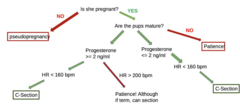
how do you evaluate a dystocia
-Determine the cause of dystocia (if there is a dystocia)
-Determine if there is maternal or fetal compromise
-Obstetrical exam
-History, PE, vaginal digital exam, abd ultrasound to determine fetal stress, rads to determine fetal number and size
what are the signs of failure to progress normally for parturition
- > 4 hrs without straining and no first puppy
- > 2 hrs between pups without straining
- > 30 min between pups with straining
-Partial delivery of pup
-Hemorrhagic vulvar discharge
What interval between puppies with straining indicates failure to progress?
More than 30 minutes.
what are the 3 different ways to correct a dystocia
-vaginal manipulation
-medical tx
-surgical tx
what is vaginal manipulation for correcting a dystocia and is it a good way to correct a dystocia
-Ferguson's reflex: Pressure on vaginal wall → oxytocin release → uterine contractions
-hard to impossible
When is medical treatment of dystocia appropriate?
When the cervix is dilated, puppies are normal-sized, and obstruction or fetal stress is absent.
what is the main way that you manage a dystocia
surgery tx
What are the main infectious causes of canine pregnancy loss?
Canine herpesvirus and Brucella.

true or false: there are lots of other infections and any infection that causes severe systemic illness, such as lepto, e. Coli, mycoplasma, canine distemper, etc, can cause pregnancy loss in the dog
true
Which Brucella species most commonly causes canine brucellosis?
Brucella canis.
true or false: canine brucellosis is reportable in most states and zoonotic
true
what are the different transmission routes of canine brucellosis
-Oral
-Conjunctival
-Venereal
-Transplacental
where is canine brucellosis secreted
-aborted material, vulvar discharge, milk, urine, and semen
-Can shed 1-4 weeks after infection and up to 64 months after infection
is it common for canine brucellosis to be asymptomatic
yes
what are the clinical signs of reproductive canine brucellosis
-infertility
-Vulvar discharge
-Embryonic death
-Abortion
-Neonatal death
-Testicular atrophy
-Epididymitis
-Scrotal dermatitis
what are the clinical signs of non-reproductive canine brucellosis
-Discospondylitis
-Anterior uveitis
-Lymphadenitis
-Glomerulonephritis
-Meningoencephalitis
what is the brucella card test
-Detects antibodies to cell wall antigens of B. canis
-Screening tool that is highly sensitive (but not very specific)
What are the limitations of the Brucella card test?
-It is highly sensitive but not very specific
-false positives are common.
how can you increase the specificity of canine brucella
adding 2-mercaptoethanol
if a dog is still positive for brucella after adding 2-mercaptoethanol, what can you do
submit for AGID +/- blood culture
what are the treatment options for canine brucella
-Euthanasia if owners are not willing to treat over the patient's lifetime
-Sterilization reduces risk of shedding
-Tetracyclines + gentamicin, or enrofloxacin LONG TERM
what can happen with treating canine brucella with Tetracyclines + gentamicin, or enrofloxacin LONG TERM
-Controls bacteremia, but doesn't often eliminate the bacteria
intracellularly
-Can/will relapse
-Repeat blood culture after 6 months and repeat PCR routinely
is canine brucellosis zoonotic?
yes!!!!!!
Why can canine brucellosis relapse after antibiotic treatment?
Treatment may control bacteremia without eliminating intracellular bacteria.
how can you prevent and control canine brucella
-Test new kennel dogs twice, 30 days apart
-Only use Brucella-negative males for breeding
-Screen all dogs every 3 to 6 months in breeding kennels
-Remove positive animals
How often should dogs in breeding kennels be screened for Brucella?
Every three to six months.
how many consecutive negative test do positive animals need to get out of quarantine
-test all dogs monthly
-need three negative consecutive tests
what is the transmission routes of CHV
-Transplacental
-Oronasal
-Venereal
where can CHV be shed in
-Nasal discharge
-Vulvar discharge
-Aborted tissues
what are the clinical signs of CHV in fetuses
-Macerated or mummified fetuses
-Stillbirths
-Neonatal death
what are the clinical signs of CHV in adults
-Mild respiratory, ocular, or genital infection
-Self-limiting papulovesicular vaginitis
-Self-limiting after developing immunity
-Most repro problems if infected for first time during pregnancy
-Protective cholesterol antibodies
-Latency (Avoid stress during pregnancy)
When are naive pregnant dogs most susceptible to canine herpesvirus?
During the last three weeks of gestation, so you should isolate them
true or false: for CHV-1 in neonates, disease or death if infected in utero or less than3 weeks of life
true
Why should puppies at risk of canine herpesvirus infection be kept warm?
The virus replicates at temperatures below 100°F.
how do you diagnose CHV-1 in neonates
-Viral isolation or IHC
-Histopathology in aborted tissues
what is the treatment for CHV-1 in neonates
-Antibodies in colostrum of immune dams
-Infection is usually fatal
-Puppies cry non-stop
-Acute hemorrhagic septicemia, thrombocytopenia, interstitial
pneumonia, encephalitis
-Cerebellar and retinal dysplasia, segmental renal necrosis
-Antivirals are rarely helpful
What vulvar discharge is characteristic of postpartum metritis?
Malodorous red to brown discharge.

what are the clinical signs of postpartum metritis
-Malodorous red to brown vulvar discharge
-Fever, dehydration, depression, endotoxemia
-Can turn into toxic/septic metritis, septicemia, shock
what are the ddx/causes of postpartum metritis
-Retained fetal membranes
-Macerated or decomposed pups
-Dystocial and uterine compromise
how do you diagnose postpartum metritis
-Clinical signs
-Clinical pathology
-Vaginal cytology
-bacterial culture
-US/rads

what will you see on a vaginal cytology of postpartum metritis
-Degenerate or toxic PMNS
-Endometrial cells
-Muscle fibers of pups

what will you see on US/rads of postpartum metritis
enlarged/fluid filled uterus
what is the treatment for postpartum metritis
-Stabilize the dog → IV fluids
-Control bacterial growth
-Evacuate uterine contents
-surgical removal of pups, membranes, devitalized tissues
Why must ecbolic drugs, like oxy and prostaglandins, be used carefully in postpartum metritis?
The uterus is prone to rupture

what are the acute clinical signs of mastitis
-Fever, depression, anorexia
-Can be life threatening
-Hot, painful mammargy glands
What findings can suggest chronic mastitis?
-puppy failure to thrive
-asymptomatic
what are the different diagnosis mechanisms for mastitis
-Macroscopic exam of mammary gland secretions
-cytology
-culture
what will you see on a macroscopic exam of mammary gland secretions in mastitis
Normal, purulent, or reddish brown
what will you see on a culture in mastitis
Degenerate neutrophils and bacteria
what will you see on culture of mastitis
- >10^4ml bacteria
- May see E. coli, Staphylococcus spp., Streptococcus spp.
What antibiotic properties are important when treating mastitis in a nursing dog?
-culture and sensitivity
-It must penetrate the milk-blood barrier
-be safe for nursing puppies.
what abx can you not use for mastitis
FLUOROQUINOLONES
what are the clinical signs associated with SIPS
-Hemorrhagic vulvar discharge > 3 weeks post partum
-Occurs when fetal trophoblastic cells do not degenerate
-Trophoblasts continue to invade endometrium and myometrium
-Damage to blood vessels
-Endometrial ulceration
-Uterine perforation (rare)
how do you diagnose SIPS
-rads/US
-vaginal cytology
what will you see on rads/US for SIPS
uterine swelling
what will you see on vaginal cytology for SIPS
Trophoblast-like cells (multinucleated and vacuolated)