Chapter 8 Late Antiquity and South Asia
 Call Kai
 Learn
 Practice Test
 Spaced Repetition
 Match
 Flashcards
 Knowt Play
1/89

There's no tags or description
Looks like no tags are added yet.
90 Terms
What do the mural paintings at Dura-Europos suggest was a component of the decoration of many Late Antique synagogues?
Narrative scenes
Why is the Christian community house in Dura-Europos such a small building?
Christians did not yet
Which Roman monument do the figures in the painting illustrating the Book of Samuel in the synagogue at Dura-Europos resemble?
Arch of Septimus Severus
Why did the Roman state persecute the Christians?
Christian's refused to pay homage to the State's gods
What is the earliest datable Christian art?
Mid-Third Century CE
Why did Constantine locate the earliest public Christian churches on the outskirts of Rome?
To avoid confrontations
Where have archaeologists found the oldest-known Christian iconographical program?
Community house, Dura-Europos
Why is a family group shown praying in the lunette of the Catacomb of Saints Peter and Marcellinus?
They represent the Christian family seeking their heavenly reward
How might you recognize a Christian sarcophagus?
The iconography in its reliefs is predominantly Christian
Which scene on the sarcophagus of Junius Bassus is an allusion to the crucifixion?
Christ before Pilate
Why are there very few depictions of the crucifixion in early Christian art?
Artists emphasized the divinity of Christ through his life as a teacher and a miracle worker
In what role was Christ depicted in much Early Christian art?
Good shepherd
How is the figure of Jesus depicted on the sarcophagus of Junius Bassus?
Like a Roman Emperor
Why is the diptych of the Nicomachi and the Symmachi significant to the art tradition of fourth-century Rome?
It deliberately continued the classical tradition
What best describes the style of the Christ as Good Shepherd mosaic from the Mausoleum of Galla Placidia at Ravenna?
Deeply rooted in classical tradition
The illustrated book had a long history in the ancient world. When and where did the tradition of placing pictures in manuscripts begin?
Pharaonic Egypt
What attributes were used to depict Christ after Christianity was officially recognized by Roman authorities?
Imperial purple
What is the subject of the scene that occupies the left third of the sarcophagus of Santa Maria Antiqua shown here?
Salvation of Jonah
What is the correct term for the entrance porch of Old Saint Peter's in Rome?
Narthex
What is the closest predecessor for Santa Costanza?
Pantheon
Which architectural form did Christian architects choose to adopt for the first public buildings where the Christian liturgy would be celebrated?
Basilica
Which buildings have a basilica form?
Old Saint Peter's
How was natural light provided in Early Christian basilicas?
Clerestory windows
Which aspect of Greco-Roman temple architecture was retained in the Early Christian basilica?
East-West Orientation
What architectural term names the vestibule area of a Christian church?
Narthex
Which buildings follow a radial form (think of the Pantheon)?
Ambulatory. Centralized or circular buildings—such as rotundas, martyriums, and baptisteries (for example, Santa Costanza itself or San Vitale in Ravenna)—follow a radial/central plan.
The plan of the church of Santa Costanza is a forerunner of which regional variant?
Eastern central plan builidng
What architectural element was introduced in the church of Santa Costanza?
Ambulatory
Scenes from what artistic group accompany the Christian images in the mural program at Santa Costanza?
Roman Funerary Art
The exterior of Santa Sabina in Rome most closely resembled the exterior of which building?
Ayla Palatina, Trier
What body of subject matter survives in the decoration of the Mildenhall Treasure, especially the "Great Dish"?
Greco-Roman iconography
Where was the Mildenhall Treasure found?
England
What is the subject of the two inner rings of the "Great Dish" from the Mildenhall Treasure
Oceanus and Nereids
What invention greatly aided the distribution of manuscripts during the Early Roman Empire?
Codex
In 380 CE, who declared Christianity the official religion of the Roman Empire?
Theodosius I
Who was the Ostrogothic patron of the church of Sant'Apollinare Nuovo in Ravenna?
Theodoric
From where and to where did Honorius, Emperor of the West, move his capital?
Milan to Ravenna
What is the Mausoleum of Galla Placidia most notable for?
Interior Mosaic Program
The word tessera, used to describe small mosaic tiles, comes from the Latin word for which of the following?
Cube
What change was introduced in the mosaics of Sant'Apollinare Nuovo?
Gold background
Which term describes the cross-inscribed halo of a Christian saint?
Nimbus
Which early church gives prominence to the life of the Virgin Mary in its decorative program?
Santa Maria Maggiore
What biblical figure was the focus of the mosaics of Santa Maria Maggiore?
Virgin Mary
How is prayer generally depicted in early Christian art?
Through the orant figure
What is the Christian interpretation of a vineyard scene?
The symbolize God’s covenant with his people
What Greco-Roman figure is celebrated in the painting program of Cubiculum N?
Hercules
What term describes the identifying objects or garments accompanying saints and other figures as a means of identifying them to the viewer?
attributes
The steatite seals found in the Indus Valley resemble seals found at contemporary sites in which area?
Mesopotamia
The Indus Civilization arose in what is now what country?
Pakistan
The lands of which modern-day country gave birth to both Hinduism and Buddhism?
India
To date, what class of architecture has not been discovered in the Indus Valley?
Palace or temple
Which feature of the small seal discovered at Mohenjo-daro references the Indian practice of meditation?
Figure appears in a yogic posture
The Gandhara region is the home of many portrayals of which being?
Buddha
The canonical version of statues of Buddha combines which two forms?
Gandharan and Mathuran
The monolithic pillars of King Ashoka are said to serve as which of the following?
The axis of the universe
The pillar of Ashoka with its lion capital shows the strong influence coming from which of the following groups?
Achaemids
What was the unifying characteristic of the regional dynasties of South Asia in the third through first centuries BCE?
Patronage of Buddhism
A yakshi is the personification of what?
Fertility and vegetation
What is the name of the mother of the Buddha, who gave birth to him through her side?
Maya
At which site did successive Khmer kings, over more than four centuries, each build a temple mountain dedicated to his own personal god?
Angkor Wat, Cambodia
Suryavarman II built his complex at Angkor Wat to associate himself to which Hindu god?
Vishnu
The caves of Ajanta provide evidence for which artistic genre?
Early south asian wall painting
Which site is home to the earliest Hindu stone sculpture?
Udayagiri
Portable statues of Hindu gods, meant to appear in processions, are most often made of what material?
Bronze
A chaitya hall was built to contain what object(s)?
Stupa
What was the purpose of the large mounds known as stupas that appear in Buddhist sanctuaries?
To house cremated remains of the Buddha
Which sect became the dominant Buddhism tradition in southern India, Sri Lanka, and mainland Southeast Asia?
Theravada
The gigantic faces on the Bayon, a temple in Cambodia, reflect the adoption of which belief system?
Buddhism
The plan of the monument at Borobudur is meant to resemble which sacred form?
Mandala
Which Buddhist shrine in Myanmar has a shiksara that resembles those of northern Hindu temples?
Ananda Temple
Hindu temples of the southern type most closely resemble which form?
Stepped Pyramid
Which mudra appears in images of the Buddha giving his first sermon?
Dharmachakra mudra
What is the significance of the Bodhi tree in Buddhist art?
Enlightenment, trumph over mara
What was added to the central part of the relief at Mamallapuram to bring the story to life?
Water
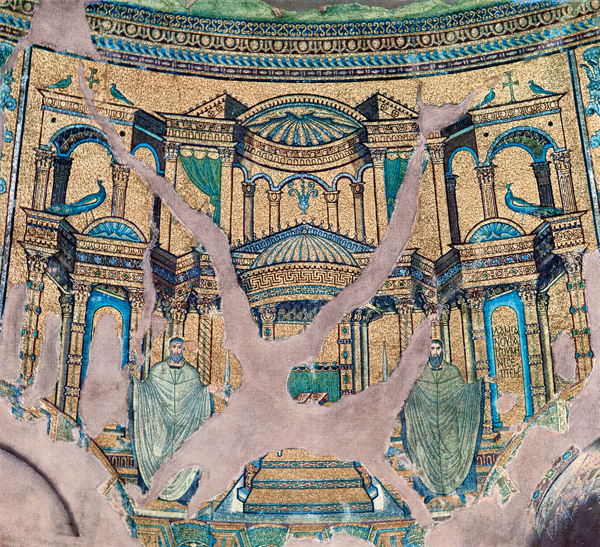
What activity is implied by the gestures of the two male figures in this mosaic?
Praying
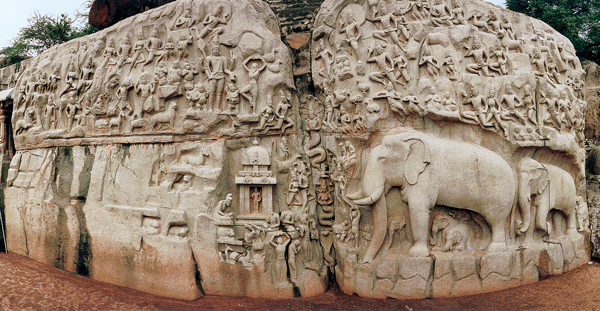
What was added to the central part of this relief to bring the story to life?
Water
Which phrase best describes the style of the Christ as Good Shepherd mosaic from the Mausoleum of Galla Placidia at Ravenna?
Deeply rooted in the classical tradition
Which of the following is NOT characteristic of Late Antique Christian art?
Shade and tonality
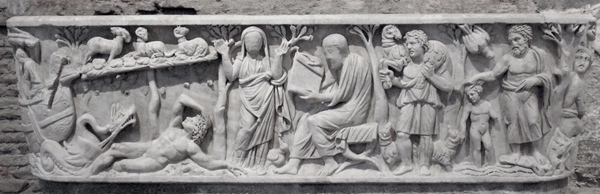
What is the subject of the scene that occupies the left third of the sarcophagus of Santa Maria Antiqua shown here?
Salvation of Jonah
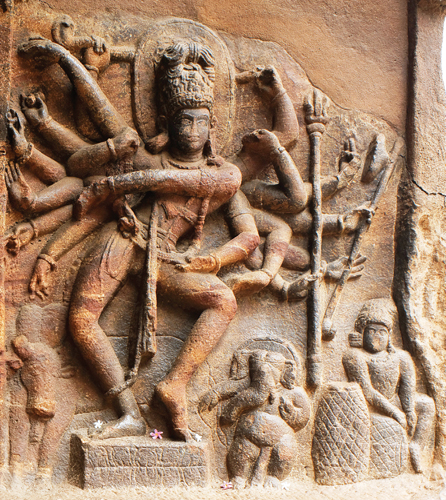
Which Hindu god is depicted in this relief at Badami?
Shiva
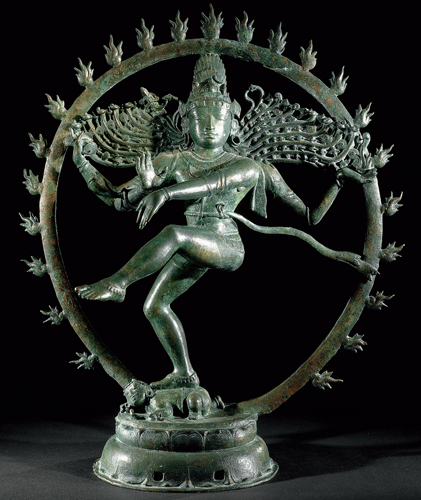
This bronze statuette represents which Hindu god?
Shiva Nataraja
What is the name of the mother of the Buddha, who gave birth to him through her side?
Maya
How did one recognize a Christian sarcophagus?
The iconography in its reliefs is predominantly Christian
Which of the following is NOT a site of early Hindu stone temples and sculptures?
Gal Vihara
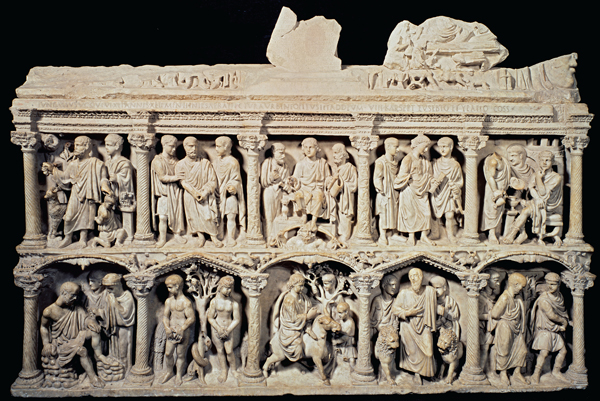
How is the figure of Jesus depicted here on the sarcophagus of Junius Bassus?
Like a Roman Emperor
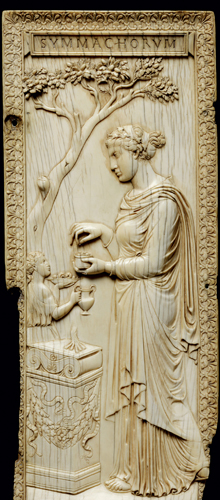
Which motif appearing on this ivory plaque ties the piece to the Christian tradition?
None
What is the correct term for the entrance porch of Old Saint Peter's in Rome?
Narthex
Which feature of the small seal discovered at Mohenjo-daro references the Indian practice of meditation?
Figure appears in a yogic gesture
Which of the following was among the innovative concepts of the Upanishads?
Belief in an almost endless sequence of rebirths
Why is the Christian community house in Dura-Europos such a small building?
Christians did not yet enjoy the patronage of the Roman state