Psych 111.2 L9 (Motivation)
 Call Kai
 Learn
Learn Practice Test
 Spaced Repetition
 Match
Match Flashcards
 Knowt Play
1/64

There's no tags or description
Looks like no tags are added yet.
Name | Mastery | Learn | Test | Matching | Spaced | Call with Kai | Chat |
|---|
No analytics yet
Send a link to your students to track their progress
65 Terms
Motivation
An inner state that energizes people toward the fulfillment of a goal (people may hide motives, be unconscious of them)
Multiple determinants of Behavior
Not just one thing, could be personality, situations, genetics, etc
Multiple determinants of Motivation
• Biological
• Physiological
• Psychological
• Cultural
• Environmental
• Situational
Instinct Theory
(Evolutionary perspective) Things in the environment are “releasers” which lead to innate, pre-programmed responses; pushed by hard-wired desires
Environmental releaser — triggers→ fixed response pattern
Ex. Stickleback will attack those that comes into his territory
Ex. Baby herring gull will peck at parents feet so that they will feed them
Ex. Baby feels touch on lips and starts sucking
Drive (drive reduction) Theory
The notion that physiological needs arouse tension that motivates action (about tension reduction — the function you want to achieve isn’t innate but the drive is)
Biological need -> tension -> do something to reduce tension
Pushed by internal tensions
Can’t explain actions to increase tension
Ex. Hungry so find food
Arousal Theory
Strive to maintain an optimal level of arousal and seek stimulation if bored, relaxation if excited.
Pushed by boredom/anxiety
Ex. Seek stimulation if bored, relaxation if anxious
Yerkes-Dodson Law
Psychological principle stating that task performance increases with arousal (such as stress or excitement), but only up to an optimal point
● Moderate arousal leads to optimal performance.
● People seek an optimum level of stimulation

Zuckerman’s sensation-seeking scale
Series of questions to determine your stimulation threshold (if you are a low or high sensation seeker
Incentive Theory
Rewards and punishments associated with different activities; extrinsic vs. intrinsic incentives
Pulled by rewards and punishments
Intrinsic Incentives
Activities that are an end unto themselves
Drives created by individual, things you like doing
E.g., eating, watching cartoons
Extrinsic Incentives
Activities with external rewards or punishments
E.g., working, doing chores
Maslow’s Hierarchy of Needs
Maslow’s pyramid of human needs that must first be satisfied before higher-level safety needs and then psychological needs become active (somewhat arbitrary; must usually satisfy bottom of pyramid before top, but can sometimes delay like hunger strikes)
Know each level

Psychological Needs
Need to satisfy hunger and thirst
Ex. water, air, food, sleep
Safety Needs
Need to feel that the world is organized and predictable; need to feel safe
Ex. shelter, safety, job, security, health, law & order
Belongingness and love needs
Need to love and be loved, to belong and be accepted; need to avoid loneliness and separation
Ex. Belongingness, love, affection, intimacy, family & friends, relationships
Esteem Needs
Need for self-esteem, achievement, competence, and independence; need for recognition and respect from others
Ex. Self-esteem, confidence, achievement, status, respect
Self-actualization Needs
Need to live up to our fullest and unique potential
Ex. Realizing personal potential, self-fulfillment, pursue talent, personal growth, peak experiences, creativity, etc.
Self-Transcendence Needs
Need to find meaning and identity beyond the self
Belonging
Basic psychological need and a primary drive (affiliation need and need for intimacy)
Inherently social creatures — cooperation is important to survival
Effect of Loneliness
Direct physiological impact on the body (can kill us)
More prone to illness, disease, and infections
Lack social support to cope with illness
Social pain travels same neural pathways as physical pain
Acetaminophen lessens social as well as physical pain
The effects of social isolation or rejection are as real as thirst, hunger, or pain.
Ostracism
Deliberate social exclusion of individuals or groups
Cannon and Washburn's (1912) Hunger Experiment
Washburn swallowed a balloon to record stomach contractions and pushed button to report hunger feelings
Hunger feelings came at peak of contractions (contractions lead to hunger, not vice-versa)
Proof stomach is not the only reason for hunger signaling
Hunger feelings came at peak of contractions (contractions lead to hunger, not vice-versa)
Even if stomachs are removed people get hungry
Amnesics will keep eating (because they forget they ate)
Monitoring Glucose Levels
Eating increases glucose levels in bloodstream
Insulin is a hormone that controls our glucose levels
The Hunger-Regulation Cycle
When blood glucose is low, people become hungry; Food raises glucose, reducing hunger and eating
Orexin
Secreted by hypothalamus; triggers hunger
Leptin
Secreted by fat cells; sends signals to the brain diminishing the reward of food
Obestatin
Secreted by stomach; sends “full” signals to brain
Ghrelin
Secreted by an empty stomach; sends hunger signals to the brain
Insulin
Secreted by pancreas; controls blood glucose
PPY
Secreted by digestive tract; sends “not hungry” signals to brain
Role of the Hypothalamus
Regulates body temperature, release of hormones, and monitors glucose levels; Two areas of the hypothalamus, the lateral and ventromedial areas, play a central role in the hunger drive, the lateral hypothalamus and the ventromedial hypothalamus
Lateral hypothalamus (LH)
“Hunger center”, if stimulate these cells, animal eats and eats. Starve to death if LH is destroyed

Ventromedial hypothalamus (VH)
“Satiation center”, stimulate this and animal will not eat. Destroy VH and animal eats and eats

The Fat Rat
Lesions of the ventromedial hypothalamus destroy the brain's primary "satiety center," leading to a well-documented syndrome of hyperphagia (excessive eating), severe obesity, and metabolic dysfunction
Body Weights of Twins
Identical twins closer in weight than fraternal twins; Very close even when raised apart
Genetic influence: Bodies have a certain set point, must eat/exercise a little/lot to break away from set point
Obesity
54% of Americans are overweight, 19% are obese. BMI=adjusts weight according to height
Why it’s Difficult to Lose Weight
Habits are hard to break; when you go on a diet, bodies adjust (reducing basal metabolic rate), so it reduces the number of calories you burn; different plans work for different people; sleep issues can disrupt hormones, leading to weight gain or making weight harder to lose, etc.
Anorexia nervosa
Eat way too little to maintain a healthy weight
– Mostly women (95%)
– About 1% of young women.
– Higher among college students.
– Partly genetic.
– Partly cultural (Western cultures, white women)
– Linked to low self-esteem
Warning signs of anorexia
Always wears layers, restricts foods, comments about being fat despite weight loss, has digestive issues, has food rituals, cooks without eating, doesn’t like to be seen eating, etc.
Effects of anorexia
Anemia, dizziness, coldness, sleep issues, menstrual issues, etc.
Bulimia
Binge and purge. Overeating followed by vomiting, laxatives, etc
– Also mostly women .
– 2% to 3% of women are affected (but one survey said 19% of female college students).
Role of the Media in eating disorders
Can tell impact of media because of certain trends:
Affects women more than men.
Affects Western cultures.
Increased over time.
Fallon and Rozin Study
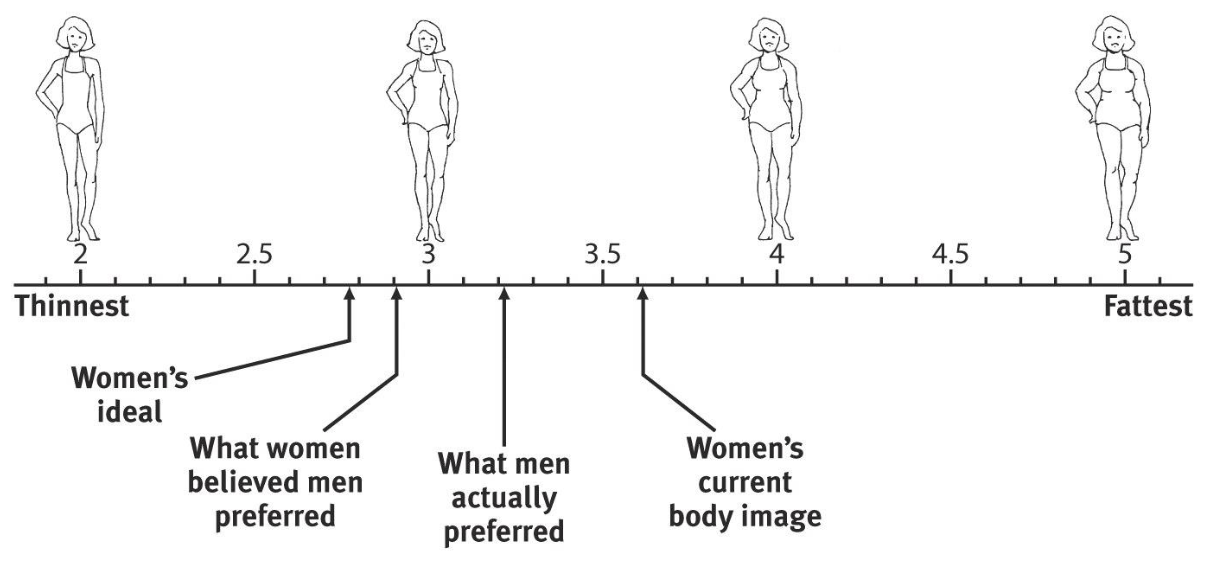
Study with 500 students at UPenn, had line figures of men and women and would ask questions like which is ideal, which is closest to body, which would others prefer
Women's ideal weight was less than real body weight, women thought men wanted them thinner than they actually preferred (men’s ideal and actual weight matched up more closely)
TV in Fiji (1995)
Introduced American satellite television in remote parts of Fiji, showing link between media and EDs
Bulimia rose 500% in 3 years
50% increase in description of themselves as “too fat”
30% more likely to be dieting
Physiological drive for sex
Primary drive (not necessarily a need) for survival of the species as important as hunger
Big role played by hormones: e.g., testosterone, estrogen.
And hypothalamus plays a role.
Testosterone
Testosterone maintains sex drive in adult males
Male Sex Drive Rat Studies
The medial preoptic area is involved in sex drives
Castration decreases sex drives
Can be revived with testosterone injections to medial preoptic area can restore drive
Estrogen implantations causes lordosis behavior in castrated male rats

Estrogens
In non-human female mammals, estrogen levels peak during ovulation, promoting sexual receptivity
Teen Sexuality
Rates of teen (age 15-17) intercourse dropped in between 1995-2008
Rate of contraception use increased
Teen pregnancy rate dropped (by over 10%)
Reasons for Teen Intercourse
Ordered most to least:
Peer pressure (higher for girls)
Curiosity (higher for boys)
“Everyone is doing it” (higher for girls)
Pressure from boys
Love (higher for girls)
Sexual gratification (higher for boys)
Belongingness Motives
Need for affiliation and intimacy
Need for Affiliation
Desire to establish and maintain social contacts
Need for Intimacy
Desire for close relationships characterized by open and intimate communication; involves self-disclosure
Self-disclosure
Sharing of intimate details about oneself to another person
Typically reciprocal
Women disclose more than men and elicit more than others
Grows over time
Determines how much you lie
Who People Lie To
People lie the most to strangers and acquaintances, then romantic partners, then friends/family, then spouses
Achievement Motivation
Secondary drive; Esteem motivation; A strong desire to accomplish difficult tasks, outperform others, and excel
Can include a strong desire for power/influence over other people
Need for Power
Esteem Motivation; A strong desire to acquire prestige and influence over other people
Types of Motivation at Work
Reward-Based Motivation
Intrinsic Motivation
Equity Motivation
Reward-Based Motivation
Companies use incentive programs:
Individualized incentives, time off or extra pay
Small-group incentive plans, offering bonuses to work unit members for reaching goals
Profit-sharing
Recognition Programs (“Employee of the Month”)
Pay-for-knowledge plans
Payment and Intrinsic Motivation
College students had 3 sessions with puzzles, some paid during second session, some were not, time spent puzzling during breaks was covertly recorded
After payment productivity on break went up dramatically, then stopped getting paid would not continue puzzling on the break
Unpaid group didn’t pass peak of paid group, but stayed higher once paid groups’ productivity fell
If people are paid for a task they already enjoy, they may lose interest in it
Motivation and Perceptions of Fairness (Monkeys)
Monkeys: feed side by side, one monkey gets cucumber, the other gets a grape
Monkey is initially satisfied with cucumber until it sees the other monkey got the grape which aggravates cucumber monkey, throws it
Cause of Lack of Motivation
Students see little value in the course or its content.
Students do not believe that their efforts will improve their performance.
Students are demotivated by the structure and allocation of rewards.
Students do not perceive the classroom climate as supportive.
Students have other priorities that compete for their time and attention
Achievement Goal Theory (Growth Mindset)
Operating under a growth (not fixed) mindset:
Growth: Abilities and intelligence are malleable traits and can be improved
More motivating for students - try harder
Fixed: Abilities and intelligence are innate and cannot change
Yeager & Dweck (2012)
Students were taught growth mindset or fixed
Growth: had higher grades, lower aggression/stress, more challenging courses