Chapter 9: Urinary System
 Call Kai
 Learn
 Practice Test
 Spaced Repetition
 Match
 Flashcards
 Knowt Play
1/77

There's no tags or description
Looks like no tags are added yet.
78 Terms
Dietetics
The science of how food and nutrition affect our health
Dieticians
Providers that specialize in food and nutrition. Their goal is to prevent and improve health through nutrition and patient education
Registered Dietician (RD)
Asses nutritional needs, diet restrictions and current health, develops and implements dietary care plans, and educates patients
Dietetic Technician, Registered (DRT)
Conducts screens, gathers data, and preforms tasks to assist the Registers Dietician to provide medical nutrition therapy
Urinary System
Responsible for maintaining a stable internal environment for the body. Removes waste products, adjusts water and electrolyte levels, and maintains the correct pH; These waste materials result in the production and excretion of urine from the body
kidneys
urethra
ureters
urinary bladder
The primary structures / organs that compromise the urinary system:
Genitourinary System (GU)
Main function is to filter and remove waste products from the blood; Organs of the urinary system and female or male sexual organs; Another name for the urinary system
Filtration
The genitourinary system (GU) is similar to a ____ plant.
Metabolic
All the body’s ______ processes result in the production of waste products.
Toxic
Waste products are a natural part of life but quickly become _____ if they are allowed to build up in the blood.
Uremia
Excess of urea and other nitrogenous waste in blood
Tubules
Waste products in the body are removed through a very complicated system of blood vessels and kidney ________.
Nephrons
Functional or working unit that kidney that filters blood and produces urine; More than 1 million in adult kidney; Each consists of renal corpuscle and renal tubules; Makes up each kidney

Ureters
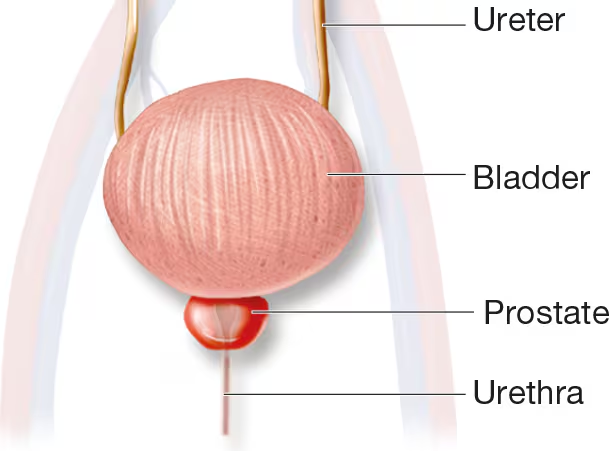
Organs (2) in urinary system that transport urine drained from the kidney to the urinary bladder; Narrow tubes (measuring less than ¼-inch wide and 10–12 inches long that extend from the renal pelvis to the urinary bladder) that leave the kidneys at the hilum and lead to the bladder; narrow tubes; Mucous membrane lined

Urinary Bladder
Organ in urinary system that stores urine; An elastic muscular sac that lies in the base of the pelvis just behind the pubic symphysis; Receives urine directly from ureters, stores it, and excretes it by urination through the urethra
Quart
The body is constantly producing urine, and the bladder can collect up to one ______ of this liquid during the night. Generally, an adult bladder signals the urge to void when it contains 300–400 mL of urine.
Urethra
Tubular canal that carries the flow of urine from urinary bladder to outside of body; Mucous membrane lined (One of the reasons that bladder infections may spread up the urinary tract); In male it is also used by reproductive system to release semen

Two (2)
The body has _____ kidneys located in the lumbar region of the back above the waist, with one on either side of the vertebral column. They are not inside the peritoneal sac, a location referred to as retroperitoneal.
Retroperitoneal
Pertaining to behind peritoneum; Describes position of kidneys, which is outside of peritoneal sac alongside spine
Concave
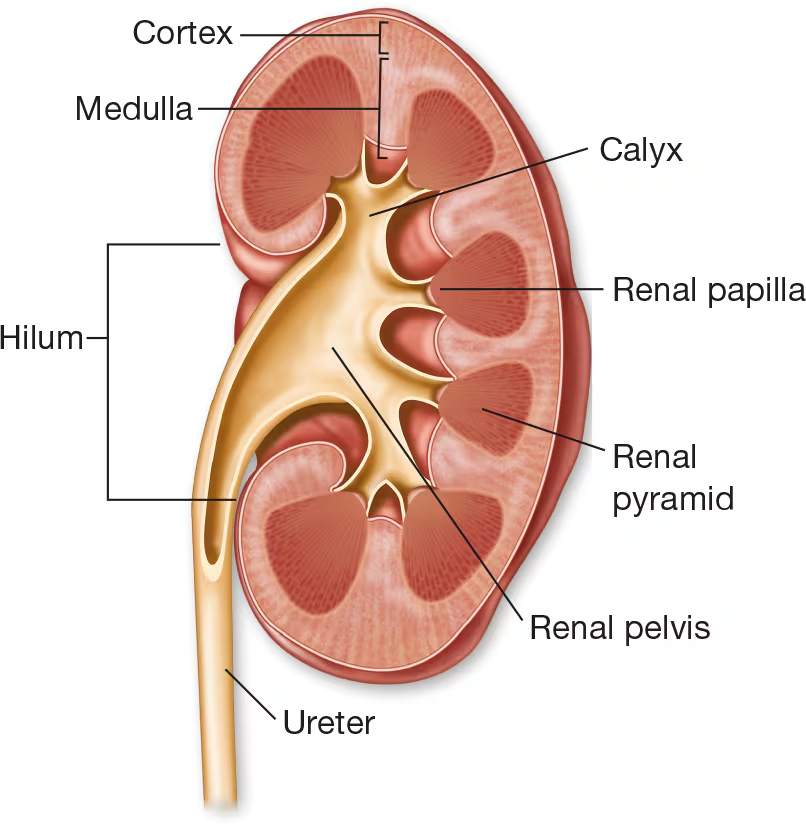
Each kidney has a _____ or indented area on the edge toward the center that gives the kidney its bean shape. The center of this concave area is called the hilum.
Hilum
Controlled entry/exit point of an organ such as kidney or lung; Where the renal artery enters the renal vein leaves the kidney

Renal Artery
Artery that originates from abdominal aorta and carries blood to nephrons of kidney; Delivers blood that is full of waste to the kidney
Renal Vein
Carries cleansed blood away from kidneys for general circulation
Cortex
Outer layer of organ; Within endocrine system, refers to outer layer of adrenal glands; Within urinary system, refers to outer layer of kidney
Medulla
Middle area of an organ; In endocrine system refers to adrenal medulla; In urinary system, refers to inner portion of kidney; Contains a dozen or so triangular-shaped areas called the renal pyramids
Renal Pyramids
Triangular-shaped region of renal medulla. The tip of each _____ points inward toward the hilum
Calyx (plural is Calyces)
Duct that connects renal papilla to renal pelvis; Urine flows from collecting tubule through calyx and into renal pelvis
Renal Papilla
Tip of renal pyramid; Each pyramid opens into a calyx
Renal Pelvis
Large collecting site for urine within kidney; Collects urine from each calyx; Urine leaves renal pelvis via ureter
Formed
The calyces and ultimately the renal pelvis collect urine as it is ______.
Arises
The ureter for each kidney _____ from the renal pelvis.
Fist
Each kidney weighs four to six ounces, is two to three inches wide and approximately one inch thick, and is about the size of your ______.
Working
In most people, the left kidney is slightly higher and larger than the right kidney. Functioning kidneys are necessary for life, but it is possible to live with only one ______ kidney.
Renal Corpuscle
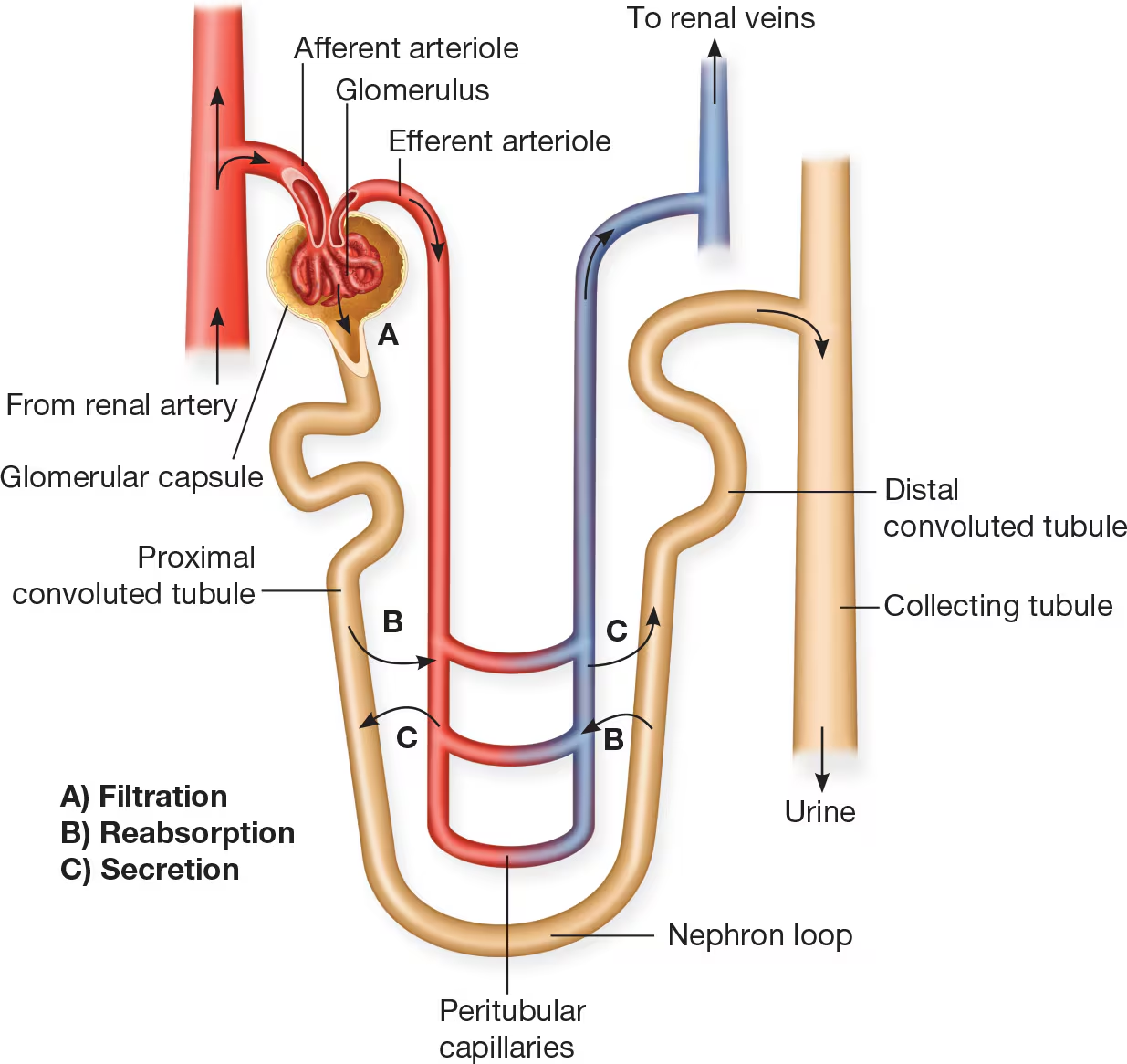
Part of a nephron; Bowman capsule and contains the glomerulus; Afferent arteriole carries blood to glomerulus and efferent arteriole carries blood away from glomerulus; Filtration stage of urine production occurs in _______ as wastes are filtered from blood in glomerulus and enter Bowman capsule
Renal Tubule
Network of tubes found in a nephron; Where reabsorption and secretion stages of urine production occur; As glomerular filtrate passes through, most of water and some of dissolved substances, such as amino acids and electrolytes, are reabsorbed; At same time, substances that are too large to filter into Bowman capsule, such as urea, are secreted directly from bloodstream into _______; Filtrate that reaches collecting tubule becomes urine
Glomerular Capsule
Part of renal corpuscle; Double-walled cuplike structure that encircles glomerulus; Within filtration stage of urine production, waste products filtered from blood enter _______ as glomerular filtrate; Also called Bowman capsule
Glomerulus
Ball of capillaries encased by glomerular capsule; Within filtration stage of urine production, wastes filtered from blood leave glomerulus capillaries and enter Bowman capsule
Afferent Arteriole
Arteriole that carries blood into glomerulus
Efferent Arteriole
Arteriole that carries blood away from glomerulus
Afferent
Term: Moving Toward
Efferent
Term: Moving Away From
Proximal Convoluted Tubule
Nephron Loop (Loop of Henle)
Distal Convoluted Tubule
Collecting Tubule
The four (4) divided sections of the renal tubule:
Smooth
The urinary bladder is composed of three layers of ______ muscle tissue lined with mucous membrane containing rugae that allow it to stretch.
Rugae
Prominent folds in mucosa of stomach; Smooth out and almost disappear allowing stomach to expand when full of food; Also found in urinary bladder
Urination
Release of urine from urinary bladder; Also called micturition or voiding
Internal Sphincter
Ring of involuntary muscle that keeps urine within bladder; Prevents the bladder from emptying at the wrong time
Involuntary
______ muscle action causes the bladder to contract and the internal sphincter to relax.
Voluntary
______ muscle action controls the external sphincter, which opens on demand to allow the intentional emptying of the bladder.
External Sphincter
Ring of voluntary muscle that controls emptying of urine from bladder; The act of controlling the emptying of urine is developed sometime after a child is two years of age
Urinary Meatus
External opening of urethra through which urine passes out of the body
1-2 inches long
Functions only as an outlet for urine
Located in the front of the vagina
Urethra in Women:

8 inches long
An outlet for urine
Passageway for semen to leave the body
Urethra in Men:

Homeostasis
Steady state or state of balance within body; Kidneys responsible for maintaining; Continually adjust the chemical conditions in the body, allowing humans to survive
Balance
Because of its interaction with the bloodstream and its ability to excrete substances from the body, the urinary system maintains the body’s proper _____ of water (H2O) and chemicals.
Excrete
If the body is low on water, the kidneys conserve it or, in the opposite case, if there is excess water in the body, the kidneys _____ the excess.
Regulate
In addition to water, the kidneys _____ the level of electrolytes—small biologically important molecules such as sodium (Na+), potassium (K+), chloride (cl−), and bicarbonate (HCO3−).
pH
Kidneys play an important role in maintaining the correct _____ range within the body, making sure it does not become too acidic or too alkaline. The kidneys accomplish these important tasks through the production of urine.
Desirable
As wastes and unnecessary substances are removed from the bloodstream by the nephrons, many _____ molecules are also removed initially.
Waste products are eliminated from the body, but other substances such as water, electrolytes, and nutrients must be _____ to the bloodstream.
Returned
Urine, in its final form ready for ______ from the body, is the ultimate product of the urine production process.
Elimination
Filtration
Reabsorption
Secretion
Three (3) stages of urine production:
Filtration
First stage of urine production during which waste particles (occurs in the renal corpuscle) are filtered from blood; Pressure of blood flowing through the glomerulus forces material out of the bloodstream, through the wall of the glomerular capsule, and into the renal tubules. This fluid in the tubules is called the glomerular filtrate
Glomerular Filtrate
Product of filtration stage of urine production; water, electrolytes, nutrients, wastes, and toxins that are filtered from blood passing through Glomerulus; Filtrate enters Bowman capsule
Reabsorption
Second phase of urine production; Substances needed by body are reabsorbed as filtrate passes through kidney tubules; Passes through the four sections of the tubule; Most of the water and much of the electrolytes and nutrients are reabsorbed into the peritubular capillaries; They can then reenter the circulating blood
Peritubular Capillaries
Capillary bed surrounding renal tubules
Secretion
Third phase of urine production; Additional waste products are added to filtrate as it passes through kidney tubules; Occurs when the special cells of the renal tubules secrete ammonia, uric acid, and other waste substances directly into the renal tubule; Urine formation is now finished; It passes into the collecting tubules, renal papilla, calyx, renal pelvis, and ultimately into the ureter
Dilute
Normal urine color may vary from almost clear, pale yellow, to deep gold, depending on how _____ it is.
As urine is being produced and collecting in the bladder, it is ______. However, as it passes through the urethra to the outside, it may become contaminated by bacteria.
Sterile
Although urine is ____ water, it also contains many dissolved substances, such as electrolytes, toxins, and nitrogenous wastes, the by-products of protein metabolism.
95%
Nitrogenous Wastes
Waste products that contain nitrogen; Products, such as ammonia and urea, are produced during protein metabolism
Urea
Waste product of protein metabolism; Diffuses through tissues in lymph and is returned to circulatory system for transport to kidneys
Approximately 95% of the nitrogenous waste is in the ____ of urea.
Form
By producing urea, the body prevents the waste nitrogen from becoming _____, which is highly toxic to cells. At times the urine also contains substances that should not be there, such as glucose, blood, or albumin, a protein that should remain in the blood.
Ammonia
Albumin
Protein normally found circulating in bloodstream; It is abnormal for albumin to be in urine
Urinalysis (U/A, UA)
Laboratory test consisting of physical, chemical, and microscopic examination of urine; Gives medical personnel important information regarding disease processes occurring in a patient.
Normally, during a 24-hour period the output of urine will be 1,000–2,000 mL, depending on the amount of fluid consumed and the general ____ of the person
Health
Normal urine is ____ because this is one way the body disposes of excess acids.
Acidic
Specific Gravity (SG, sg. gr.)
Characteristic of urine that indicates amount of dissolved substances in urine; Urine varies from 1.001 to 1.030; Highly concentrated urine has a higher _____, while the ____ of very dilute urine is close to that of water