Fish biology quiz 4
 Call Kai
 Learn
 Practice Test
 Spaced Repetition
 Match
 Flashcards
 Knowt Play
1/54

There's no tags or description
Looks like no tags are added yet.
Name | Mastery | Learn | Test | Matching | Spaced | Call with Kai | Chat |
|---|
No analytics yet
Send a link to your students to track their progress
55 Terms
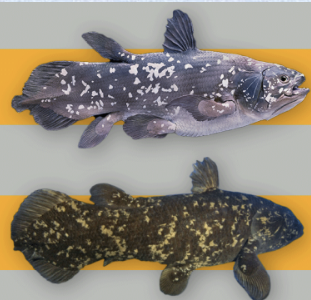
Hollow oil filled cadual neural and hemal spine
intracranial joint gape extension
fat-filled swimbladder
Coelacanthiformes 1 family es,

slender paired fin
internal nostrils
spiral value
Ceratodontiformes- 3 familys
extinct walking devonian lung fish
tetrapod evolution

Compressiform
compressed

Depressiform
Depressed

anguilliform
snake like

Fusiform
Like tuna
what are sagittal body shape?
fusiform
what are transverse body shape?
compressed and depressed
caudal fin shapes
Heterocercal(sharks), homocercal(teleost fish)
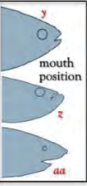
Mouth position
terminal (y) superior (z) and subterminal/inferior (aa)

Head features
laternal line, nare(nostril), spircales, gill slits, operclulm and preperculum

Morphometrics
finlets, the tiny fins on the back
caudal keel, the little lines by the caudal fin
standard length is mouth to where the body ends right before the fin
fork length is mouth to where the fin forks
total length is mouth to the end of the fish

Musculature
Myomere-resulting muscle block
Myotome-developing muscle segment
Bony fish skeleton
Neural arch- upper arch of the spine
Haemal arch- lower arch of the spine
neurocranium-upper part where the eyes are
branchiocranium (including gill arches) (dentary, angularr, maxilla, articular, suspensorium, opercular series)

Skull, 3 parts for chondricthyes, 5 for osteichthyes
Chondricthyes
palatoquadrate- upper jaw
chondrocranium- upper part of the skull
meckels cartilage-lower jaw
Osteichtyes
Pre maxillary- upper lip
Dentary bone- lower lip
maxillary- bone that conntects the lips
peropercle- frizzy part
opercle-right side of peropercle

what are the 4 components of swimming
1 skull
2 vertebrae
3muscles
4 fins
Reactive force has 2 vector components
thrust: swimming direction
lift: 90 degrees to thrust
lateral life forces what to cancel
tail stroke
resultant force is what?
thrust- drag propels the fish foward
Pressure does what to a fuisform body for drag?
displacing water its minimized

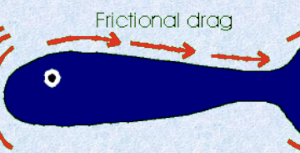
Friction does what to a fish for drag?
water flows along the side which minimized by scales and slime
what does vortex do to minimize drag?
along the sides and tail minimizing steamlined body and fin

Undulation
wave passes down fin
Oscillation
Fins act as paddles
Moments of rotation in maneuverability
yaw: right/left
pitch: up/down
roll: axial spin
what does a neutral buoyancy do?
saves energy and free fins to enchance maneuverablilty
Physoclistous
No connection swim bladder and esophagus
Physostomous
swimbladder and esophagus connected
Ancestral living bony fish have what swimbladder
Physotomous

Phyoclistous functions
gas enters the swimbladder at gas gland (ventral) and leaves at oval (dorsal)

Physoclistous gas gland function
1 giant secretoryh cells release lactate into capillaries
2 acidic blood causes oxyhemoglobin (hbO2) to relase oxygen (o2)
3 Counter-current gas exchange in capiliaries concentrate po2 until oxygen diffuses into swimbladder against pressure
N2 is slowly carried passively into swimbladder eventually replacing o2 in fish lving at stable depths
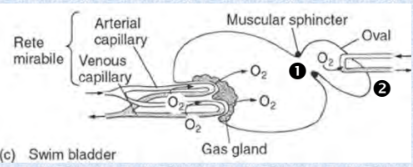
Physoclistous swimbladder
1 muscular spincter reazes allowing gas to flow into the oval cavity
2 capillaries lining the oval absorb oxygen from the swimbladder adjusting its volume to shallow depths
Barotrauma
fish is brought to surface too fast for the oval to reduce swimbladder volume
Sharks buoyancy
large oil-filled liver
caudal fin produces upwards thrust
Swimming speeds
Cruising or sustained speed: aerobic red muscle: >200min: migration
Prolonged Speed: aerobic red muscle: maintained for ≤ 200 min: ends in fatigue
Burst Speed: anaerobic white muscle: maintained for < 20 sec: attack & defense
Beamish 1978
Fastest burst speed
Black marlin-82
mako for sharks
tunas
Role of mauthner cell
acoustic stimluls on one side of the fish fires muscles to rapid accelerate to escape and attack
Swimming muscle (myotome) type
red and white
red
low percent of swimming muscle
richly vascularized
high myoglobin, lipids, mitochondria
aerobic: sustained swimming
White
high percent of swimming muscle
poorly vascularized
low myoglobin, lipids, mitochondria
Anaerobic: short bursts
salmon have pink muscles, they have both muscles
only fish for full body endothermy
opah- have counter-current heat exchangers at gills
Counter-current heat exchange
rete mirabile in red swimming muscles
warm blood in veins transfer heat to blood in arteries
Branchial system
Mouth → buccal cavity → across the gills → opercular cavity → out through the opening beneath the operculum.
Branchial pump uses
branchiocranium-jaws and gill-supporting structures
Branchial pump
Mouth opens
mouth and gill-cover cavities expand, lowering pressure
water enters through the mouth while the outer gill flaps remain closed
mouth closes
cavities contract, raising pressure
water is pushed across the gills
outer gill flaps open
water exits behind the gill covers

Counter-current gas exchange
Water and blood flow in opposite directions
water always has more oxygen available than the blood beside it
oxygen keeps moving into the blood
the fish extracts oxygen efficiently.
Heart has 4 section and is located near what
the gills and pumps deoxygenated blood
sinus venosus: receiving chambers for inflowing vessels
atrium: initial acceleration of blood
ventricle: primary acceleration of blood
bulbus arteriosus: even flows rate of blood emerging from heart
Alternative respiratory modes
gill and gut- fish absorbs oxygen from gills and gut
lungs- fish have lungs that absorb oxygen
mouth- fish have vascular folds in the mouth that absorbs oxygen
Homoeostatsis
= maintenance and regulation of a
stable internal environment
(relative to the external environment):
•gases (O2, CO2): respiration
•temperature: thermoregulation
•immunity: immunoregulation
•solutes: osmoregulation
Thermoregulation
metabolic processes in fishes increase with temp, peak and then drop-off
Immunorgulation
Innate immunity organ- scales, skin, mouth,gills, esophagus, intestine, sleen, head kidnet, thymus
adaptive immunity- T lymphocyte from thymus, B lymphocyte from head kidney and immuniglobulin in mucus
Osmoregulation
Osmosis = water
passes through a semi-permeable membrane from a
less concentrated (hypoosmotic) to a more
concentrated (hyperosmotic) solution (and stops
when both sides of the membrane have equal
isoosmotic concentrations)
Osmolality
= concentration of solute
molecules per kilogram of water,
expressed as milliosmoles / kilogram
(mOsm/kg)
Osmoregulation marine vs freshwater
marine fish
tend to desiccate:
- drink much
- excrete concentrated
urine
- actively excrete
excess ions at gills:
chloride cells
freshwater fish
tend to bloat:
- drink little
- excrete dilute urine
- actively uptake ions
at gills:
chloride cells
Osmoregulation
Classification of fishes based on acclimation salinity
Stenohaline: tolerates a narrow salinity range(fresh or sea)
Euryhaline: tolerates a broad salinity range( estuarine or diadromous)
Osmoregulation
The tissues of a fish can have greater
(hyperosmotic), less (hypoosmotic), or
the same (isoosmotic) osmolality as
the aquatic environment, OR the
environment can have greater, less, or
the same osmolality as the fish (i.e.,
these are relative states)es).
Osmolality = concentration of