Ochem OAT
 Call Kai
 Learn
 Practice Test
 Spaced Repetition
 Match
 Flashcards
 Knowt Play
1/147

There's no tags or description
Looks like no tags are added yet.
Name | Mastery | Learn | Test | Matching | Spaced | Call with Kai | Chat |
|---|
No analytics yet
Send a link to your students to track their progress
148 Terms
Infrared Spectroscopy
Commonly used to identify the functional groups present in a molecule
How does infrared spectroscopy work?
Every bond has a unique vibration frequency in the infrared region of the EM spectrum. Bonds absorb radiation (in the form of light) that has the same frequency as their frequency of vibration. However, for vibrations to occur for a given bond, it must have a net dipole moment. Transmittance levels are used to determine unique functional groups
_______________ bonds such as in O2 and N2, as well as the carbon-carbon bonds in C2H2 and C2H4 do not have a dipole moment and therefore do not show up on an IR spectrum
Symmetrical
On an IR spectrum, which axis is the wavenumber on?
X-axis
On an IR spectrum, which axis is the percent transmittance on?
Y-axis
What does it mean if the transmittance is very low?
It means that light did not make it to the detector and was absorbed by the sample
What is the absorption frequency and the appearance of -OH on an IR spectrum?
Absorption Frequency: 3200-3500
Appearance: Large, broad peak
my 1st paycheck was a BROAD range between 3000-3500
What is the absorption frequency and the appearance of NH on an IR spectrum?
Absorption Frequency: 3300
Appearance: Sharp peak (secondary amine has 1 peak while a primary amine has 2 peaks)
3300 wasn’t good enough so i said “NaH” sharply
What is the absorption frequency and the appearance of -COOH on an IR spectrum?
Absorption Frequency: 2500-3500
Appearance: Broad jagged peak
What is the absorption frequency and the appearance of a nitrile (C triple bond N) on an IR spectrum?
Absorption Frequency: 2200-2250
Appearance: Medium peak
What is the absorption frequency and the appearance of C=O and C=N on an IR spectrum?
Absorption Frequency: 1700-1750
Appearance: mid-sized
COcaiNe is MID
What is the absorption frequency and the appearance of aromatic (C=C) on an IR spectrum?
Absorption Frequency: 1450-1600
Appearance: Medium peak
NMR Spectroscopy
Used to determine the molecular structure of a compound
What are the two most important types of NMR spectroscopy?
1. H NMR (proton NMR)
2. C NMR (carbon NMR)
When are protons equivalent?
When they exsist in the same chemical environment
When are protons non-equivalent?
When they exist in different chemical environment
In H NMR spectroscopy, do equivalent or non-equivalent protons in a molecule generate a distinct signal?
Non-equivalent protons generate a distict signal.
What can make protons chemically equivalent even if they are bonded to different carbon atoms?
Internal lines of symmetry
Will a proton with less electron density around it be considered de-shielded or shielded?
De-shielded (it will also be downfield/to the left on an NMR spectrum)
Why are protons next to electronegative atoms considered de-shielded?
Because the electronegative atom will withdraw electron density
What does the multiplicity of a proton's H NMR signal indicate?
The number of non-equivalent neighboring protons
What rule can be used to predict the multiplicity?
the n+1 rule (n = # of nonequivalent neighboring protons)
What is integration for a NMR signal?
A number that is above each NMR signal that indicates the relative number of protons giving rise to each signal
In C NMR spectroscopy, do chemically equivalent or nonequivalent carbons generate a distinct signal?
Nonequivalent carbons generate a distict signal
Are carbons near electronegative atoms considered deshielded or shielded?
Deshielded
A compound's molecular formula can be used to determine how many __________________ it has
Degrees of unsaturation
A fully saturated hydrocarbon contains the maximum number of ___________ atoms with the molecular formula of ____________
hydrogens; CnH2n+2
Each degree of unsaturation indicates ___ less hydrogens are present compared to the maximum
2
A pi bond or ring will cause ______ degree(s) of unsaturation. Why?
One because they both reduce the number of hydrogen atoms in a compound by 2
What can be determined by finding the degree of unsaturation?
If there is a presence of pi bond or ring
Formula for degree of unsaturation
Degrees of Unsaturation = (2C + 2 + N - X - H)/2
Mass Spectroscopy
Used to determine the mass of a compound
What happens to the sample before mass spectroscopy?
The sample is vaporized, ionized, and smashed into molecular fragments and then sent through a long tube where they are deflected to varying degrees by a magnetic field and separated according to their mass to charge (m/z) ratio
What does a charge of +1 mean in correlation with mass spectroscopy?
it means that its mass to charge ratio is represented of the fragment's mass
What is the molecular ion peak?
The tallest peak in the rightmost section of the spectrum that represents the compound's molecular mass.
Ex: the molecular ion peak of acetone is generated by acetone that is ionized but intact. The peak is located at 58 because that is the molecular mass of acetone.
What is the base peak?
The tallest peak in the entire spectrum which corresponds to the most stable molecular fragment (designated as 100% intensity, and the intensities of all other peaks are reported relative to this value)
What is UV-Vis spectroscopy used for?
To analyze molecules with conjugated pi bonds (which absorb light in the UV or visible light spectrum
What does higher absorption mean?
That the molecule has more conjugated pi bonds
How does conjugation stabilize a molecule?
By reducing its overall energy
Molecules with _________ ___________ will absorb longer wavelengths of light
greater conjugation
pigment beta-carotene (a highly conjugated molecule) has a maximum absorption of _______________
400- 500nm
What is the apparatus used for liquid-liquid extraction?
Separatory funnel
How does a separatory funnel work?
The funnel is filled with two solvents that are immiscible (they cannot mix). In most cases, one solvent will be hydrophobic and will form the organic layer while the other will be hydrophilic and form the aqueous layer. The compounds between layers will be shaken within the funnel to allow migration of the compounds between layers and then they are allowed to separate again. The stopcock on the funnel is opened to drain the bottom layer of solvent. The top layer is poured out through the top of the separatory funnel.
What are the 3 common applications of liquid-liquid extraction?
1. Used to separate two neutral compounds with different polarities
2. Used to separate two compounds based on acidity
3. Used to separate two compounds based on basicity
Thin Layer Chromatography
Separates compounds based on differing polarity/intermolecular forces
Is thin layer chromatography used for small or large samples?
Small
How does the solvent move up the TLC plate?
Capillary action
Do non-polar or polar compounds move up the TLC plate faster?
Non-polar
Why do non-polar compounds move up the TLC plate faster?
Because the solid absorbent on the TLC plate is polar (the more polar the compound, the more it will interact with the silica on the TLC plate and the slower it will travel)
Hydrogen bond donors move especially _______ because they interact with the silica gel
slow
What is the retention factor (Rf)
it is equal to the distance the compound traveled divided by the distance the solvent traveled
The compound that moves the furthest in TLC (the least polar compound) will have the __________ retention factor?
largest
The Rf value is inversely proportional to the _____________________
polarity
Column chromatography
Uses the same principles as TLC but functions to separate components in a mixture rather than monitor a reaction over time
Less polar compinds with weaker IMFs come out of the column _______
First
Gas-liquid chromatography
Used to determine the relative abundance of compounds in a liquid mixture
Components with ________ boiling points travel slower. Why?
higher boiling points move slower because they are more likely to condense in the column
What is retention time?
The time it took a compound to pass through the column
A compound with a higher boiling point will have a _______ retention time
longer
Distillation
A technique used to separate two miscible liquids with differing boiling points
Recrystallization
A method used for purifying solids
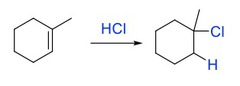
HBr (or HCl, HI)
to alkyne, alkene
add Br and H
Markovnikov, rearrangements possible
Alkyne + 1 eq HBr = Alkene with Br at most substituted
+ 2nd eq HBr = Alkane with 2 Br at most substituted
hydrohalogenation
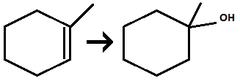
H3O+
to alkene
add -OH and H
markovnikov, rearrangements possible
hydration
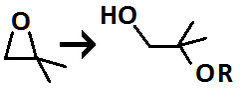
H+, ROH
to epoxide
add -OR and H
markovnikov, rearrangements possible
addition of alcohol
Br2 or Cl2/
CCl4
to alkyne, alkene
anti-addition of 2 Br
Alkyne + 1 eq Br2 = Alkene with Br at each side,
+ 2nd eq Br2 = Alkane with 2 Br at each side
bromination
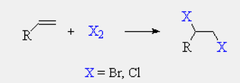
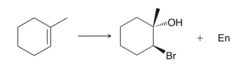
Br2 or Cl2/
H2O
to alkene
add Br and OH- (Halogen on least substituted)
markovnikov, anti-addition
bromination in H2O
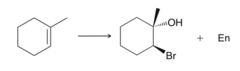
Br2 or Cl2/
ROH
to alkene
add Br and -OR (Halogen on least substituted)
markovnikov, anti addition
bromination in alcohol
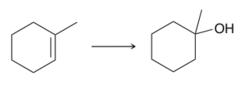
1) Hg(OAc)2, H2O
2) NaBH4
to alkene
Add H and -OH
markov, anti-addition
Oxymercuration/demurcuration
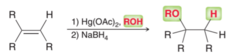
1) Hg(OAc)2, ROH
2) NaBH4
to alkene
add H and -OR
markov, anti-addition
alkoxymercuration-demurcuration
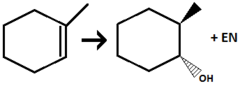
1) BH3 • THF
2) H2O2, -OH, H2O
to alkene
add H and -OH
anti-markov, syn-addition
hydroboration-oxidation
H2,
Pd/C or Pt/C or Ni
to alkyne, alkene
adds 2 H, syn addition
Alkene → Alkane
Alkyne → Alkane
Catalytic Hydrogenation/reduction

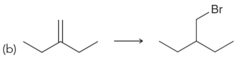
HBr/
ROOR (peroxide)
to alkene
adds H• and Br•
anti-markov
hydrobromination with peroxide
MCPBA or RCO3H
to alkene
adds epoxide ring between double bond
epoxidation

1. RCO3H (MCPBA)
2. H3O+
to alkene
adds 2 -OH
anti-addition
anti-hydroxylation
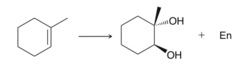
1) OsO4
2) H2O2
to alkene
alkane to double alcohol
syn-addition
syn-hydroxylation

KMnO4 (cold, dilute)/
-OH
to alkyne, alkene
alkene -> double alcohol
(syn-addition)
alkyne -> double ketone
syn-hydroxylation

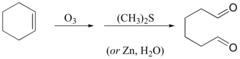
1. O3
2. (CH3)2S
or
2. Zn/H2O
to alkene
cleaves alkene =
1º -> aldehyde
2º -> ketone
ozonolysis under reducing conditions
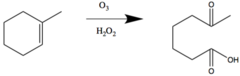
1) O3
2) H2O2, NaOH, H2O
to alkyne, alkene
cleaves double bond into ketone (2º substituted) and carboxylic acid (1º)
alkyne -> 2 carboxylic acids
terminal alkyne -> 1 carboxylic acid and 1 CO2
ozonolysis under oxidizing conditions
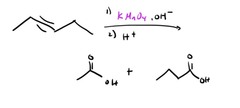
KMnO4 (hot, concentrated)/
H3O+
to alkyne, alkene
cleaves alkene into ketone (2º substituted) and carboxylic acid (1º substituted)
cleaves alkyne into 2 carboxylic acids
(ozonolysis under oxidizing conditions)
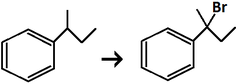
Br2, light or heat
to alkene
adds Br anywhere there's an available H
favors 3º cation, high selectivity
free radical bromination
Cl2, light or heat
to alkene
adds Cl where there's an available H
selective for what is most available
free radical chlorination

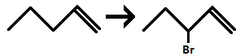
NBS
light or heat or ROOR (peroxide)
to alkene
adds Br to allylic/benzylic carbon, keeps alkene
allylic/benzylic bromination
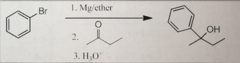
1) Mg/ether
2) ethyl methyl ketone
3) H3O+
to phenyl bromine
Br replaced with ketone at most substituted (ketone is reduced to alcohol)
nucleophilic addition of a grignard reagent to a ketone
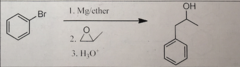
1) Mg/ether
2) epoxide
3) H3O+
to phenyl bromide
Br replaced with epoxide at least substituted (epoxide ring opens to most substituted and alcohol forms)
nucleophilic addition of a grignard reagent to an epoxide
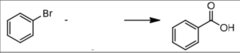
1) Mg/ether
2) CO2
3) H3O+
to phenyl bromide
Br replaced with carboxylic acid
nucleophilic addition of a grignard reagent to CO2
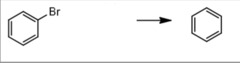
1) Mg/ether
2) H2O
grignards are protonated in protic solutions
protonation of a grignard reagent
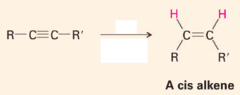
H2,
Lindlar's catalyst
to alkyne
alkyne --> cis (Z) alkene
reduction to cis-alkene
Na or Li,
NH3 (l)
to alkyne
alkyne --> trans (E) alkene
reduction to trans-alkene
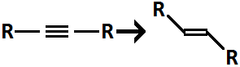
H2SO4
or
1) Sia2BH THF
2) H2O2, OH-, H2O
to alkyne
reduces internal alkyne to ketone
ketone forms on either side of the bond
enol intermediate tautomerizes to ketone

HgSO4/
H2SO4
to alkyne
reduces terminal alkyne to ketone
markov
enol intermediate tautomerizes to ketone
hydration
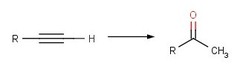
1) Sia2BH THF
2) H2O2, OH-, H2O
to alkyne
reduces terminal alkyne to aldehyde
anti-markov
enol intermediate tautomerizes to ketone
hydration

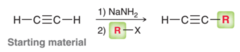
1. NaNH2,
2. R-X
to alkyne
deprotonates terminal alkynes, -R attaches where halide was
keeps alkene structure
(addition of an acetylide ion)
1. NaNH2,
2. ketone, H2O
to alkyne
deprotonates terminal alkynes,
ketone attached at most substituted and reduced to alcohol
keeps alkene structure

1. NaNH2,
2. epoxide, H2O
to alkyne
deprotonates terminal alkynes,
epoxide attaches at least substituted side and ring opens to most substituted side, epoxide reduces to alcohol
keeps alkene structure

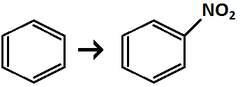
HNO3/
H2SO4
to benzene ring
attaches -NO2 to benzene ring
nitration (EAS)
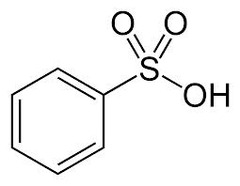
SO3/
H2SO4
to benzene ring
adds -SO3H to benzene
sulfonation (EAS)
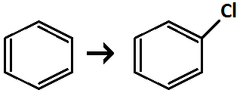
Cl2
AlCl3
to benzene ring
add Cl to aromatic ring
chlorination (EAS)
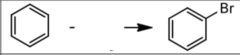
Br2/
FeBr3
to benzene ring
adds Br to aromatic ring
bromination (EAS)
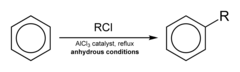
X-R
AlCl3
to benzene ring
adds -R to aromatic ring
*can rearrange
Friedel-Crafts Alkylation
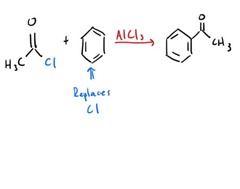
X-ketone
AlCl3
to benzene ring
adds -ketone to aromatic ring where X was
Friedel-Crafts Acylation