2) Alternatives to Fusion
 Call Kai
 Learn
 Practice Test
 Spaced Repetition
 Match
 Flashcards
 Knowt Play
1/75

There's no tags or description
Looks like no tags are added yet.
76 Terms
Two eyes, two images, one single percept
Fusion based on eye movements
Fusion performed by the visual cortex
similarity b/w the two monocular images
What are the 4 alternatives to fusion?
Binocular confusion
Suppression
Rivalry
Luster
Define Binocular confusion.
Dissimilar images on corresponding retinal points appear at the same location → incorrect percept of different objects simultaneously occupying same location
Grossly dissimilar images can’t be fused into one percept
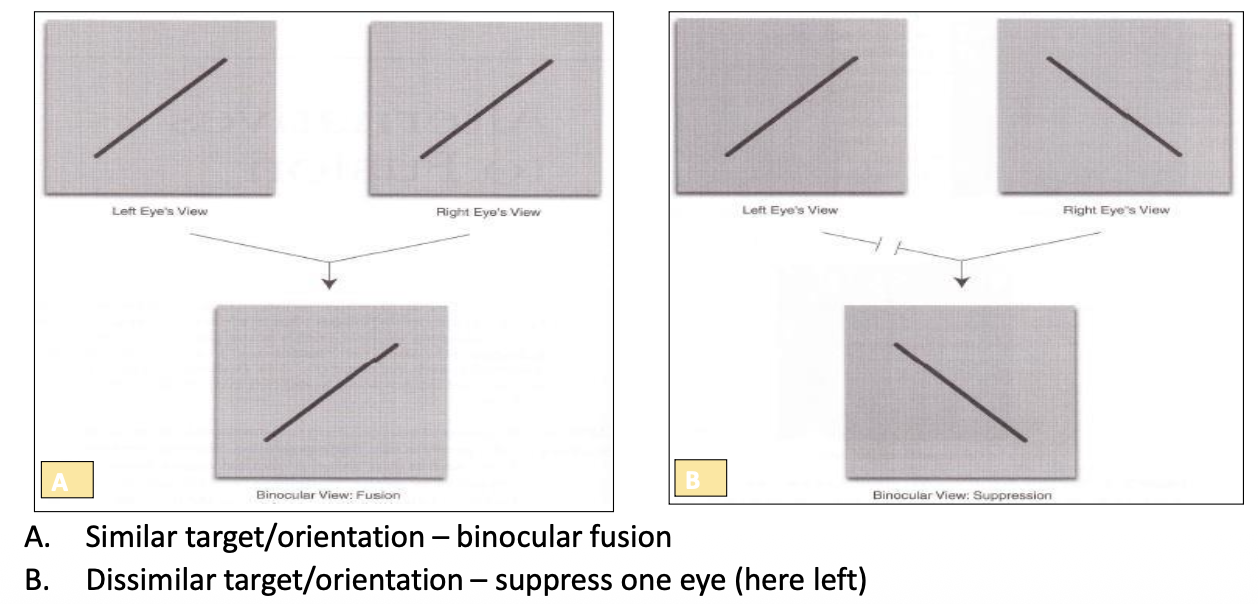
Define Binocular suppression.
→ Ignoring all or part of one eye's image to avoid conflicting info
arises from binocular interaction that suppresses some monocular info from binocular percept
↓ Sensitivity = ↑ thresholds = ↑ rxn times
~75–150 ms (doesn’t instantly with diplopia and confusion)
Similar: fusion
Dissimilar: one eye may be suppressed
only under binocular viewing conditions
What is Physiological suppression?
→ Normal suppression that prevents diplopia
e.g., suppressing objects beyond Panum's area during fixation
adaptation to prolonged diplopia
weaker or less salient image
Which image properties increase likelihood of suppression?
Dim
Low-contrast
Blurred
Stationary
Peripheral images
Which image properties resist suppression?
Bright
High-contrast
Sharply focused
Moving
Foveal images
Define Binocular rivalry (Alternating perception).
→ Alternating suppression when dissimilar images stimulate corresponding retinal areas
likely when competing images have similar salience or clarity
one eye's image is visible while the other's is suppressed, then they alternate
Note: Simultaneous excitation of corresponding retinal areas by dissimilar objects leads to confusion → RETINAL rivalry
What is a requisite for re-establishment of binocular vision?
Return of retinal rivalry
occurs in peripheral vision
Brightness
Colour
Contours
→ One entire image dominates
typical of small targets
What is Mosaic dominance?
→ Different local regions alternate dominance
typical of large targets
What are spatial zones of binocular rivalry?
→ Independent local regions undergoing rivalry
similar to cortical hypercolumn receptive fields
What does frequent rivalry of an attended object suggest?
Abnormal rivalry, possibly ocular misalignment
Confusion
Approximately 50% of the time each
it dominates > 50% of the time
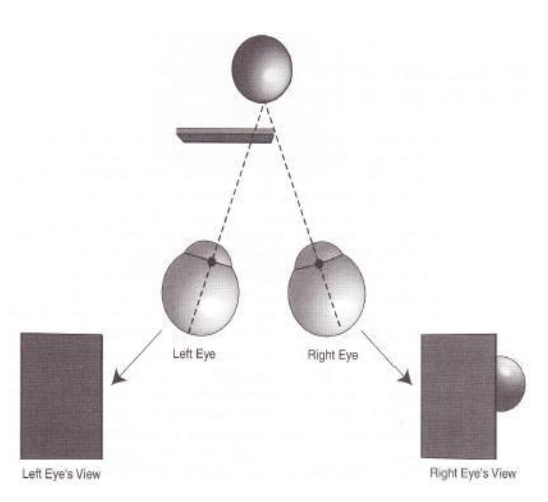
→ Distant object partially occluded by nearer object
near object and part of distant object fall on corresponding points
lack of matching points in each eye’s view = relative depth cue
target in one eye becomes less visible due to a mask in the other eye
this is not the same as rivalry
During saccadic eye movements
No - similarities don’t prove shared mechanisms
Seeing 2 images of 1 object in different visual directions (noncorresponding or disparate retinal points)
Diplopia: 1 object seen 2x
Confusion: 2 objects at 1 location
Rivalry: alternating suppression
Similarity of the targets presented to each eye
zone of suppression forms around the contour

Small = often entirely suppressed
Large = undergo rivalry
An X appears with a suppressed zone near its crossing

Stronger stimuli = more complete suppression + longer dominance
it suppresses adjacent bg and replaces it with the dominant eye's bg
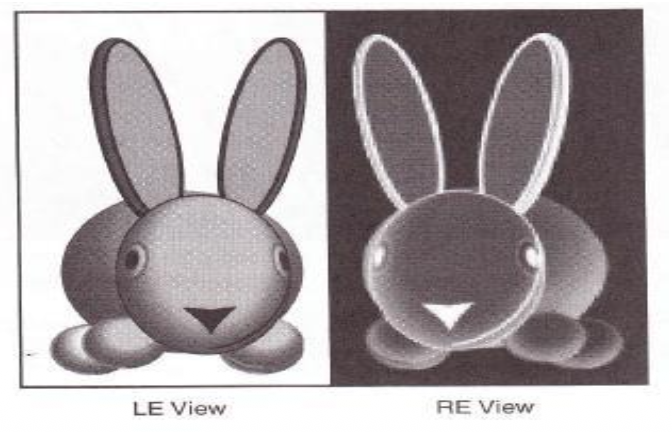
→ shimmering, metallic percept from similar contours with different luminance, color, or contrast polarity
specialized form of rivalry
Does binocular luster prevent stereopsis?
No - stereopsis can remain, even with opposite-contrast stereograms
In vision therapy with red-green targets, luster suggests fusion
What is the Inhibitory-interaction theory of suppression?
→ Dominant-eye neurons inhibit nondominant-eye neurons
in the LGN
What is the Feedback-loop theory of suppression?
Cortical feedback to the LGN gates attention and suppressed-eye info
What is the Lateral-connection theory of suppression?
Intracortical connections b/w cortical cells modulate suppression
Rivalry involves cortical mechanisms after orientation and spatial-frequency processing
Attention alternates between one eye and the other
eye with more contours in its image dominates
What is the Reciprocal lateral inhibition model?
Monocular cortical cells inhibit each other before converging on binocular cells
What is the Comparator-neuron model?
comparator monitors output that alternately gates left- or right-eye input
Brief presentations can prevent rivalry
Blinks can interrupt rivalry
Rivalry is not instantaneous, it takes time to develop
Nasal retina
Esotropes
non-deviating eye's foveal image rivals an image forms on nasal retina of the turned eye
since nasal retina is dominant → severe binocular confusion with the fellow fovea, forcing deep suppression → amblyopia
.
Exotropes
image falls on the temporal retina → weaker rivalry/confusion with the non-deviating fovea → amblyopia less common
Why does monovision CL correction work?
→ sharp image suppresses the blurred image
one eye is corrected for near
dominant eye for distance
Moving images are more salient and tend to dominate stationary images
List 6 clinical technique to measure suppression.
Worth four
Suppression scotoma (4 BO test)
Phoria Testing
Vergence Ranges
Vectographic VA slides
Bagolini lenses
Rivalry or luster
Suppression at:
13 inches - suggests a large area
only at distance - suggests a smaller area
(+) Avoids diplopia/confusion during navigation
(-) sacrifices binocular vision
Where does a suppression scotoma extend in esotropia?
From fovea to eccentric fixation point
more extensive
proportional to angle of dev
Degree of stereopsis
Amblyopia
4 prism BO test (suppresion scotoma)
Diplopia = no suppression
No diplopia = suppression
Maintains a fused target through vergence movements
What happens during vergence testing if there is suppression?
→ A single image moves toward the prism apex
Motion direction identifies the suppressing eye (eye seeing the motion = seeing eye)

→ Each eye sees different letters
omitted letters identify the suppressed eye
What is the normal, strabismus and suppression Bagolini response?
Normal = 2 streaks crossing centrally as an X
Strabismus = streaks don’t cross at the central point
Suppression = 1 streak is seen

Combine them with neutral-density filters
List 4 methods to break suppression.
Brief dominant-eye patching
ND filter
Blurred/frosted lens
Motion before the suppressing eye