Non-Organic Hearing Loss
 Call Kai
 Learn
 Practice Test
 Spaced Repetition
 Match
 Flashcards
 Knowt Play
1/14

There's no tags or description
Looks like no tags are added yet.
15 Terms
Non-organic hearing loss
Refers to individuals or types of HL that do not exist or are exaggerated
Function = Malingering = Feigning
Can be conscious or subconscious
NOT a case of misunderstanding task
Children vs adult malingering
Adults = $
Children = attention
Will often feign other symptoms
Clues for identifying non-organic HL
Odd behavior
Inconsistent with in clinic behavior and family’s report of child behavior
Poor agreement between PTA and SRT
PTA > SRT by 10-15dB
Poor test reliability at individual frequencies
Differentiating a malingerer from a true HL
REAL: threshold for speech is almost the same as PTA
MALINGERING: threshold for speech is much better than that for PTA
Evidence of “loudness matching” for PT and Speech
Why doesn’t loudness matching work?
spectral distribution of SPL along the cochlea contributes to loudness perception
if noise is narrower than the auditory filter bandwidth, variations in bandwidth of the noise have little influence on loudness level with a fixed overall level
if noise is wider than the auditory filter bandwidth, increasing the bandwidth while fixing the overall level results in an increase in loudness even when SPL is fixed!
Key concept: speech reaches their criterion loudness level faster than PT because speech crosses critical bandwidths and PTs do not

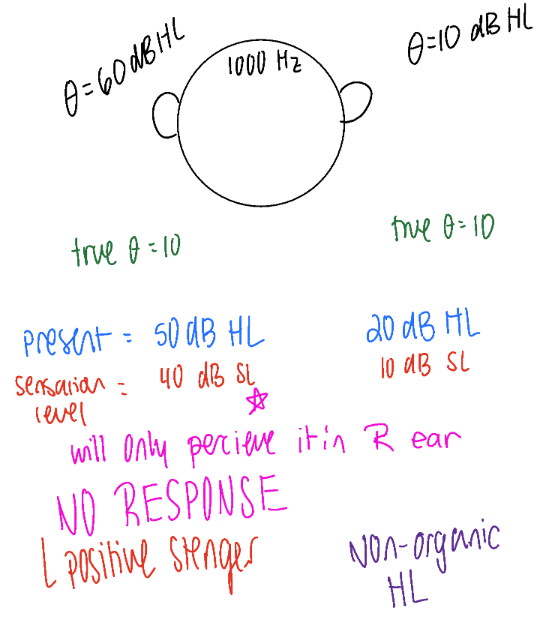
Stenger Test
Done to see if asymmetrical HL is ( > 30-40 dB)
Stenger effect: sound presented to both ears is perceived only in the ear in which it is louder
Stenger Test Procedure
simultaneously present:
Stimulus 10dB above obtained threshold in better ear
Stimulus 10dB below obtained threshold in poorer ear
Stenger Test Results
Pt responds = negative stenger (legit response)
Pt does not respond = positive stenger (malingering)
Goal of testing
get accurate info on hearing status
NOT identifying a malingerer
Auditory Processing Disorder (APD)
Difficulty following auditory instructions
Difficulty understanding speech in unfavorable listening conditions
Easily distractible or inattentive
Often mishear
Ask for frequent repetition
Difficulty localizing sound
APD evaluation
Should rule out other explanations with following tests
Peripheral hearing test (testing cochlea)
We want to test the central pathways;
Language testing
Nonverbal intelligence testing
Attention testing
APD test battery
SCAN-C: test for APD in children
Performance Intensity (PI): uses words from PSI test
Dichotic Digits Test: presents different numbers to ears, must repeat
Duration pattern test
Random gap detection test
Auditory processing weakness
A child who fails one or more tests in APD battery may be considered to have auditory processing weakness
Some clinicians feel AP weakness can coexist with other developmental issues like ADD and SLI
APD intervention
environment modifications
compensation strategies
things a teacher could do
direct intervention
commercially made products
Fast ForWord: intervention
Earobics
Targeted Sound Intervention