A&P Midterm (exam #3)
 Call Kai
 Learn
Learn Practice Test
 Spaced Repetition
 Match
Match Flashcards
 Knowt Play
1/53

There's no tags or description
Looks like no tags are added yet.
Name | Mastery | Learn | Test | Matching | Spaced | Call with Kai | Chat |
|---|
No analytics yet
Send a link to your students to track their progress
54 Terms
3 types of muscle
skeletal, cardiac, and smooth
shared characteristics
excitable/responsive (respond to stimulus)
contractility
extensibility (stretch and extend)
elasticity (recoil back to original state)
shared functions (all muscle types)
movement
generate heat
Skeletal muscle movement
moving body around
cardiac muscle movement
movement of heart
smooth muscle movement
internal movement (organs)
Cardiac muscle
bulk of heart walls
striated*(intercalated discs)
involuntary* (cannot control)
Smooth muscle
walls of organs
moves fluids and ingested solids
no visible striations*
involuntary*
Skeletal muscle
posture (unique function)
movement of skeleton
voluntary*
striated*
adaptable strength
multinucleated
insertion meaning
attachment point that moves
origin meaning
attachment point that stays put
action meaning
main action
a fiber =
1 cell
a fascicle=
multiple fibers
a muscle=
multiple fascicles
muscle fibers
up to a few cm
striated*
multiple nuclei visible (fusion from development)
myoblasts
muscle “stem cells”
fiber development
myoblasts→ myotube → skeletal muscle fiber
unique anatomical features
sarcolemma/transverse (T) tubules (plasma membrane)
sarcoplasmic reticulum (SR) (stores Ca2+)
contractile proteins (myosin and actin)
mitochondria (lots of ATP production
sarcolemma
plasma membrane
excitable-can form and carry out an electrical current
sarcoplasmic reticulum (SR)
stores Ca2+
releases Ca2+ when exposed to electrical current
4 tissue types
muscle, nervous, connective, and epithelial
arteries
blood away from heart to muscle
nutrient rich
oxygen, fuel, and calcium
veins
blood to the heart from the muscle
nutrient poor
waster: co2 and lactic acid
contraction requirements
nutrients
waste removal
nervous input
skeletal muscle-vasculature
1 artery + 1 vein per muscle, but lots of capillaries
capillaries
where nutrient + waste exchange happens
Nervous input
the CNS uses neurons to make skeletal muscles contract
Parts of a neuron
NEED TO KNOW: cell body (soma), axon, axon branches, axon terminals
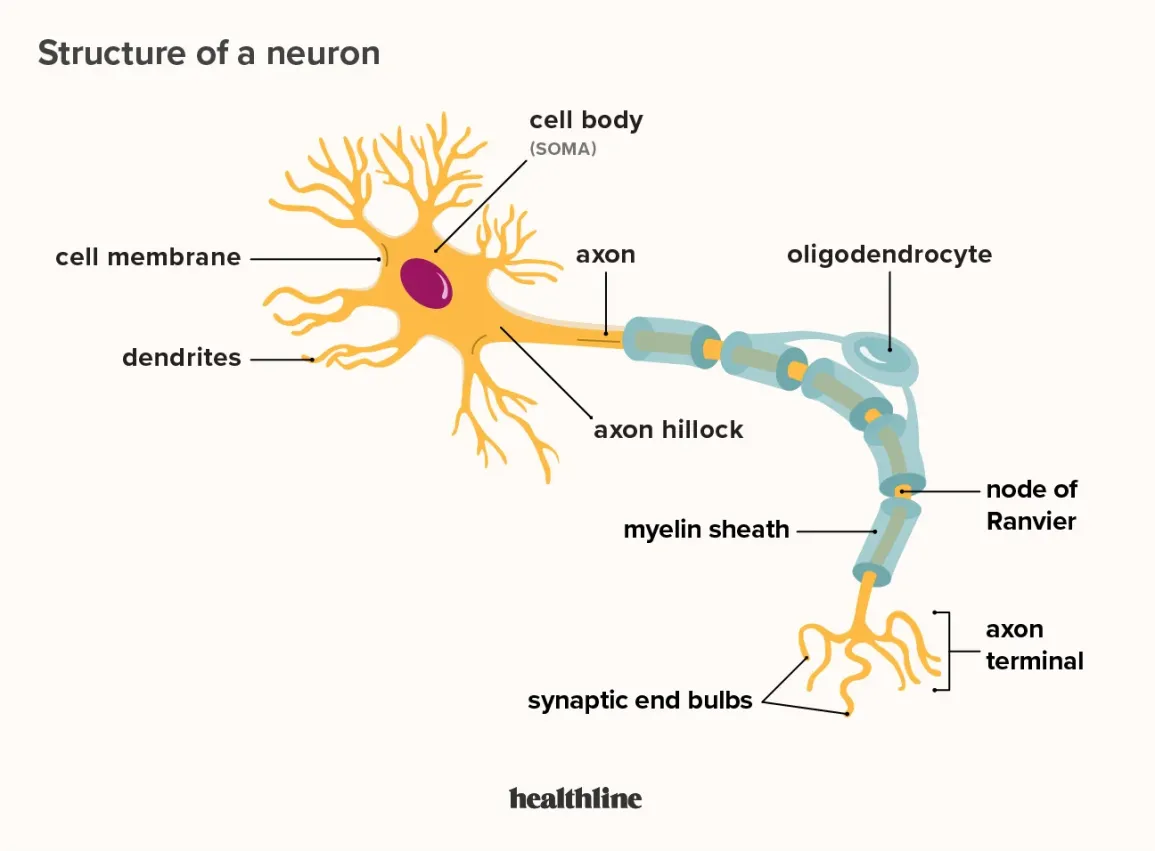
synapse
where a neuron communicates with another cell
Where do neurons synapse with a skeletal muscle?
Neuromuscular junction
how many neurons control each fiber?
1
1 fiber connects to…
1 neuron
1 neuron has many…
branches
1 neuron connects to many…
fibers
What is a motor unit
1 SMN and ALL of the fibers it controls
What happens when a SMN fires?
every NMJ is activated
in 1 neuron, NMJs are where?
spread out among many fascicles
Somatic Motor neuron
type of neuron that always synapses w/ skeletal muscle
How does a contraction become stronger?
More neurons being activated
endomysium
covers muscle fiber
perimysium
covers muscle fascicle
epimysium
covers entire muscle