Module 3A: Bones of the Forearm
 Call Kai
 Learn
 Practice Test
 Spaced Repetition
 Match
 Flashcards
 Knowt Play
1/37

There's no tags or description
Looks like no tags are added yet.
38 Terms
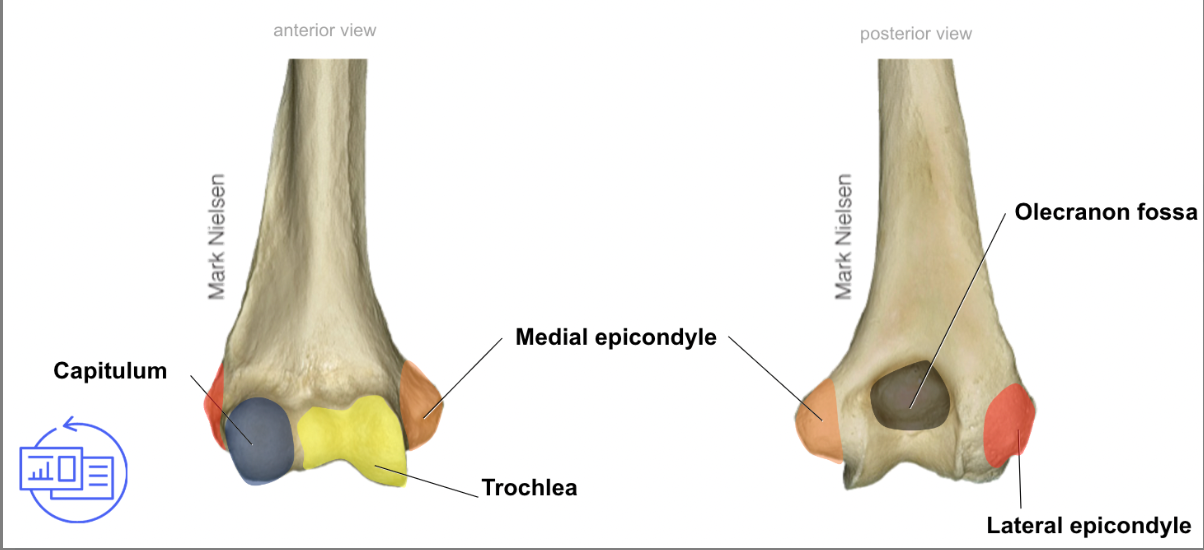
Distal Humerus (Anterior)

Distal humerus (Posterior)

Coronoid and Olecranon fossa functions
Coronoid fossa: makes space for ulnar in flexion
Olecranon fossa: makes space for ulnar in extension
The ulna is _____ and radius is ____
The ulna medial and radius is lateral
how do you tell them apart?
radius is thicker at the distal end
this is because the radius is the one articulating with the carpals

The ulna articulates with the _____
the trochlea of the humerus
The radius articulates with the ________
the capitulum of the humerus

The Radius

Radial fracture (also called broken wrist)
break at the end of the radius near wrist joint
also called foosh

The Ulna (wrench bone)

Ulna landmarks

Radioulnar joint
made of 3 articulations:
proximal radioulnar joint
middle radioulnar joint
distal radioulnar joint

Proximal radioulnar joint
head of radius + radial notch of the ulna
Synovial pivot joint
Annular ligament (stabilizes radial head)

middle radioulnar joint
fibrous joint
Solid syndesmosis
Interosseous membrane (connective tissue sheet between the radius and ulna (attachment point for deep muscles)
allows for pronation and supination to occur smoothly

Distal radioulnar joint
Head of ulna + ulnar notch of the radius
Synovial pivot joint
Ventral and dorsal radioulnar ligaments (stabilizes radial head on distal side)

Synovial pivot joint function
Pronation + supination
Proximal and distal RU joints
Elbow joint
made of 3 articulations in one joint capsule:
Humeroradial joint
Humeroulnar joint
Proximal radioulnar joint
Humeroradial joint
head of radius and capitulum of humerus
Pivot joint
represents modified ball and socket joint
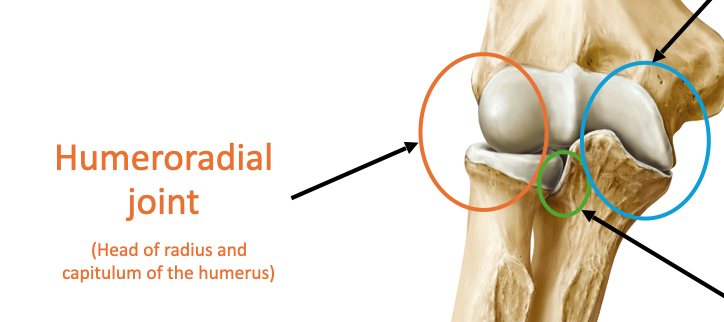
Proximal radioulnar joint
head of radius + radial notch of the ulna
already discussed as an articulation of radius and ulna

Humeroulnar joint
trochlear notch of the ulna and trochlea of the humerus
synovial hinge joint

synovial hinge joint movements
Flexion
Extension
Bones of the wrist and hand
phalanges
metacarpals
carpals

Phalanges
each phalange has a distal middle and proximal section
thumb only has distal and proximal
each finger numbered 1-5 starting with thumb

Carpal bones
Scaphoid
Lunate
Triquetrum
Pisiform
Hamate
Capitate
Trapezium
Trapezoid
“Some lovers try positions that they cannot handle”

remembering the carpal bones
Pisiform = looks like a little pea
Triquetrum = begins with tri (third one)
Trapezium + Trapezoid occur in alphabetical order: ium rhymes with thumb + zoid is right beside
hamate has a ‘hook’
Most common carpal bone injury
scaphoid fracture
often done by FOOSH
notice proximity to distal radius

Joints of the hand
Interphalangeal joints I-V
Metacarpal (MCO) joints I-V
Carpo-metacarpal (CMC) joint I
Intercarpal and Midcarpal joints
Carpo-Metacarpal (CMC) joints II-V
Interphalangeal joints I-V (Thumb to Pinky)
between phalanges
synovial, hinge joints

Metacarpal (MCO) joints I-V (Thumb to pinky)
Between metacarpals and proximal phalanges
Synovial, condyloid structure (rotational movements & flexion/extension)

Carpo-metacarpal (CMC) joint I (thumb)
Between distal carpal (trapezium) and 1st metacarpal
Synovial, saddle joint
thumb has own joint since its the most mobile

Carpo-metacarpal (CMC) Joints II-V
Between distal carpal row and metacarpals
Reduced motion (except 1st CMC)
Condyloid/ellipsoidal, synovial joint
most common joint for arthritis

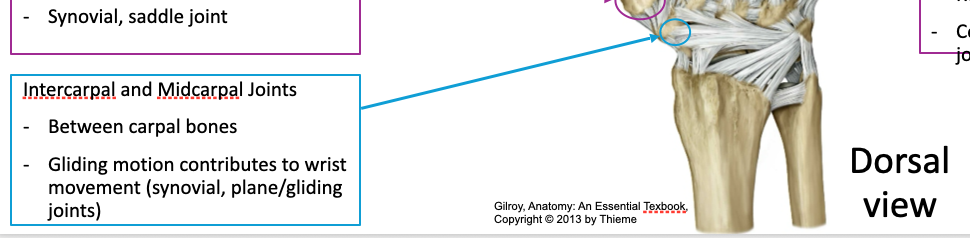
Intercarpal and Midcarpal joints
Between carpal bones
Gliding motion contributes to wrist movement (synovial, plane/gliding joints)
Movements at the wrist joint
Flexion/ Extension
Radial/ Ulnar deviation
Supination/ Pronation
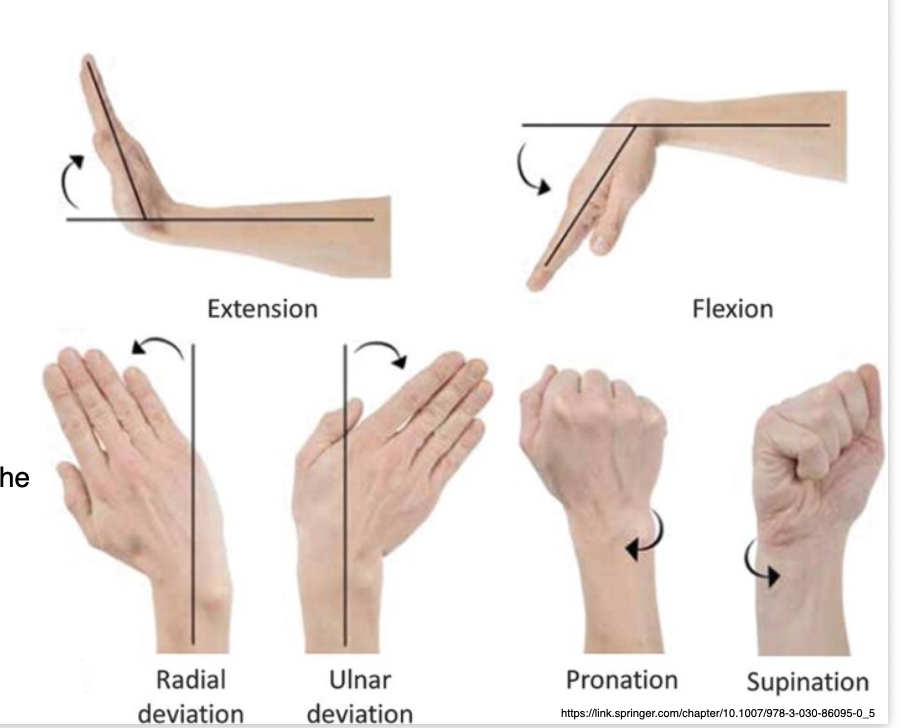
Radial and ulnar deviation
Radial: moves wrist towards thumb side (Abduction)
Ulnar: moves wrist towards pinky side (adduction)
Interphalangeal joint movements (PIP & DIP)
flexion
extension

Metacarpophalangeal (MCP) Joints
abduction
adduction
flexion/ extension

1st Carpometacarpal (CMC) Joint (Thumb)
Flexion/ extension
abduction/ adduction
Opposition

Arches of the hand
these arches work together for balance and stability of hand
allows us the grasp and reach
important for: scissors, cutlery, handwriting
3 main arches
2x transverse arches
Longitudinal arch
