comple concepts in cardiac function day 2
 Call Kai
 Learn
Learn Practice Test
 Spaced Repetition
 Match
Match Flashcards
 Knowt Play
1/49

There's no tags or description
Looks like no tags are added yet.
Name | Mastery | Learn | Test | Matching | Spaced | Call with Kai | Chat |
|---|
No analytics yet
Send a link to your students to track their progress
50 Terms
arryhthmias definition
alsocalled dysrhythmias
disorders of the electrical impulse within the heart that cause disturbances of HR, heart rhythm, or both
arryhthmias impact
without a normal rate and regular rhythm, the heart does not perform efficiently as a pump to circulate oygenated blood
arryhthmias symptoms
may initially produce symptoms related to the hemodynamic effect they cause, such as a decr. in cardiac output
ECG/EKG , what is it?
the electrical impulse that tracels through the heart can be viewed by means of an ECG/EKG. Each phase of the cardiac cycle is reflected by specific wavefoms
helps to identity cardiac issues and other health concerns
the 12 lead EKG uses multipls leads placed on the body to view different areas of the heart
cardiac waveforms
P wave: atrial depolarization, represents the electrical impulse starting in sinus node and spreading through the atrea
PR Interval: time fr sinus node stimulation and AV node conduction. Normal range 0.12 to 0.20 secs
QRS - ventricular depolarization, represents ventricular depolarization. normal duration: < 0.10 second
QT: Represents the total time for ventricular depolarization and repolarization. Measured from beginning of QRS commple to end of T wave
T wave ventricular repolarization
cardiac monitoring: centralized monitoring system
provides contnuous oversight of cardiac activity across clinical units
cardiac monitoring: advanced alarm system
automatically alerts medical staff upon detecting dysrhthmias, ischemia, or MI
cardiac monitoring: ambulatory recording
includes devices like Holter monitors which are portable and recording in nature for long term patient monitoring
what are you looking for in EKGs?
P wave: atrium is contracting, SA nodes have fired, you want P-waves to look like twins
PR interval - slow it down a second, you want a really good ventricular polarization
QRS: polarization desensitzing
QT: ventrical depolarization and repolarization
ST: looks like tombstones, it tells you that heart isnt resting if it is not what its looking like
T wave: were gonna do it again
sinus bradycardia (symptomatic)
rate <60 BPM
morphology remains consistent with normal sinus rhythm
sinus tachycardia
rate > 100 BPM
consistent P, QRS, and T wave morphology
what does sinus bradycardia look like
dizziness
lightheadedness
SOB
confusion
fatigue
hypotension
regular rhythm
normal P-wave and PR interval
Rate < 60 BPM

how to treat sinus bradycardia
treat underlying cause
atropine 1 mg IVP
can only give it 3 times, on 3rd mg, no other drugs you can give
Transcutaneous pacing
pace pads cannot be on them forever
needs a pacemaker or go inside heart and put a transvenous pacer in heart
after atropine and transcutaneous, THEN transvenous
what does sinus tachy look like
chest pain
SOB
palpitation
dizziness
aniety
Rate > 100 bpm
regular rhythm
Normal P-wave and PR interval
because someone in dehydrated or in pain

what is the treatment of sinus tachy
treatment is usally determined by the severity of symptoms and directed at identifying and treating its cayse
there is always a cause
what does supraventricula tachycardia look like
aniety
panic
SOB
dizziness
palpitations
chest pain
usually a female pt with either emotional/physical stress

treatment of supraventricular tachycardia
vagal maneuvers
bear down
blow through straw
adenosine 6mg, 12 mg IVP
2 times, half life of 10 secs, will flatline for a bit
electrical cardioversion
you should be able to with pacer pads
what does A-FIB look like
dizzy
lightheadedness
SOB
chest pain
palpitations
hypotension
may be transient, statying and stopping suddently, and occuring for a very short time or can be persistent, requiriing treatment to terminate the rhythm or to control the ventricular rate
riskk of stroke, PE, HF because of blood clots due to quivering
a-fib treatment
rate control: beta blockers, calcium channel blockers, to control the HR
Metoprolol 5 mg is routine dose
Cardizem
Heparin Drip
amniodarone for rhythm
Rhythm control: flecanide and propafenone
Anticoag therapy
Later: ablation, pacemaker
If treatment doesnt work, ablation ( go in heart and burn codunction pathway so SA node takes a different route)
if that doesnt work, pacemaker

V- tach definition and s/s
3 or more consecutive ventricular beats at a rate > 100 bpm
dizziness, lightheadedness, palpitations,
SOB
chest pain
near syncope
ocnfusion
hypotension
tachycardia

treatment of v-tach
antiarryhtmic meds like amiodarone or lidocaine
electrical cardioversion
last resort
high potential of moving clots and setting them off so it is scary
worry about QRS if anything bc continued widening = flat lining
Stable v-tach comes fro same area
unstable/polymorphic you want to trat like v-fib, comes from diff areas
treatment of v-fib
Same as pulselessness VT: follow ACLS protocol
CPR until defibrillator arrives
do code until return of spontaneous circulation (ROSC)
rapid defibrillation
identify and treat the underlying cause
epinephrine 1 mg IVP every 3-5 mins
short acting, epi drip
amiodarone (antiarrhythmic)

definition of tosades de pointes
turning of points
rare, life threatening form of polymorphic v-tach characterized by twisting ppearance of QRS complees on ECG

etiology and factors of torsades
prolonged QT interval due to drug toicity
electrolyte imbalances (low mag)
congenital factors
treatment of torsades
magnesium
what can you do for asystole and pulseless electrical activity
can only do high wuality CPR
cannot shock because theres nothing to shock
will give epi sometimes to see what will happen
know 1st av block
prolonged PR interval, consistent

cardioversion - what is it
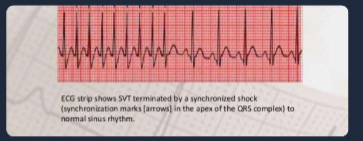
syncronized shock: defibrillator is set to synchronize with the EKG on a cardiac monitor so that the elecctrical implse dischargers during ventricular depolarization (QRS comple)
indications: SVT, A-fib, A-flutter, or unstable VT with a pulse
what is defibrillation
asynchronos shock: high energy delivered immediately without regard to the cardiac cycle
indications: v-fib and pulseless v-tach

what is ICd (implantable cardioverter defibrilator
detects and terminates life threatening tachycardia or fibrillation
indications: sudden cardiac death survivors (VF) or symptomatic (VT)
criteria: predetermined rate limit and isolectric line segement changes
monitoring: interrogated remotely or in-person for programming
types: single and dual chamber
pt who has an ICD has to have family learn CPR bc ICD may not work
pacemaker what is it
electronic device delivering electrical stimulation to regulate HR
indications: slower than normal HR, conduction disturbance, or advanced HF
sensitivity: programmed to detect intrinsic electrical activity and cause response
control: used fo some tachyarrhtyhmias unresponsice to medication
indications and function of a pacemaker
used when pt develops symptomatic bradycardia, may require emergency packing
ECG tracingL displays a pacemaker spike (vertical linr) with each impulse
capture: occurs when the spike is accurately positioned to trigger a response
safety and complications of pacemaker technology
keep cell phones 6-12 inches away (use opposite ear)
avoid proimity to learge magnets
MRIs can be a problem for older pacemakers
bradycardia symptomatic is pacemaker doesnt work
failure to capture:
pacemaker spikes but no comple is happening afterwards
failure to sense:
doesnt know what is going on with heart, just starts pacing whenevr it wants to