Mohammad Menstrual Cycle
 Call Kai
 Learn
Learn Practice Test
 Spaced Repetition
 Match
Match Flashcards
 Knowt Play
1/15

There's no tags or description
Looks like no tags are added yet.
Name | Mastery | Learn | Test | Matching | Spaced | Call with Kai | Chat |
|---|
No analytics yet
Send a link to your students to track their progress
16 Terms
What is menarche?
Menopause?
Menarche is the beginning of menses and ovulation. It begins on average at about 12 years of age.
Menopause is the cessation of menses and ovulation. It occurs around age 50. Estrogen and progesterone concentrations decrease.
What is the typical length of the menstrual cycle?
What are the four phases in order?
The average menstrual cycle is about 28 days.
The menstrual phase, follicular phase, ovulatory phase, and luteal phase.
What is the overall hormonal pathway regulating the menstrual cycle?
The hypothalamus releases GnRH →
the anterior pituitary produces FSH and LH →
the ovary produces estrogen and progesterone →
these hormones affect the uterus and provide feedback to the hypothalamus/pituitary.
When does the follicular phase begin?
How long does it typically last?
What are hormone levels like at the beginning of the follicular phase?
It begins on day 1 of the menstrual cycle, which is also the first day of menses/bleeding. Menses lasts for about 7 days.
About 14 days in a typical 28-day cycle.
FSH, LH, estrogen, and progesterone all begin at low levels. Low estrogen and progesterone levels are the reason that menses begins.

What happens to FSH during day 4 of the follicular phase?
What happens to estrogen?
During approximately the first 4 days, FSH begins to rise, recruiting a small number of follicles for growth and development.
Estrogen begins to rise, especially as the dominant follicle develops. The estrogen rise contributes to stopping menstrual flow and stimulates proliferation/formation of the endometrial lining.

What happens to the follicles during the follicular phase?
What does the follicle synthesize?
FSH promotes follicle growth and development. Around days 5-7, one follicle becomes the dominant follicle. This dominant follicle will ultimately release the ovum at ovulation.
Follicular growth allows the follicle to enlarge and begin synthesizing estradiol, progesterone, and androgen.
What happens to basal body temperature during the follicular phase?
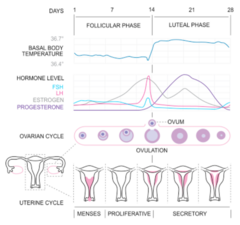
Basal body temperature is relatively low and dips just before day 14/ovulation.
When does ovulation occur in an average cycle?
Around day 14.
What hormonal pattern triggers the LH peak before ovulation?
What does this peak cause?
A sustained rise in estrogen together with low progesterone triggers the pituitary to produce a peak/surge of LH.
The LH peak causes final follicular maturation and release of the egg. This is why ovulation kits detect the spike in LH!
What happens to the endometrium around ovulation?
What happens to basal body temperature?
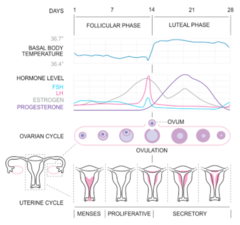
The endometrial lining has been thickening because of the estrogen rise during the follicular phase.
Basal body temperature begins to rise.

When does the luteal phase occur?
How long does it typically last?
It occurs after ovulation.
About 14 days.

What happens to progesterone during the luteal phase?
Progesterone rises substantially after ovulation.

What does the dominant follicle release that contributes to negative feedback in the luteal phase?
The dominant follicle releases estradiol and inhibin, which provide negative feedback to GnRH and FSH.
Their negative feedback contributes to atresia (degeneration) of the non-dominant follicles recruited during the cycle.
What happens to the dominant follicle after ovulation?
The dominant follicle undergoes luteinization (turns into a hormone-producing cell). This luteinized follicle becomes the corpus luteum, which produces estrogen, progesterone, and androgen.
What is the effect of high progesterone on the uterine lining during the luteal phase?
High progesterone maintains and stabilizes the uterine/endometrial lining.

What happens to FSH during menopause?
The declining estrogen during menopause provides less negative feedback to the brain, so FSH production increases.