Topic 1 : Lifestyle, Health and Risk
 Call Kai
 Learn
Learn Practice Test
 Spaced Repetition
 Match
Match Flashcards
 Knowt Play
1/27

There's no tags or description
Looks like no tags are added yet.
Name | Mastery | Learn | Test | Matching | Spaced | Call with Kai | Chat |
|---|
No analytics yet
Send a link to your students to track their progress
28 Terms
Explain the meaning of water being a ‘polar’ molecule
water has a partially positive region shown by H+ and a partially negative region, shown by O-
State and explain some properties of water
water is used as a solvent - due to being a polar molecule water molecules can form hydrogen bonds with other polar molecules or solute molecules
water is a liquid - so has the ability to flow due to it’s polar nature and so it is cohesive
water can be used as a transport medium - it is adhesive so can travel up the xylem by sticking to the xylem wall against the gravitational pull
What are carbohydrates?
sources of and stores of energy
organic substances containing carbon, hydrogen and oxygen in the ratio 1:2:1
Define what are monomers and polymers and give examples of each
monomer - smallest unit from which larger molecules are made from e.g monosaccharides
polymers - molecules made from a chain of monomers joined together e.g polysaccharides, polypeptides
What are monosaccharides and what is the general formula for them? examples?
they are single and simple sugars
CnH2nOn
e.g glucose, fructose and galactose
State properties of monosaccharides
sweet- taste
soluble in water (H2O)
State and draw the two different types of glucose
alpha glucose
beta glucose

State the roles for alpha and beta glucose
alpha glucose - forms polysaccharide molecules e.g starch and glycogen / the main substrate for respiration / the form in which carbohydrate is transported in mammalian blood
beta glucose - monomer unit for cellulose providing structural support and tensile strength in cell walls
State the roles for the monosaccharide fructose and galactose
fructose - helps to attract animals for pollination / forms with glucose to form the disaccharide sucrose
galactose - forms with glucose to form the disaccharide lactose (found in milk)
State the type of sugar for monosaccharides and their molecular formula
triose - C3H6O6 e.g glyceraldhyde
tetrose - C4H8O4 e.g therose
pentose - C5H10O5 e.g ribose
hexose - C6H12O6 e.g glucose
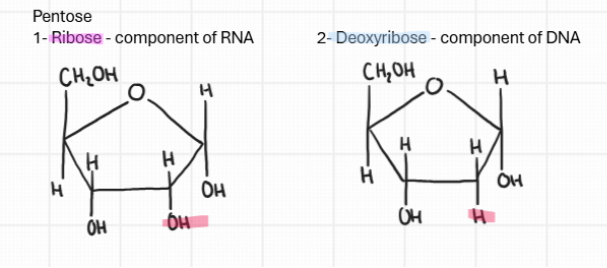
State and draw the two monosaccharides of pentose
ribose - a component of RNA C5H10O5
deoxyribose - a component of DNA C5H10O4
What are disaccharides and how are they formed? give examples
formed when 2 monosaccharides join together by glycosidic bonds in a condensation reaction
e.g - sucrose (sugar stored in sugar cane), maltose (sugar found in germinating seeds) and lactose (milk sugar)
Explain the meaning of the following terms:
condensation
hydrolysis
catalysts
condensation - the joining of two molecules which involves the removal of water (H2O)
hydrolysis - addition of water (H2O) to break molecules e.g the gylcosidic bonds in a disaccharide
catalyst - speeds up the rate of reaction without being used up by providing an alternative pathway with a lower activation energy
State how each of the following disaccharides are produced:
maltose
sucrose
lactose
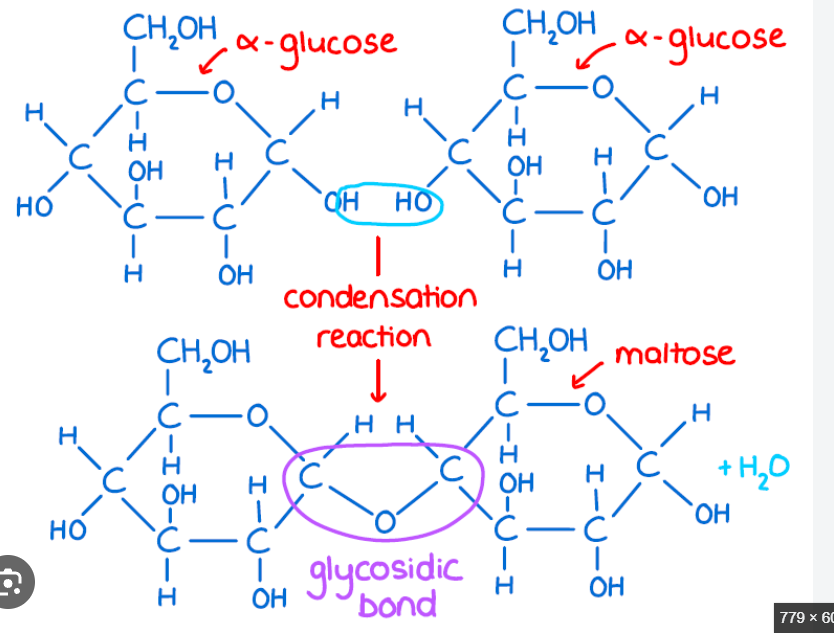
maltose - when two alpha glucose join together to form maltose (malt sugar)
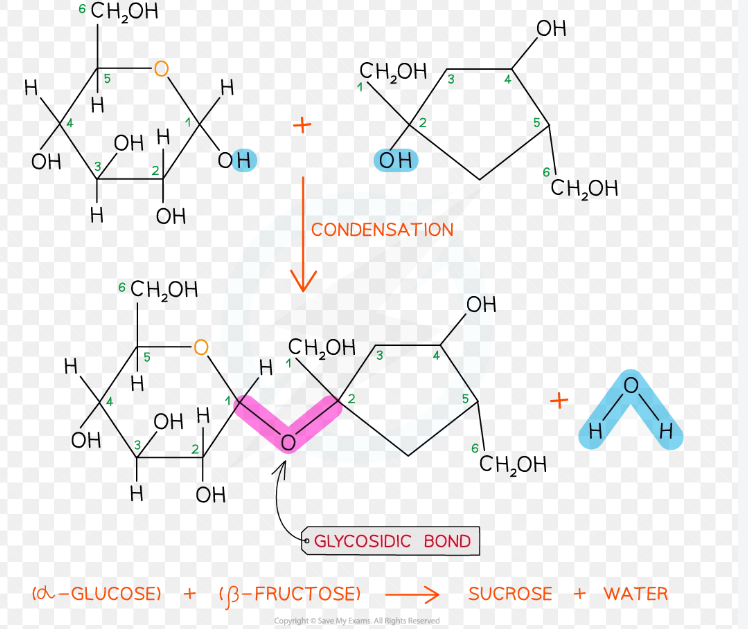
sucrose - when a glucose molecule and a fructose molecule join together to form sucrose (table sugar)
lactose - when a glucose molecule and a galactose molecule join together to form lactose (milk sugar)
only maltose and lactose are linked by 1-4 glycosidic bonds
Draw a diagram to show the formation of sucrose and label the glycosidic bonds
linked by a 1,2 glycosidic bond
Draw a diagram to show the formation of maltose and label the glycosidic bonds
formed by 1,4 glycosidic bonds
State and explain three functions of disaccharides
provide the body with a quick-release source of energy - only made up of two sugar molecules so are easy to break down by the digestive system and absorbed into the bloodstream
easily soluble in water - due to the presence of many hydroxyl groups so can form many hydrogen bonds when aqueous
sweet in taste
Define the term polysaccharides and give examples
polysaccharides - repeated chains of many monosaccharides joined tother by glycosidic bonds in a condensation reaction
e.g starch, glycogen, amylose and amylopectin
How can the structure of polysaccharides differ? What does this suggest?
can be branched or unbranched - being branched increases the rate at which a polysaccharide can be broken down
straight or coiled - Being straight makes the molecules suitable for constructing cellular structures e.g. cellulose / Being coiled makes a molecule more compact and suitable for storage e.g. amylose in starch
Where and why are starch and glycogen useful as storage molecules?
starch - main storage polysaccharide in plants
glycogen - main storage polysaccharide in animals and fungi
Compact; large quantities can be stored
Insoluble; they will have no osmotic effect
State the properties of starch and what is it formed from
insoluble
compact
highly branched
made of 2 polysaccharides: Amylose + Amylopectin
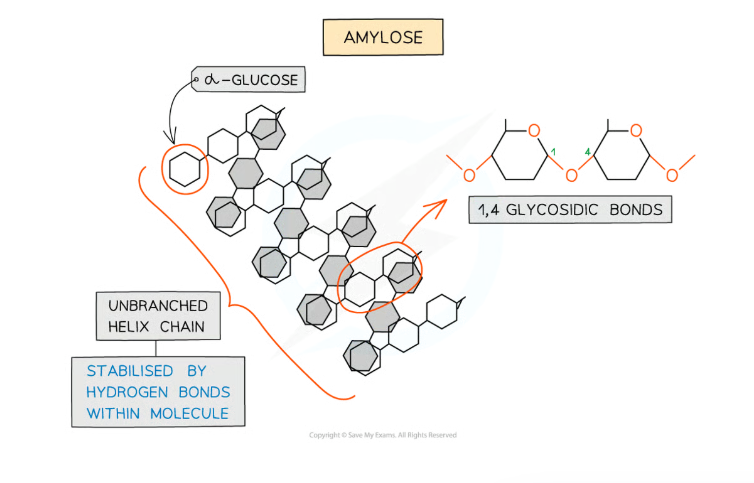
State and explain the properties of amylose
unbranched helix shape - The helix shape enables it to be more compact and thus more can be more easily stored
held together by H-bonds within molecules
has 1,4 - glycosidic bonds between alpha-glucose molecules
State and explain the properties of amylopectin
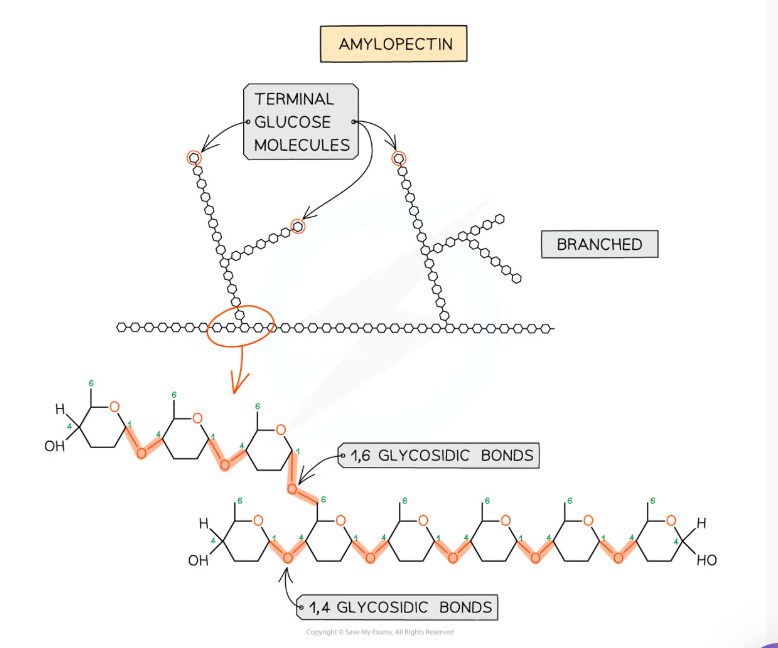
branched molecule - branches result in many terminal glucose molecules that can be easily hydrolysed for use during cellular respiration or added to for storage
has 1,4-glycosidic and 1,6-glycosidic bonds at branch points
Describe the formation of glycogen
formed through joining alpha-glucose molecules in a condensation reaction
forming 1,4 and 1,6 glycosidic bonds
Explain how the structure of glycogen relates to its role as an energy storage
it is highly branched so many terminal glucose molecules are broken down at the same time (hydrolysis)
stored as granules in muscles/liver - enables a high celullar respiration rate
It contains both 1,4 and 1,6 glycosidic bonds
compact - lots can be stored in a small space
large molecule therefore insoluble - has no osmotic effect and so will not diffuse out of the cell easily
Describe and explain the structure of cellulose
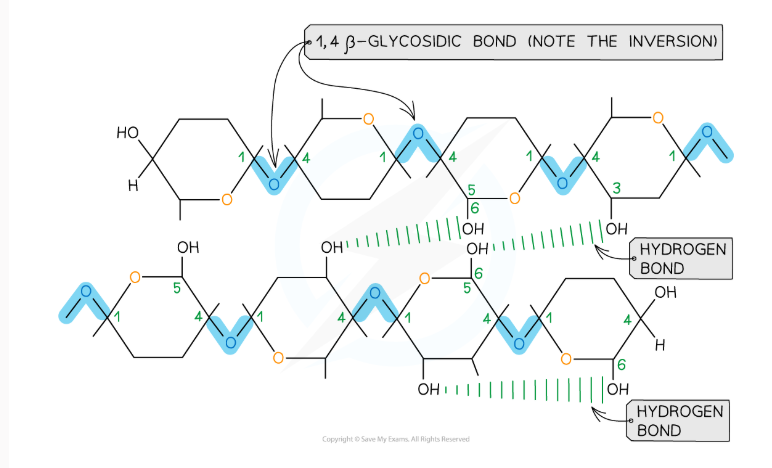
a polysacchride made by joining together two or more beta-glucose molecules in a condensation reaction to form water
beta-gluose molecules are held together by 1,4 glycosidic bonds —→ this is done due to the inversion of the B-glucose moolecules
there are hydrogen bonds that hold the chain in place, giving cellulose its strength
Draw and label the different bonds in a cellulose structure
Describe and explain the function of cellulose
high tensile strength - allows cellulose to be streched without breaking thus can withstand turgor pressure
main structural component of cell walls due to the hydrogen bonds providing it’s strength