BIO 1300 Exam #2 Review
 Call Kai
 Learn
Learn Practice Test
 Spaced Repetition
 Match
Match Flashcards
 Knowt Play
1/230

There's no tags or description
Looks like no tags are added yet.
Name | Mastery | Learn | Test | Matching | Spaced | Call with Kai | Chat |
|---|
No analytics yet
Send a link to your students to track their progress
231 Terms
Passive Transport
type of transport that doesn’t require energy to transport substances
Simple Diffusion
type of passive transport where the substance passes directly through the phospholipid bilayer
What type of diffusion is osmosis?
simple diffusion
Facilitated Diffusion
type of passive transport where the substance needs the help channel proteins or carrier proteins to pass through the phospholipid bilayer
Active Transport
type of transport that requires ATP (energy) to cross the phospholipid bilayer
What direction do substances using passive transport go from?
high to low; with their gradient
What direction do substances using active transport go from?
low to high; against their gradient
Na+ / K+ Pump
pumps 3 Na+ out and 2 K+ in
The sodium-potassium pump is a separation of what?
ions and charge
Is outside of the cell in a Na-K pump positive or negative?
positive
Is inside of the cell in a Na-K pump positive or negative?
negative
Membrane Potential
Electrical charge difference across a membrane; measured in millivolts (mV)
What is the measure (mV) of a resting cell?
-70 to -90 mV
Where is the energy coming from when a substance doing active transport is using potential energy?
from a concentration gradient
Cotransport
Transport of 2 or more solutes at same time
What two things does cotransport couple?
a substance going down/with its gradient with a substance going against its gradient
Symporter
cotransporter protein that pumps solutes in the same direction

Antiporter
cotransporter protein that pumps solutes in different direction directions

Secondary Active Transport
energy stored from a solute going down/with gradient is used to transport a solute going against its gradient
Vesicles
bubbles inside the cell made of phospholipids that are used to transport stuff around/across the cell
Microtubules
“Train tracks” for intracellular vesicle transport
Exocytosis
release of large molecules or proteins outside the cell; secretion
Endocytosis
brings large molecules & particles into cell
Types of endocytosis
Pinocytosis, Receptor-Mediated Endocytosis, and Phagocytosis
Pinocytosis
“Cell drinking”; Contents of vesicle are random
Receptor-mediated endocytosis
Receptors on cell surface “grab” target molecules; Receptors collected in a vesicle
How is receptor-mediated endocytosis different than pinocytosis?
receptor-mediated endocytosis collects specific molecules in higher concentration
pinocytosis collects random molecules in lower concentration
Phagocytosis
“Cell eating”; Pseudopodia (false feet) extend around food creating a food vacuole
RNA
single stranded, but can wrap around itself to pair; Base pairing; G – C; A – U

DNA
two strands that match up (Complementary to each other); Double helix; Base pairing; A – T; G – C (hydrogen bonds); Order of bases; = info

The order of bases in DNA determines what?
the information that it contains
What end is the phosphate end and what end is the OH end?
5’ end and 3’ end
DNA is synthesized in what direction?
5’ to 3’
New nucleotides are added to what end?
3’ end
Antiparallel
strands run in opposite directions
Chromatin
packed into a chromosome during cell division; Chromosome =; 1 DNA molecule; + proteins
Chromatin fibers
DNA and proteins
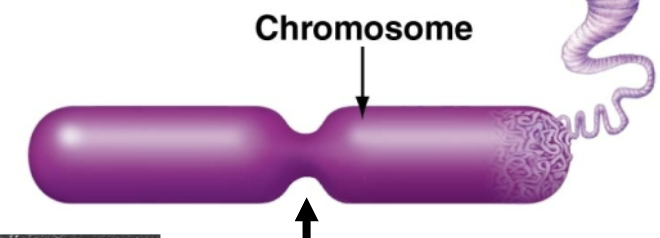
Chromosome
1 DNA molecule and proteins
Centromere
narrow part of chromosome, Near middle; where duplicate chromosomes are connected; (right before cell division)
Human Chromosomes
46 per cell; 2 sets of 23
Number of autosomes in a cell
44
Number of sex chromosomes in a cell
2
XX
female
XY
male
Genome
All the genetic information in a cell or an organism
Genomics
study of the genome
Ribosomes
site of protein synthesis, made of proteins and RNA

Where can ribosomes be found?
free floating
bound to Rough ER
bound to Nuclear envelope
Order of making a polypeptide chain
DNA>mRNA>polypeptide
Gene
Unit of heredity
Segment of DNA
Genetic information
Codes for an RNA product
Recipe for polypeptide
One gene equals how many polypeptides
1 kind of polypetide
Gene Expression
Turning the information in DNA into a working protein
RNA intermediate
coded for by gene that carries information (mRNA) to make a polypeptide
Transcription
Synthesis of RNA from information in DNA; DNA strand = template for RNA
RNA Processing
Pre-mRNA converted to final, functional form; 5’ cap added to 5’ end (Modified guanine nucleotide), poly-A tail added (50-250 adenine nucleotides)
What’s the Nuclear Pore For?
to allow mRNA to move out of the nucleus
Codon
sequences of 3 letters that codes for an amino acid, redundant (different letters can code for the same AA), not ambiguous (one codon only codes for one AA)
Start codon
AUG, Met (Methionine)
Stop codons
tell ribosomes to stop translation
UGA, UAG, UAA
Genetic Code
Is universal; Same from species to species
Exons
segments that code for AA
Introns
intervening sequences in mRNA that do not code for the final polypeptide
mRNA Splicing
Introns cut out; Exons connected together

Alternative Splicing
Sometimes not all exons are used; Cell can put exons together in different ways
What are the “players” of translation?
mRNA, Ribosomes, tRNAs, and Amino acids
tRNA
Transfers AAs to ribosome (Transfer RNA)

Anticodon
3 letter sequence that matches/binds with a codon
Translation
mRNA to polypeptide, AAs covalently linked to appropriate tRNA, tRNA match with mRNA codons at the ribosome, Add AA to growing chain Ribosome moves along mRNA, codon by codon
When are the large subunit and small subunit of ribosomes together
when bound to mRNA
What are the three binding sites for tRNA
A site, P site, and E site
A site
Entry point for tRNAs bringing next AA
P site
site of growing polypeptide
E site
exit cite
3 stages of Translation
Initiation, Elongation, Termination
Initiation
Ribosomes and 1st tRNA binds to mRNA at the start codon (AUG)

Elongation
tRNA enters A site and binds to codon; Growing chain transferred to A site where a new peptide bond formed; Ribosome shifts to next codon (tRNAs shift position, “Old” tRNA leaves)

Termination
Release factor (Protein that binds to stop codons)

Different Types of Gene Expression
housekeeping genes, inducible genes, tissue-specific genes
Housekeeping Genes
Always expressed in Constant levels, carry out basic metabolic functions, structure
Examples of housekeeping genes
Cytoskeleton proteins (Actin and Tubulin)
Inducible genes
As needed, can be turned on and off, expression levels can be varied
Example of an Inducible gene
iNOS (Inducible nitric oxide synthase)
During inflammation
Prolactin
mammary gland cells
Tissue-specific Expression
Liver-specific genes: only turned on in liver (But all genes present)
Hemoglobin: Only RBC
Pepsin: Only chief cells in stomach
Gene Regulation
Turning Genes On and Off
Prolactin Effect
Prolactin binds to receptor
Signal is carried by signaling cascade
Regulatory protein enters nucleus
Transcription
Translation
Processing/Sorting and Packaging
Exocytosis into mammary gland duct
DNA Replication
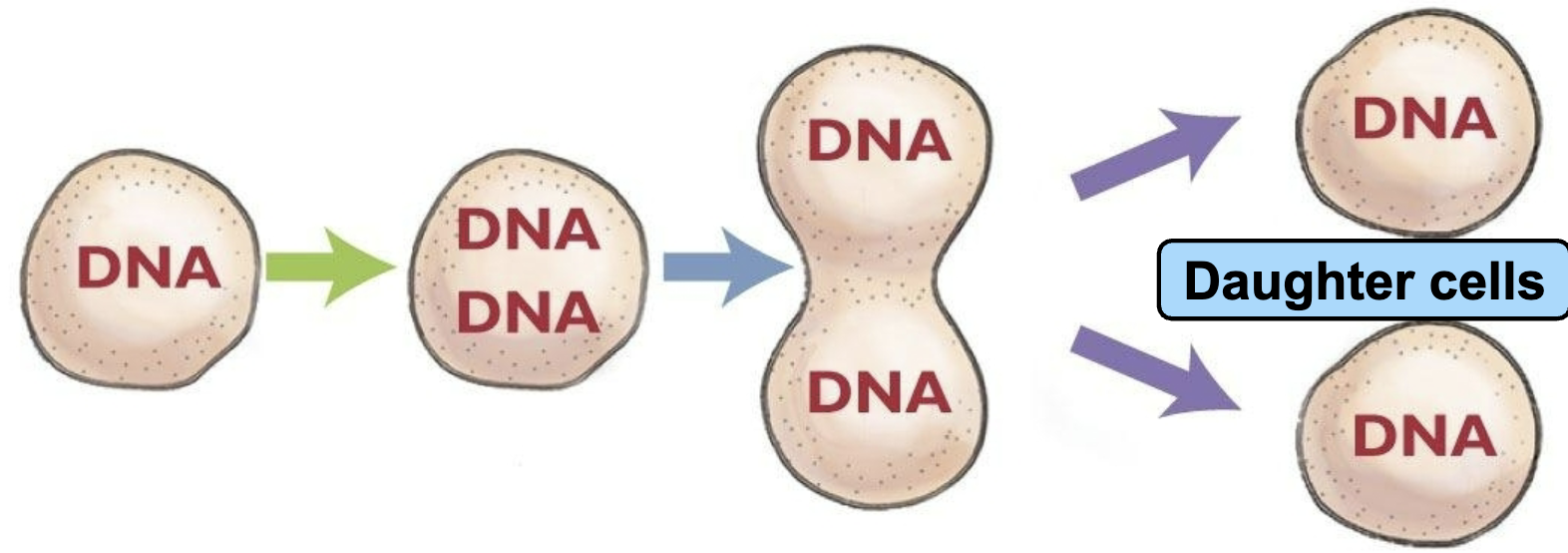
DNA copying, Cells divide: Growth, Replacement, Healing
Must duplicate DNA before division
1 set of DNA → 2 DNA copies → 2 daughter cells with 1 copy each
Daughter cells; Double helix “unzips”; Each separate; strand acts as; a template for; a new strand; Nucleotides added 1 by 1; Base-pairing with template; DNA polymerase; DNA Polymerase; Old Strand; New Strand; Incoming Nucleotides; Begins at origin of replication; Multiple origins per chromosome in humans; Replication; bubble forms; as DNA unzips; Spread out; until merge
Steps of DNA Replication
Double helix “unzips”
Each separate strand acts as a template for a new strand
Nucleotides added 1 by 1
Base-pairing with template
DNA polymerase
Begins at origin of replication
Multiple origins per chromosome in humans
Replication bubble forms as DNA unzips
Spread out until merge
Cell cycle
Sequence of events; From formation of a cell to its own division; Varying lengths; Some cells
Interphase
Most of cell cycle; Metabolism and; growth; 3 sub-phases; G1 phase; Normal cell functions; S phase; DNA synthesis; G2 phase; Prep to divide; M; phase; Cell; Division; G1; S; G2
Mitotic (M) Phase
Mitosis = division of the nucleus; Equal distribution of chromosomes; Cytokinesis =; Division of the; cytoplasm; Result =; 2 identical cells; w̅ same #; of chromosomes; Interphase; M; phase; Mitosis; G1; S; G2; Cytokinesis
G0 Phase
Exit cell cycle at G1; Some cells can re-enter; Normal cell; functions; No division; Ex) Neurons
G0 phase
Like a railroad spur; Main Line; Spur
The Phases of Mitosis
4 phases; Prophase; Metaphase; Anaphase; Telophase
Prophase
Chromatin; condenses into; chromosomes; Mitotic spindle; forms; Nuclear envelope; disintegrates; attaches to
Mitotic Spindle
Made of microtubules; and centrosomes; Guides and separates; chromosomes; Xs = Chromosomes; Centrosome
Metaphase
Chromosomes line up on a plane; In center of cell
Anaphase
Duplicate chromosomes; pulled apart; By mitotic spindle; Towards opposite sides
Telophase
Opposite of prophase; Chromosomes uncoil; Nuclear envelope forms; Mitotic spindle disappears
Cytokinesis in human cells
Usually starts with; anaphase / telophase; Cleavage furrow forms; Contractile ring; pinches cell in 2; Proteins
Cell Cycle Regulation
and; Cancer