HRM 5820 Test 2 Flashcards
 Call Kai
 Learn
Learn Practice Test
 Spaced Repetition
 Match
Match Flashcards
 Knowt Play
1/77

There's no tags or description
Looks like no tags are added yet.
Name | Mastery | Learn | Test | Matching | Spaced | Call with Kai | Chat |
|---|
No analytics yet
Send a link to your students to track their progress
78 Terms
Selection
The process by which companies decide who will or will not be allowed into the organization
Takes the pool of applicants delivered by recruitment and selects a subset of them
The selection process uses a combination of
measures, tests, and instruments
Good and reliable selection measures must be
Reliable, Valid, Generalizable, Useful (Utility), Legal
Reliability is
The consistency of a selection method or test over time, raters, items/scales
The degree to which a measure is free of random error (and therefore more precise)
Sources for random error include
Interviews: Unusual circumstances, distractions
Tests and Surveys: Poorly worded questions, scoring mistakes, item ambiguity, judgment calls
References: Mood of reference giver
Repetition in Items (inter-item reliability)
Give an applicant a survey that asks the same kinds of items multiple times; correlate the items (ex: survey scale)
Repetition in Times (Test-retest reliability)
Example: Give a test to an applicant multiple times, correlation of the administrations (ex: height)
Repetition in Raters (Inter-rater reliability)
Example: Interview an applicant with multiple interviewers; correlate their scores (ex: judges panel)
What does reliability tell/not tell us?
All reliability tells us is whether we’re measuring something consistently, precisely, and without random error
It does NOT tell us whether we are measuring the right thing consistently, precisely, and without random error
Validity
The degree to which a selection method accurately measures what it is intended to measure
Content Validation
Does the measure assess what it is meant to assess?
Concurrent Validation
Give measure to people already on the job, correlate with performance (or some other criterion) at that time
Predictive Validation
Give measure to job applicants but don’t use it to hire (just hire using something else that is unrelated to the measure). Then correlate it with performance (or some other criterion) several months late
Which Bulls-Eye portrays reliability and validity
Low-to-no spread at the center of the target
Generalizability
The extent to which the results of a selection method apply across different contexts, such as different jobs, departments, or organizations.
Utility
The degree to which the selection method adds value to the hiring process by improving decision-making
What are some measures of utility?
Does this selection methodology lead to
Increasing overall profitability
Allowing us to accurately select those who will succeed on the
job?
Legality
Adherence to employment laws and regulations in the selection process.
Resumes and References

Cognitive Abilities
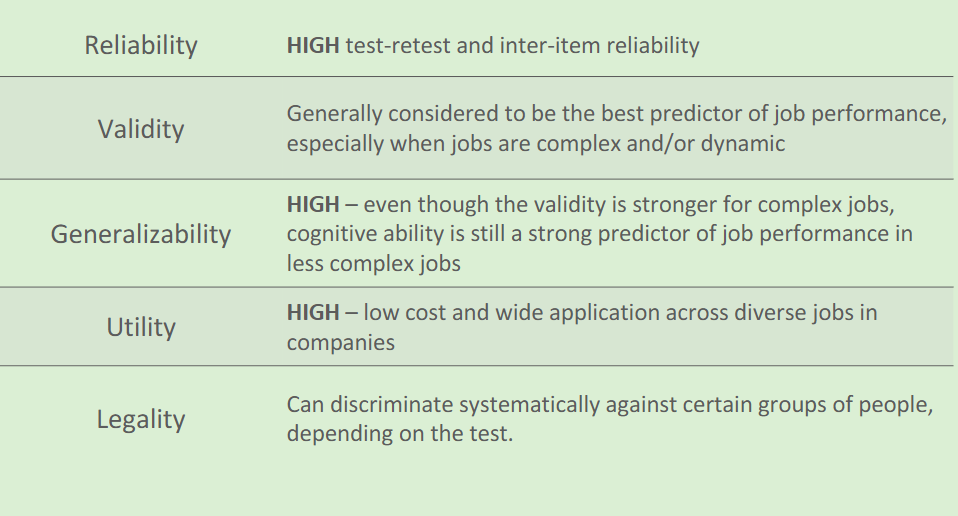
Cognitive Abilities - Examples
The SAT, GRE, GMAT, and other such tests measure two or three of the cognitive ability dimensions
The most popular tests used by employers (including the National Football League) is the Wonderlic Personnel Test (WPT)
Personality

Personality - things to know
The relatively STABLE/ENDURING organization of a person’s characteristics
50% of personality is inherited, evidenced through studies on twins
Personality vectors of interest
Conscientiousness, Extraversion, Agreeableness, Openness, Emotional Stability
Interviews - things to know
Historically unreliable and invalid
There’s a lot of “noise” due to:
Interviewer tendencies and mood
Applicant mood and anxiety
Applicant preparation and coaching
Interviewer-applicant gender mix, interaction style mix, age mix
How to Improve the Interview
Base questions on job analysis
Standardize: Ask exact same questions of each candidate
Avoid opinion-oriented questions (why would you like to work here, strengths/weaknesses)
Focus on situational questions (A customer is getting upset. How would you respond?)
Use rating scales on a question-by-question and overall basis
Use the same set of interviewers for all candidates
Interviews

What is Training?
A planned effort to help employees acquire job-related knowledge, skill, and behaviors, with the goal of applying these on the job
What does training improve/reduce?
• Job performance
• Customer satisfaction
• Retention
• Job Attitudes
• Injuries
• Grievances
The Stages of Training
Conduct Needs Assessment
Ensure employee readiness for training
Create learning environment
Ensure transfer of training
Evaluate results of training
Under what approach do you develop effective training programs?
“instructional design process” - a systematic approach to training
Why Conduct a Needs Assessment?
Establishes why we are doing the training in the first place
Within a Needs Assessment, you perform
Organizational Analysis
Task Analysis
Person Analysis
Task Analysis
What tasks and KSAOs need to be the focus of the training program?
Involves the same kinds of steps used in job analysis
Task Statement
A summary of what needs to be trained
short sentences that describe what the worker does, how the worker does it, to whom or to what it is done, and why
Person Analysis
Who needs training the most?
Are we sure that training is the solution, rather than new equipment, new procedures, or more feedback?
Organizational Analysis
• What aspects of the organization make training more or less effective?
• Is there managerial and peer support for training?
• Does the organization have the resources (budget, time, and expertise) for training?
What are the 2 things that the “Ensure Employee Readiness” step asks?
Are employees trainable
Are employees motivated to learn
What effects employee motivation as far as training readiness is concerned?
• An awareness of the economic
and career benefits that come
from the training
• Self-efficacy - belief that they can successfully learn the training content
• Personality
• Conscientiousness
• Openness (i.e. Inquisitiveness)
In order to Create a learning environment, you must perform the following steps
• Provide the training objective(s)
• Deliver the training content
• Provide opportunities to practice
• Provide feedback
Provide the training objective(s)
• Take the task statements and turn them into specific goals that trainees will strive to meet
• Ensure that the outcomes are measurable
Deliver the training content
• Content can be delivered using a variety of instructional methods
• These methods can be categorized according to whether trainees:
• Hear the content
• See the content
• Do the content
Hear Content Training Delivery Examples
• Classroom instruction
• Distance learning
See Content Training Delivery Examples
• Classroom instruction with audiovisuals
• Distance learning with audiovisuals
• Interactive video or computer systems
Do Content Training Delivery Examples
• Business games
• Role playing
• Simulations
• Apprenticeships
• On-the-job training
Critical features of the various content delivery methods:
• How similar is it to the task setting?
• How much control do trainees have over the pacing of the instruction
• How many trainees can take part at once?
• How expensive is it?
Common Training Techniques Breakdown

What does it mean to ensure transfer of training
To transfer the KSAO’s gained during training to on-the-job work.
This transfer is increased when trainees practice learned skills in the first days and weeks back on the job
What are some ways to perform training evaluation?
1. Trainee satisfaction
2. Transfer of training
3. New skills/knowledge
4. Performance improvements
5. Return on investment
Trainee Satisfaction Details
Ask the participants how satisfied they are
Ask them:
Do you perform the task?
How many times do you perform the task?
To what extent do you perform difficult and challenging learned tasks?
Little to no relationship between trainee reactions and most other training outcomes, but utilized by 75% of US companies
How do you measure K (Knowledge/Cognitive) Outcomes?
Measured with paper-and-pencil tests or computer-based exercises
How do you measure S (Skill-based) Outcomes?
Measured using trainer, peer, or supervisor evaluation; work sample tests; or computer-based exercises
How do you measure O (Affective/Social) Outcomes?
Measured using surveys & interviews
How do you measure Results?
Improvements in performance, productivity, quality, absenteeism, turnover, etc.
Measured using manager observation or personnel records
Pre-test/Post-test Design Details
• Measure performance, knowledge or attitudes of ALL employees before
training
• Then, train only PART of the employees
• After the training is complete, measure performance, knowledge or attitudes again, and compare the trained group to the untrained group
Pre-test/Post-test Design Caveats
• Groups compared after training may differ for reasons other than training, such as pre-existing differences in KSAOs
• Example: Some training is only offered to people who are deemed to have “managerial potential”
• Ideally, we’d randomly assign, but this is hard!
For selection measures to be good, they must be…
reliable, valid, generalizable, useful, and legal
What affects the legality of selection measures?
whether they hinder Equal Employment Opportunity
Equal Employment Opportunity
• Government’s attempt to ensure all individuals have equal chance for employment, regardless of their membership in certain groups
• This is accomplished using:
• Constitutional amendments
• Congressional legislation
• Executive orders
• State legislation
Who enforces EEO?
Is enforced primarily by the EEOC (commission): The government commission to ensure that all individuals have an equal opportunity for employment
EEOC responsibilities
• Investigate & resolve complaints filed (employees who feel they have been discriminated against must file claim within 180 days
• Monitor and gather information on the hiring practices of organizations
• Issue guidelines that help employers determine when their decisions violate laws enforced by EEOC
Civil Rights Act of 1964 (Title VII)
Makes it illegal for an employer to Fail or refuse to hire or discharge any individual, or otherwise discriminate against any individual with respect to his/her compensation, terms, conditions, or privileges of employment because of such individual’s race, color, religion, sex, or national origin
Under the Civil Rights Act of 1964 (Title VII), there are two types of illegality
• Disparate Treatment
• Disparate Impact
Disparate Treatment
Intended to treat people differently based on group status
Disparate Impact
“Facially neutral” employment practice adversely affects different groups
How to prove Disparate Treatment
Show that the plaintiff:
• Belongs to a protected group
• Applied for & was qualified for the job
• Was rejected despite qualifications
• Employer either kept seeking or hired someone with similar qualifications
Defendant’s rebuttal for Disparate Treatment
• Hired someone better
- or -
• Gender, religion, national origin is
a bona fide occupational
qualification (BFOQ)
• Race can never be considered a
BFOQ under any circumstances
How to prove Disparate Impact
Must show that the practice in question is disproportionally affects a protected group relative to the majority group
• 4/5ths rule
4/5th’s Rule
There is disparate impact if the hiring rate for a protected group is less than 4/5’s (80%) of the hiring rate for the majority group
*do independent study for the math on this. Not hard, but not easy to replicate on this platform
Defendant’s rebuttal for Disparate Impact
Show employment practice is a “business necessity”
How?
• Job analysis shows it to be critical
• Good criterion-related validity (i.e., there is evidence that this necessity predicts how well people do on the job)
What Acts have supplemented Title VII?
• Age Discrimination in Employment Act (ADEA, 1967)
• Americans with Disabilities Act (ADA, 1990)
What is the ADEA (Age Discrimination in Employment Act)?
• Prohibits discrimination against employees age 40 and over
• Protects only the 40+ group: favoring older workers over younger ones is legal
• Firms cannot hire only younger workers, unless it is a business necessity without other valid alternatives
• Firms cannot coerce employees into taking early retirement. If employees accept early retirement they sign an agreement waiving their right to sue under ADEA
What is the ADA (Americans with Disabilities) Act?
Prohibits discrimination against employees with disabilities (subject to specific exceptions) in all employment practices
• Including application procedures, hiring, firing, promotions, compensation, and training
What is the definition of Disability
• A physical or mental impairment that substantially limits one or more major life activities.
• (blindness, deafness, paralysis, etc...)
• A record of having such an impairment...
• (cancer in remission, history of mental illness, etc...)
• Being regarded as having such
• (visible signs, rumored illness, etc...)
Under the ADA, employers must distinguish between the following
• Essential Job Functions: Fundamental duties of the position, as defined by the frequency and criticalness ratings in a job analysis. Must be performed by all job holders
• Marginal Job Functions: Less important duties. Need not be performed by all job holders
ADA Details
• Cannot refuse employment if disability affects marginal job functions
• Can refuse employment if disability affects essential job functions, but only if a “reasonable accommodation” cannot be made without “undue hardship”
Summary of Legal Acts

Affirmative Action distinguishes itself from the Civil Rights Act and the EEOC by
seeking to redress (remedy) discrimination rather than reduce discrimination
What does Affirmative Action involve and who introduced it?
• Involves special training programs and recruitment efforts for minority groups
• Also allows for consideration of group status in making employment decisions
• Qualification screening should occur first. If applicants are equally qualified, preference can be given to protected group member
• John F. Kennedy via Executive Order in 1961