CH. 14: Staphylococci and other GP Bacteria
 Call Kai
 Learn
Learn Practice Test
 Spaced Repetition
 Match
Match Flashcards
 Knowt Play
1/17

There's no tags or description
Looks like no tags are added yet.
Name | Mastery | Learn | Test | Matching | Spaced | Call with Kai | Chat |
|---|
No analytics yet
Send a link to your students to track their progress
18 Terms
Disk diffusion assays
Sensitive: zone of inhibition, size determines how sensitive
Resistant: not killed by antibiotic

Staphylococci
GPC
catalase - positive
modified oxidase - negative
mostly skin flora, few pathogens
opaque colonies - creamish colors

Micrococci
G. stain similar to Staphylococci
catalase - positive
modified oxidase - positive
mostly skin flora, not usually pathogenic
often produce bright yellow colonies, BUT, not always

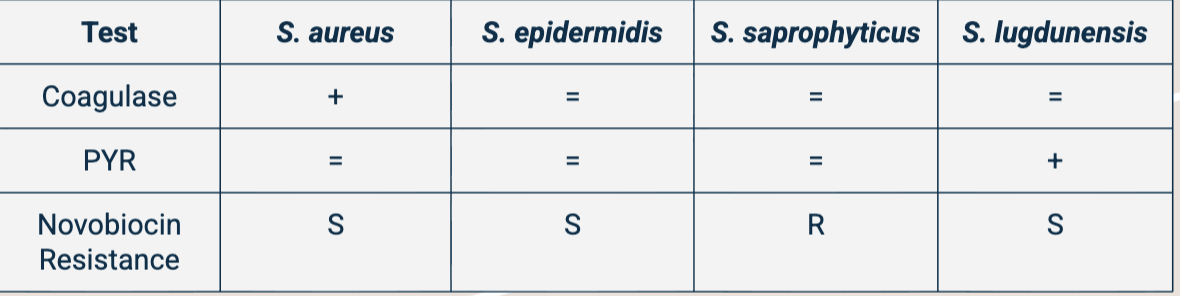
Coagulase positive Staph species(s)
S. aureus
Coagulase negative Staph species(s)
S. epidermidis
S. saprophyticus
S. lugdunensis
Coagulase testing for enzyme “clumping factor”
coagulase tube testing:
most accurate, bacteria + plasma in tube, detects bound AND free coagulase
coagulase slide testing:
detects BOUND only, bacteria + plasma on slide, 10-15 sec results, some false negs
staph latex testing:
most common, detects bound coagulase AND protein A (clumping protein), 10-15 sec results, very sensitive and specific

Pyrrolidonyl arylamidase (PYR) test
RAPID test to detect presence of PYR enzyme
red color change if present
Clinically revelant Staphylococci
S. aureus
most clinically significant species
produce several enterotoxins and exotoxins
colony morphology: beta-hem. on BAP, buttery to creamy color, convex round smooth colonies

S. aureus skin and wound infections
folliculitis, furuncles, and carbuncles
opp. skin infections caused by injury
carb. are multiple furun. that fuse
abscess
necrosis
pus-filled
can be caused by carb., insect bites, needles, other penetration
treatment: antibiotics, surgery

S. aureus - Impetigo
superficial skin infection
large pustules
highly contagious
most common in children
direct contact spread
treatment: topical anti. or goes away on own

S. aureus - Scalded Skin Syndrome
exfoliative dermatitis
most common in newborns or immunocompromised
causes
exotoxins that can travel all over body
blisters to whole body skin loss
treatment: IV anti.

S. aureus - Toxic Shock Syndrome
multisystem disease caused by systemic production of TSST-1 toxin
most common long-term tampon use
toxins absorbed thru vaginal walls
hypotension, fever, chills, vomiting, diarrhea, shock
treatment: IV anti. and supportive therapy, can be fatal
S. aureus - food poisoning
GI disturbance
toxins produced in improperly stored food
ingested
most common in meats, dairy, eggs, mayo at room temp for long time
rapid onset (2-8 hrs), but resolves by itself in 24-48 hrs
Staphylococcus epidermidis
usually normal skin flora, but can cause hospital-acquired infections
most common in foreign-surface in body
catheters, prosthetic valve endocarditis, CSF shunts
colony morphology: gamma hem. on BAP, light gray, convex smooth colonies

Staphylococcus saprophyticus
most associated w/ UTIs in sexually active young females
adheres to vaginal/vulval mucosa
rarely causes infection in other mucous membranes
colony morphology: gamma hem. on BAP, bright white

Methicillin-resistant S. aureus (MRSA)
resistant to ALL beta-lactam anti.
produces PBP2a - penicillin binding protein
deactivates beta-lactam to make ineffective
vancomycin thru IV only treatment
Vancomycin-resistant S. aureus (VRSA)
very rare, but dangerous emerging pathogen