Ch.12 UP pt.2
 Call Kai
 Learn
 Practice Test
 Spaced Repetition
 Match
 Flashcards
 Knowt Play
1/57

There's no tags or description
Looks like no tags are added yet.
58 Terms
What happens during reception when reflected sound reaches the transducer?
when reflected sound arrives at the transducer, multiple neighboring elements in the probe are excited. These elements create electrical signals that return to the systems receiver via multiple channels
How are more accurate images created LPA, BF
when the ultrasound receiver introduces variable time delays to some of these electrical signals during reception.
Why does the receiver use variable time delays?
Because echoes come from different depths and need different timing adjustments to be properly focused.
Do the delay patterns stay the same during dynamic receive focusing?
No, the delay patterns during receive-focusing change continuously as the transducer listens for reflections.
How does transmit focusing differ from dynamic receive focusing?
Transmit focusing is limited to a single focal point for each transmitted beam, while dynamic receive focusing adjusts to echoes from many depths.
Who controls dynamic receive focusing?The ultrasound system automatically.
The ultrasound system automatically. The sonographer does not control it.
How many focal points does one sound beam have?
A focus can be considered the “waist” of a sound beam. Just as a person has a single waist, a sound beam has only one focus.
How does a phased array create multiple transmit foci at different depths?
It sends multiple sound beams down each scan line, with each beam focused at a different depth.

If the sonographer selects three focal points, how many sound pulses are transmitted down each scan line?
Three distinct sound pulses are transmitted down each scan line. Each electrical spike pattern has a different degree of curvature
Which electrical pattern creates the shallowest focus?
the pattern with the greatest curvature created the beam with the shallowest focus.
Which electrical pattern creates the deepest focus?
The pattern that is least curved produces the beam with the deepest focus.
How is each line of the image created when using multiple transmit foci?
By combining the focal zones of the multiple transmitted pulses.

What is the shape and arrangement of the PZT crystals in an annular phased array?
Concentric rings cut from the same circular slab of PZT. Ring shaped elements with a common center. Has the appearance of a bull’s eye target.

What does concentric mean?
Rings that share the same center, like circles inside one another.
How does an annular phased array steer its sound beam?
Mechanically. Electronic steering is not possible with annular arrays.
Beam steering annular array
Mechanical steering creates the two-dimensional image. A motor physically moves the ringed-element array so that the sound beams are transmitted in different directions.

Annular Phased array image shape
Since the beam steering of an annular array is mechanical, the image is fan or sector shaped.
What is the primary advantage of annular phased arrays?
that multiple transmit focal zones create each scan line of the image. Phased = adjustable/multi-focus
How are focal depths related to the diameter of PZT crystals?
Smaller diameter crystals = shallower focus.
Larger diameter crystals = deeper focus.
Which crystal creates the shallowest/deepest focus in an annular array
The innermost (smallest) ring.
The larger outer rings.
What information is collected from the innermost crystal?
information only from the shallowest depths is collected; all remaining information from the inner crystals reflected sound pulse is ignored.

What happens after the innermost crystal is fired?
Then the next larger crystal is fired down from the same scan line, and only information from its focal zone is processed. This is repeated for each of the rings. Information is stored only from the respective focal zone, which gets progressively deeper with every ring.
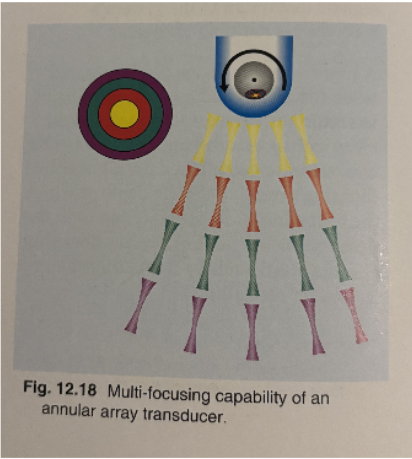
How many focal depths are created by 4 annular rings?
An annular array comprising 4 ringed elements transmits 4 pulses down each scan line, each with a different focal depth. The final image is a composite of information from only the focal zone of each crystal.
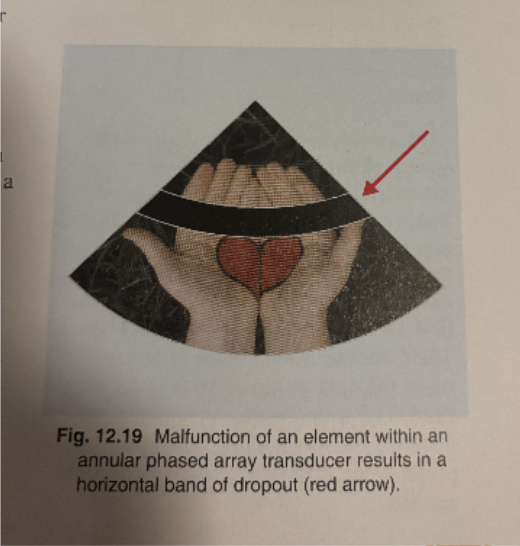
What happens when one ring in an annular array malfunctions?
only a portion of the image is lost. This will appear as a horizontal or side-to-side band of dropout at a particular depth.
Why does damage to one ring only affect a portion of the image?
that each ring of an annular array is responsible for collecting image data from its focal zone.
If the innermost ring malfunctions, the most superficial region of the image is lost.
If an outermost ring malfunctions, a deeper horizontal band of the image is lost.

Linear sequential array
A transducer with a large acoustic footprint that creates RECTANGULAR images.

What is another name for a linear sequential array
Linear switched array.

How many PZT elements does a linear sequential array have?
120-250 rectangular-shaped stripes of PZT arranged side by side in a line. Each crystal is about 1 wavelength in width.
How long is the acoustic footprint of a linear sequential array?
Approximately 10 cm
Beam steering in Linear sequential arrays
A small group of crystals (3-10) but not all, are fired simultaneously to create a narrow directional beam. This improves lateral resolution.
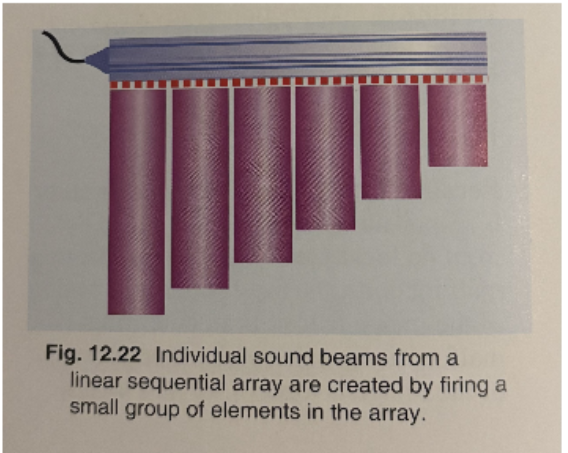
Does a linear sequential array use actual beam steering?
No, there is no “actual” steering with these transducers, the pulses are sent down parallel lines. The scan lines are parallel and remain equally spaced at all depths.

How were older linear sequential arrays focused?
In the old days they were considered fixed focusing by using internal or external options. In today’s world they are focused electronically.
What type of image can electronic focusing create in modern linear sequential arrays?
This form of beam steering creates parallelogram-shaped images rather than rectangle. In modern linear sequential arrays, focusing is achieved electronically.
What two types of focusing do modern linear sequential arrays perform?
both transmit and receive focusing using electronic phase delays.
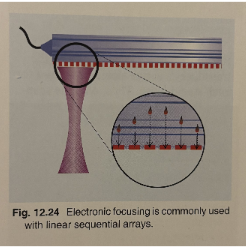
How is transmit focusing achieved in a linear sequential array?
electronic transmit focusing is achieved with a curved excitation pattern of the active elements. The outer elements in the group of PZT crystals are fired earlier than the inner elements.

How is receive focusing achieved in a linear sequential array?
Achieved dynamically by introducing electrical delays in the signals returning from the transducer. The phase delays change continuously during reception, thereby focusing the beam at many depths.

What image shape does a linear sequential array produce?
A rectangular image because sound beams are emitted from small groups of crystals at different locations along the probe face.
Can a linear sequential array create an image wider than its transducer footprint?
The image is never wider than the transducer. Although a transducer with a 10 cm footprint may produce an 8 cm wide image, it cannot create an image wider than 10 cm.

What happens if one PZT element in a linear sequential array is damaged?
only the portion of the image extending directly below the damaged element is affected.

Why does damage to one element only affect part of the image?
Recall that only a small subset of the transducers active elements is fired for each sound pulse. Thus, only the scan lines that would have been created by the defective crystal are affected.
While using linear array transducers, why is it necessary to fire a GROUP of crystals to produce a sound beam? Why can't a single crystal be used instead?
Recall that sound waves produced by a small active element diverge in a spherical shape or a Huygens’ wavelet. A sound wave fired from a SINGLE element of a linear sequential array would have such a shape. The beam would quickly diverge and result in poor lateral resolution. In contrast, a sound beam created by the combination of wavelets from a small group of active elements is directional and well defined.
What would happen if only one crystal were used to create a sound beam?
The sound beam would quickly diverge (spread out).

Can linear sequential array transducers steer sound beams electronically?
Yes, linear arrays can steer sound beams electronically. This form of beam steering created parallelogram-shaped images, rather than rectangular images.
What controls electronic beam steering?
beam formers of phased array systems steer sound beams electronically.

What is a sloped electrical pattern?
An electrical firing pattern where the signals reach the PZT elements at slightly different times, causing the sound beam to travel at an ANGLE. (sloped-pattern phase delays)
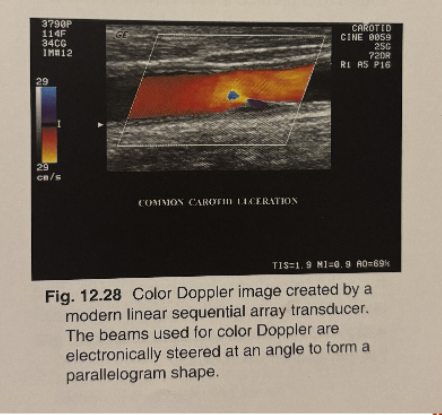
During a color Doppler exam, why might the gray-scale image be rectangular while the color Doppler portion is parallelogram-shaped?
Because the gray-scale beams have no slope and travel straight down, while the Doppler beams have a slope and travel at an angle.
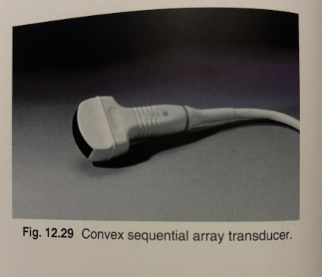
What are convex, curved, or curvilinear arrays?
They are ultrasound transducers with PZT crystals arranged in a bowed or curved shape created to increase the clinical usefulness of linear array transducers.
What type of image does a convex array naturally produce?
A fan-shaped or sector-shaped image.

How many PZT elements does a convex array contain?
A convex array has 120 to 250 rectangular shaped strips of piezoelectric material arranged side by side in a bowed line.
How large is the acoustic footprint of a convex array?
It can be as long as 10 cm. the active elements in a convex sequential array are similar in size to a linear array, and much larger than those found in a phased array. Each crystal is about 1 wavelength in width.
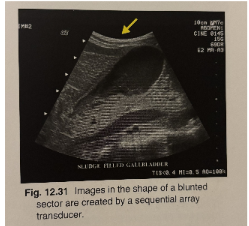
What image shape does a convex array produce?
Blunted sector-shaped images are created by a convex array. At intermediate depths, these images have a traditional sector shape; however, rather than coming to a point in the near field, the image appears to have a “bite” taken out of it.

Why does the image look like it has a “bite” taken out of the top?
Because the transducer is curved, so the image does not begin at one pointed location.
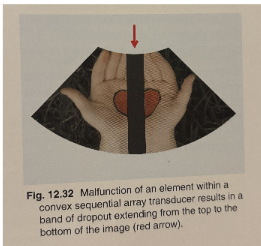
What happens if one active PZT element in a convex array is damaged?
Only the portion of the image directly below that element is affected.

What is a vector array transducer?
A combination of linear sequential and linear phased array technologies. Vector array is also known as virtual sector
What is the main advantage of a vector array?
Sloped phase delay patterns can electronically steer the sound beams in different directions.

How many PZT elements does a vector array contain?
A vector array is designed with 120 to 250 RECTANGULAR-shaped strips of piezoelectric material arranged side by side in a line. The footprint of the vector array may be small, often only a few centimeters
What two technologies does vector array beam steering combine?
combines linear and phased array technologies. Some, but not all, of the crystals are fired simultaneously to create a single sound beam in vector arrays. This is similar to a linear sequential array transducer.
How does a vector array steer its sound beams electronically?
The beam former sends electrical signals with sloped timing patterns to a group of active elements as they excite a group of elements in a vector array. As a result, the beams radiate out in different directions from the face of the transducer. This is similar to a phased array transducer.