13. Diet-treatment interactions
 Call Kai
 Learn
Learn Practice Test
 Spaced Repetition
 Match
Match Flashcards
 Knowt Play
1/21

There's no tags or description
Looks like no tags are added yet.
Name | Mastery | Learn | Test | Matching | Spaced | Call with Kai | Chat |
|---|
No analytics yet
Send a link to your students to track their progress
22 Terms
Effect of food on drugs
more acute
shows up as an increase or reduction of known effects and side effects of the drug
often recognized because they are fast acting and tied to an obvious drug response
Effec of drugs on food
Much slower
Outcome is related to nutrients/nutrition
often missed
Nutrition and pharmacology overview
most of nutrition and supplement have an effect on ADME

Interactions prior to administration
= mixing drug in food (e.g. patient has trouble swallowing so drug is mixed with apple sauce)
can be okay, but don’t do it if possible because:
dosage forms often need to stay intact
medication can degrade or react with the food
Never mix medicines with food unless you checked.
Main causes of food → drug interactions
Interactions prior to administration
Interations in the gastro-intestinal tract
Interference of uptake from the GI tract
Modulation of drug biotransformation
… (other pharmokinetic effects)
Pharmacodynamic interactions
How can ADME and food be related
Antibiotics may bind to Ca, Mg, Fe in the gatrointestinal tract because that may form insoluble complex (-)
Full stomach - empty stomach effects (±)
Effects of fatty meals (±)
Interactions during absorption from the intestine (±)
Effects on metabolism (biotransformation) in the liver (±)
Processes determining oral bioavailability
Humans are actually not made to take drugs orally
Because they will pass through liver which is made for detoxification = drug does not work.
But it should be able to pass through liver and end up in systemic circulation

Taking a drug on a full or empty stomach?
Delayed gastric emptying → decreased absorption rate
If you take a drug on a full stomach the effect takes much longer to take place
If you take a drug on an empty stomach the effect takes place immediately
Effect on bio-availability depends on:
Acid stability
dissolution behavior in stomach
Effects of taking a drug after consuming a fatty meal
Increased bioavailability of lipophilic durgs:
For lipophilic drugs - such as Abiraterone, Lapatinib and cannabidiol (CBD) - taking these with a fatty meal increases its systemic absorption greatly.
Delayed gastric emptying: High fat meals take much longer to digest, this may cause drugs to take effect much later.
Unpredictable fluctuations and risk of toxicity: although high absorption seems advantageous, meal fat content may vary widely from day to day. Therefore medications with a narrow therapeutic window - such as oral chemotherapies, unpredictable spikes are not great.
Therefore during chemotherapy they attempt to have a very stable diet to avoid sudden dietary changes

Explain this scheme
Summarizes how a high-fat meal affects oral drug absorption
Depending on where a drug falls in the biopharmaceutics classification system which sorts drugs along two axes: solubility and pemeability
F= bioavailability
Tmax = time to reach max plasma concentration
Class 1 = like paracetamol
Class 2 = typically compounds not well soluble in water. Therefore if they are highly permeable, then they are likely fat soluble.
Class 3 = Usually very polar compounds, so polar that therefore they do not pass membrane and can be used if there is an infection in the stomach. Polarity causes them to be taken up much slower.
Class 4 = most chemotherapeutic drugs. Hard to predict, can go any direction.
Why it is so difficult to predict what certain drugs will do?
Humans evolved active transport mechanisms in the gut and liver to absorb essential nutrients (vitamins, amino acids, cholesterol) while activley pumping out plant toxins
However, many drugs use these nutrients transporters, cellular pumps, and liver detoxification enzymes to enter the bloodstream or be expelled
Because foods, dietary supplements, herbal compounds, and drugs all compete for the same specific transport and metabolic pathways, interferences are highly unpredictable. A specific plant compound might block or stimulate a transporter used by one drug while leaving another drug untouched—even within the same class of medication
Many targeted therapies against cancer have complicated physical properties. Because these drugs have a narrow therapeutic window, subtle variations in how our evolved transport systems handle them can easily cause unexpected drug toxicity or treatment failure.
Important enzyme present in the liver
Cytochrome P450
Involved in the metabolism of many drugs
There are different forms in the liver (and intestines), each with a certain selectivity for certain substances (different forms seen in picture)
Activity may differ per person (age, gender, polymorphism) and per situation
Affected by other pharmaceuticals and sometimes also food.
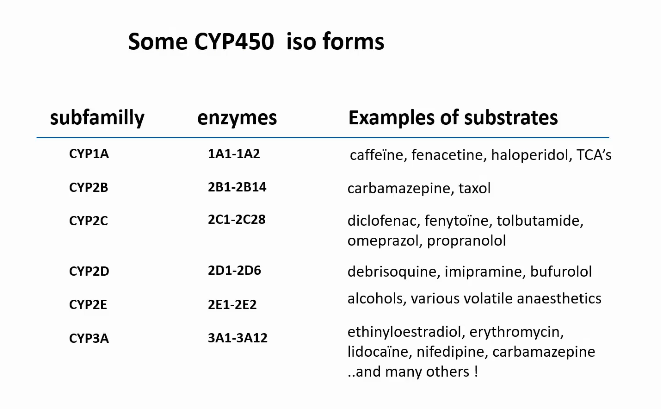
CYP3A4
An isoform of CYP450
Commonly used enzyme in regards to drugs.
Works in two ways depending if they drug is in an active form or as an inactive pro-drug
If an active drug is broken down into an inactive form, inhibiting the enzyme increases drug blood levels whereas stimulating it lowers drug levels
If a pro-drug requires CYP3A4 to convert into its active metabolite, inhibiting the enzyme prevents the drug from becoming active
Grapefruit juice can inhibit CYP3A4 = dangerous
Grapefruit juice, CYP3A4 and drug interactions
Grapefruit contains flavonoid compounds that inhibit CYP3A4.
This blocks the breakdown of active drugs, causing plasma concentrations and exposure to rise sharply.
Interactions with St. John’s Wort
Doesnt inhibit CYP3A4 but stimulates it.
This accelerates the breakdown of medications such as busulfan, cyclophosphamide, and paclitaxel into inactive forms, leading to abnormally low blood levels and therapeutic failure
Challenges of making drugs against cancer
Pharmokinetics has often become the final concern
Frequently poorly soluble in both water and fat (‘brick dust’)
Low bioavailability
Many interactions, including with food.
How can high-dose herbal supplements interfere with drug biotransformation? (Curcuma)
Curcumin acts as an inhibitor of the CYP3A4 enzyme
For example tamoxifen is used as an anti-hormone drug in breast cancer
Tamoxifen is only active when converted by CYP2D6 and CYP3A4 into endoxifen
Therefore high doses of curcuma will reduce the drug efficacy.
Especially if patients are rapid metabolizers for CYP2D6, if then CYP3A4 is slow due to the curcuma, it will limit the effectiveness of the drug (polymorphism)
Effect of drugs on food
Effects of drugs in the oral cavity
Effects on taste or sense of smell
Effects on appetite or satiety (+ or -)
Various effects in the GI tract
Metabolic effect
Disturbance of absorption or metabolism of micronutrients
Disturbance of microbiota
Nutrition related problems caused by drugs
Direct GI effects: loss of appetite, nausea, vomiting, and altered taste, mucositis, xerostomia, diarrhea, constipation
Protein-energy malnutrition/weight loss (because you eat less if nauseaus, altered taste, etc)
Specific nutrient deficiencies, such as B12 and folic acid depletion from antifolate drugs, electrolyte imbalances
Side effects of drugs in the oral cavity
Diverse forms of ulcera, opportunistic infections
Erythema, swelling of gingiva, salivary glands
Tongue abnormalities
Problems with (false-) teeth
taste and/or smell disorders
dry mouth
Xerostomia
Common in cancer patients
Often associated with/caused by drug use
long list of compounds potentially involved, in particular: many anti-cancer drugs, also other tricyclic anti-depressants, SSRIs, anti-cholinergics, beta-blockers, opiates, some antihistamines etc.
Cachexia
a complex condition marked by severe, unintentional weight loss and muscle wasting that cannot be reversed by normal nutrition alone
Changes drug adminstration as ADME is changed
e.g. if drug is lipophilic normally a higher dose would be given as some would end up in people’s fat
Therefore people with cachexia need a lower dose