Development of Human Locomotion Chapter 5
 Call Kai
 Learn
 Practice Test
 Spaced Repetition
 Match
 Flashcards
 Knowt Play
1/46

There's no tags or description
Looks like no tags are added yet.
47 Terms
Loco means
from place to place
Motion is the action
or process of moving or being moved
Locomotion is
the act of moving or the capability to move, from place to place
Whole Body approach
describe the developmental sequences of running
(stages)
Component Approach
changes that are expected to occur with each body segment
(Steps)
Before Locomotion, we must do what
Hit Milestones of
Crawling → Creeping → Stand → Walk
Crawling is from ages
7-8 months
chest and stomach are on the floor or minimally elevated
Creeping is from ages
9-12 months
arms and legs are alternating to locomote
Standing happens around what age
9 months
attaining an upright position
use of external objects
There is different perspectives for infants in _________
Walking
Progressive alternation of leading leg and continuous contact with supporting surface
Gait Cycle: Swing and Support Phase
What are the two types of balance?
Static and Dynamic
What can improve walking balance?
Dynamic Base, Foot Angle, Speed
Walking Constraints
Muscular Strength
Balance
Walking with external loads (heavy backpacks)
Clothing/footwear
What is a natural extension of walking?
Running
Children exhibit early running skills 6-7 months after onset of independent walking
difference from running and walking : running has flight phase
Development Aspects (Phases) of running
Support, Flight and Recovery Phases
Running Constraints
Balance and Muscular Strength (Flight Phase)
Running Whole Body Approach
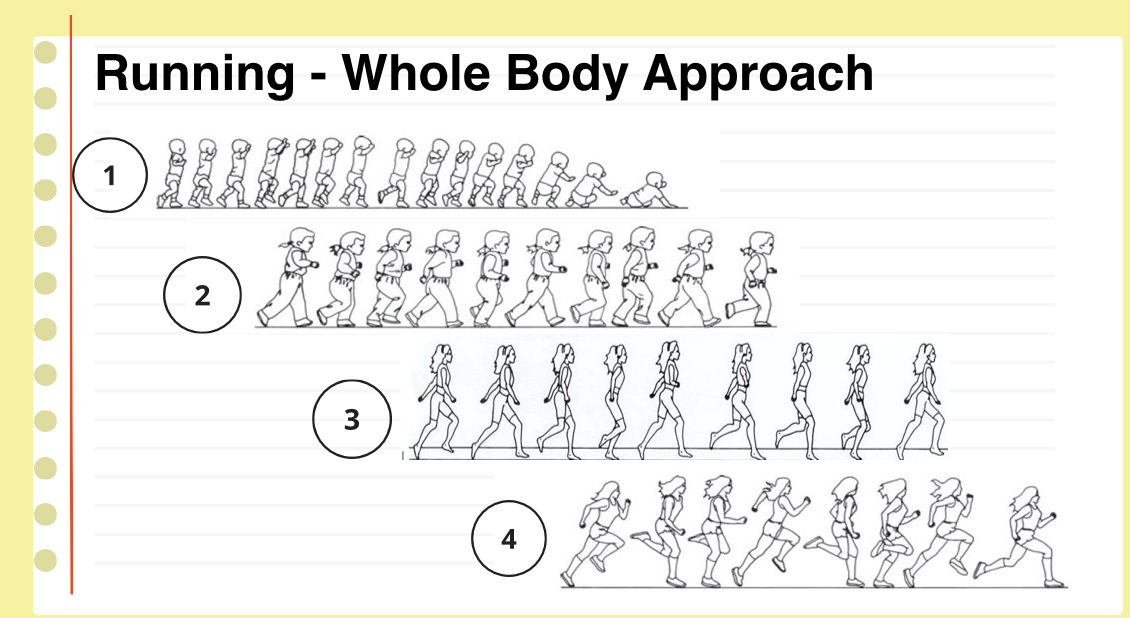
Running Leg Action
Step 1: Run is flat-footed with minimal flight
Step 2: Swing thigh moves with greater acceleration, causing 90 degree maximal flexion of the knee, flight time increases
Step 3: Heel-toe, swing leg is primarily forward, support leg moves from flexion to complete extension by takeoff
Running Arm Action
Step 1: Arms do not participate in running action, held in high guard
Step 2: Spinal rotation swings arms bilaterally, flailing appearance
Step 3: Spinal rotation continues to be the prime mover of the arms, elbow is flexed
Step 4: Upper arm begins to drive forward and back. Arm opposition and elbow flexion.
Jumping is when an individual
propel themselves off the ground with one or both feet and then land on both feet
hopping, leap, vertical jump, and horizontal jump
What kind of jump is when an individual propel themselves with one force and land on the same foot
Hopping
Leaping occurs
when individual propel themselves with one foot and land on the other
What jump type is when the body thrusts upward
Vertical Jump
Horizontal Jump is when
body is thrusted upwards and forward
Jumping Phases
Preparatory, Takeoff, Flight, and Landing
Jumping Phase 1 : Preparatory
Crouch and backward swing of arms
Jumping Phase 2 : Takeoff
Body fully extends, arms are forward
Jumping Phase 3 : Flight
Extension of the hips, knees and ankles, vigorous swing of arms airborne
Jumping Phase 4 : Landing
Absorbing the landing forces by flexing knees, hips and ankles
Landing feet ahead of center of gravity
Jumping Constraints
Strength, Muscular Power, Arm-Leg Coordination
Standing Long Jump - Whole Body Approach
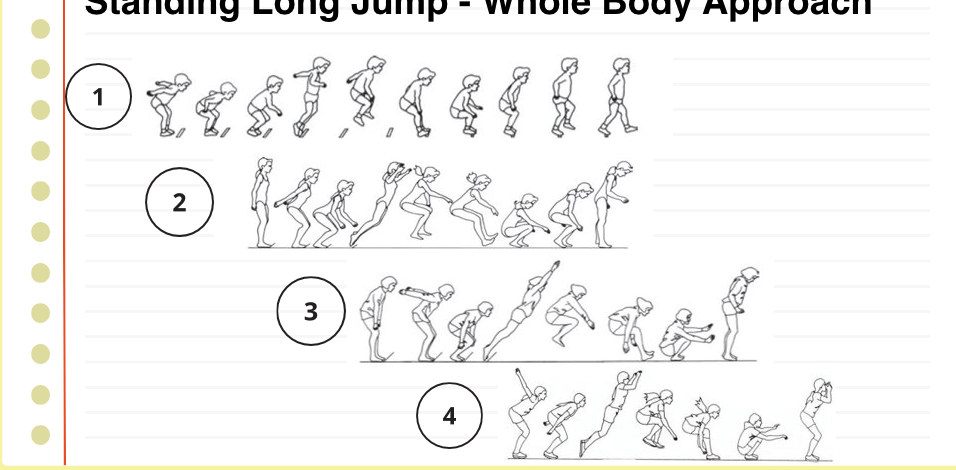
Standing Long Jump: Developmental Sequence - Arm Take Off Phase
Step 1: Arm inactive
Step 2: Winging arms
Step 3: Arms abducted
Step 4: Arms forward; partial stretch
Step 5: Arms forward; full stretch
Standing Long Jump: Developmental Sequence - Arm Flight and Landing Phase
Step 1: Arms winging
Step 2: Arms abducted; lateral rotation
Step 3: Arms abducted; medial rotation
Step 4: Arms overhead
Standing Long Jump - Developmental Sequence - Trunk Take Off Phase
Step 1: Slight lean, head back
Step 2: Slight lean, head aligned
Step 3: Forward lean, chin tucked
Step 4: Forward lean, head aligned
Standing Long Jump - Developmental Sequence - Trunk Flight and Landing Phase
Step 1: Slight lean
Step 2: Corrected lean
Step 3: Maintained lean
Standing Long Jump - Developmental Sequence - Leg Take Off Phase
Step 1: Fall and Catch, weight is shifted forward
Step 2: Two-footed takeoff, partial extension
Step 3: Two-footed takeoff, full extension
Standing Long Jump - Developmental Sequence - Leg Flight and Landing Phase
Step 1: Minimal tuck
Step 2: Partial tuck, hips and knees flex in synch, knees extend for two-foot landing
Step 3: Full tuck, flexion of both knees precedes hip flexion, knees extend to reach two-foot landing
Jumping - Developmental Sequence - Vertical Jump INITIAL STAGE
Inconsistent preparatory crouch
Difficulty in taking off with both feet
Poor body extension
Little or no head lift
Arms not coordinated with the trunk and leg action
Jumping - Developmental Sequence - Vertical Jump ELEMENTARY PHASE
Knee flexion exceeding 90 deg angle on preparatory crouch
Exaggerated forward lean during crouch
Two-footed takeoff
Not fully extended
Arms attempting to aid in flight and balance
Noticeable horizontal displacements on landing
Jumping - Developmental Sequence - Vertical Jump MATURE STAGE
Preparatory crouch with knee flexion from 60-90 deg
Forceful extension at hips, knees, and ankles
Simultaneous coordinated upward arm lift
Upward head tilt with eyes focused on target
Full body extension
Controlled landing very close to point of takeoff
Hopping is when an individual
propel themselves with one force on the same foot
Requires additional strength and better balance
Children perform better on their preferred foot
Hopping - Whole Body Approach

Hopping - Developmental Sequence - Leg Action
Step 1: Momentary flight
Step 2: Fall & catch; swing leg inactive
Step 3: Projected take-off, swing leg assists
Step 4: Projected delay, swing leg leads
Hopping - Developmental Sequence - Arm Action
Step 1: Bilateral inactive
Step 2: Bilateral reactive
Step 3: Bilateral assist
Step 4: Semi-opposition
Step 5: Opposing assist
________ Emerge shortly after running has been accomplished
Galloping
Forward step
Leap by a trailing foot
(Front facing direction, same foot)
Sliding is the same as
gallop, just performed sideways
Child must face straight ahead while moving sideways
Challenging as children are required to face a different direction, and may turn to perform galloping
For skipping, most
difficult
Forward, followed by a hop on the same foot, alternating leading foot
GOOD TO KNOW!