Bio Chem Ch 13
 Call Kai
 Learn
Learn Practice Test
 Spaced Repetition
 Match
Match Flashcards
 Knowt Play
1/26

There's no tags or description
Looks like no tags are added yet.
Name | Mastery | Learn | Test | Matching | Spaced | Call with Kai | Chat |
|---|
No analytics yet
Send a link to your students to track their progress
27 Terms
autoradiography
used to visualize imaged that have been exposed to oligonucleotides that have been radiolabeled
Florescence
EtBr slips between DNA bases and can be used as a stain
Nucleases
catalyze hydrolysis of phosphodiester backbone of nucleic acids
Endonuclease
cleavage in the middle
Exonuclease
cleavage at the ends of the molecule
Restriction Endonucleases
crucial role in recombinant DNA, cleaves double stranded DNA
recognizes palindrome (read same from both ends)
sticky ends joined by hydrogen bonding between complementary bases
ligase reseals ends
EcoR1
Cleaves between A and G
Leaves sticky ends
Hae III
Cleaves between C and G
Leaves blunt ends
Gel Electrophoresis
separates based on size
Positive and negative end
No SDS
Recombinant DNA
molecules that contain DNA from two sources
Vectors
sources for getting recombinant DNA into cells
Phage
bacteria that infect viruses
Viral
Plasmid
small circular double stranded DNA molecule separate from chromosomal DNA
replicates independently
used for cloning
Bacterial
Plasmid- Selection
plasmid has selectable marker that indicated bacteria contains plasmid
antibiotic resistance
Plasmid criteria
origin of replication
Selectable marker
Multiple cloning site and restriction sites
Cloning with pUC plasmids
cut foreign DNA with two different endonucleases
Cut plasmid with endonucleases
Blue/white screening
pUC plasmid contains lacZ gene
codes to cleave disaccharides
contains X-gal that is colorless unless it interacts with B-galactosidase
when foreign DNA is inserted, it disrupts the lacZ gene
No growth on petri dish
no resistance
no plasmid
Blue on dish
resistance
no DNA
took up plasmid
No color
took up plasmid
DNA insterted

Expression Vectors
Used to make proteins
Needs origin of replication, multiple cloning sites, one selectable marker
must be able to be transcribed with
promoter
ribosomal binding site
transcription termination sequence
Polymerase chain reaction (PCR)
increases the amount of given DNA without cloning DNA
heat DNA to separate

PCR key component
taq polymerase from thermos aquatics
PCR primer issues
needs the same GC content
needs to be the same length
cannot be complementary
DNA fingerprinting
shows only selected DNA sequences
DNA digested with restriction enzymes and ran on agarose gel
Uses southern blot: matches complementary DNA
Digest DNA with restriction endonucleases
Put in agarose gel electrohporases
Transferred to nitrocellulose paper
Incubate with DNA probe
Compare DNA to sample
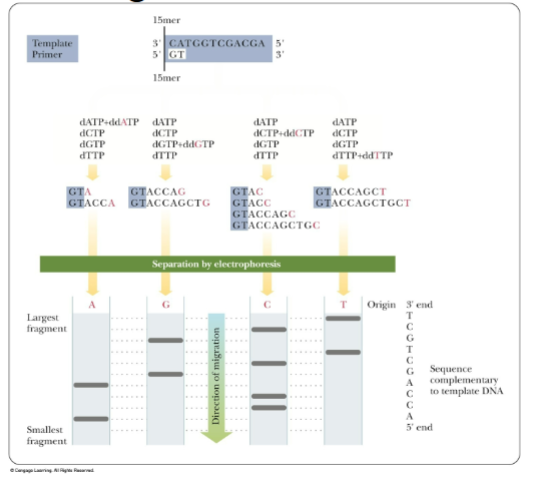
Sequencing DNA
uses dideoxy nucleotides
missing OH at 3’, doesn’t allow DNA replication
incorporates ddNTP on chain causes termination
DNA sequence is mixed with oligonucleotide that serves as a primer for synthesis of complementary strand
gel elctrophoresis is used to read strand