4) EPQs: Transport Across Membranes
 Call Kai
 Learn
 Practice Test
 Spaced Repetition
 Match
 Flashcards
 Knowt Play
1/12

There's no tags or description
Looks like no tags are added yet.
13 Terms

Answer:
i) Membrane fluidity allows proteins to diffuse laterally in the membrane.
ii) Active fluorescent proteins will eventually diffuse into the bleached area, turning it fluorescent again.
iii) From the information provided, we know that the shorter the recovery time, the higher the membrane fluidity. When cholesterol concentration increases, recovery time also increases. This is because cholesterol can fit between fatty acid tails of phospholipids, restricting the movement of membrane components.
iv) Cholesterol provides strength to the cell membrane. Red blood cells require more cholesterol to withstand the physical force they experience as they’re squeezed through capillaries. Gut epithelial cells don’t experience this physical force, so don’t need as much cholesterol.
v) One variable that must be kept constant is temperature. This is because it affects the kinetic energy of molecules in the membrane. Another variable that must be kept constant is the size of the area bleached. This is because it affects how many fluorescent proteins must diffuse into the dark patch to restore fluorescence.

Answer:
i) In the cells in Figure 1, the cell membranes are detached from the cell walls. This is because the salt solution the cells were placed in has a lower water potential than the plant cells, which causes water to leave the cells via osmosis.
ii) The condition of the cells in Figure 1 is a problem for plants because the leaves will begin to wilt, which disrupts photosynthesis.
iii) The palisade cells can return to their normal appearance by decreasing their water potentials, which is achieved by actively transporting ions into the cells.

Answer:
Donated human organs are placed in an isotonic solution during transport to ensure there is no net movement of water into or out of the cells via osmosis. If there was net movement of water into the cells of the organ via osmosis, the cells would burst. In contrast, if there was net movement of water out of the cells of the organ via osmosis, the cells would shrivel.

Answer:
i) First, place samples of the plant tissue in solutions with different concentrations of solutes. Next, after a period of time, record the change in the mass of the tissues. Using these results, plot a calibration curve. Finally, from this calibration curve, record the solute concentration where there is no change in mass of the plant tissue. This solute concentration has the same water potential as the plant tissue.
ii) A lower water potential in the leaves means the leaves have a smaller water potential gradient with the surrounding air. This means that less water is lost in transpiration, which is advantageous to plants in hot, dry climates.
iii) The student’s conclusion could be correct because he calculated a correlation coefficient of 0.4, which indicates a weak positive correlation between the water potential of a plant and the distance from the equator where the sample was collected. However, the student only used 5 plants, which is a very small sample size. Furthermore, he only sampled one individual of each plant species, which may not represent the global distribution of the species.

Answer:
First, urea is hydrophilic, meaning it can only pass through channels in the membrane. Next, urea has a complementary shape to channel proteins, meaning it can attach to channel proteins.

Answer:
First, the cell has microvilli, creating a large surface area. Second, there are also many channel proteins, which can be used for facilitated diffusion. Additionally, the cell also has many mitochondria, which are used to produce ATP for active transport.
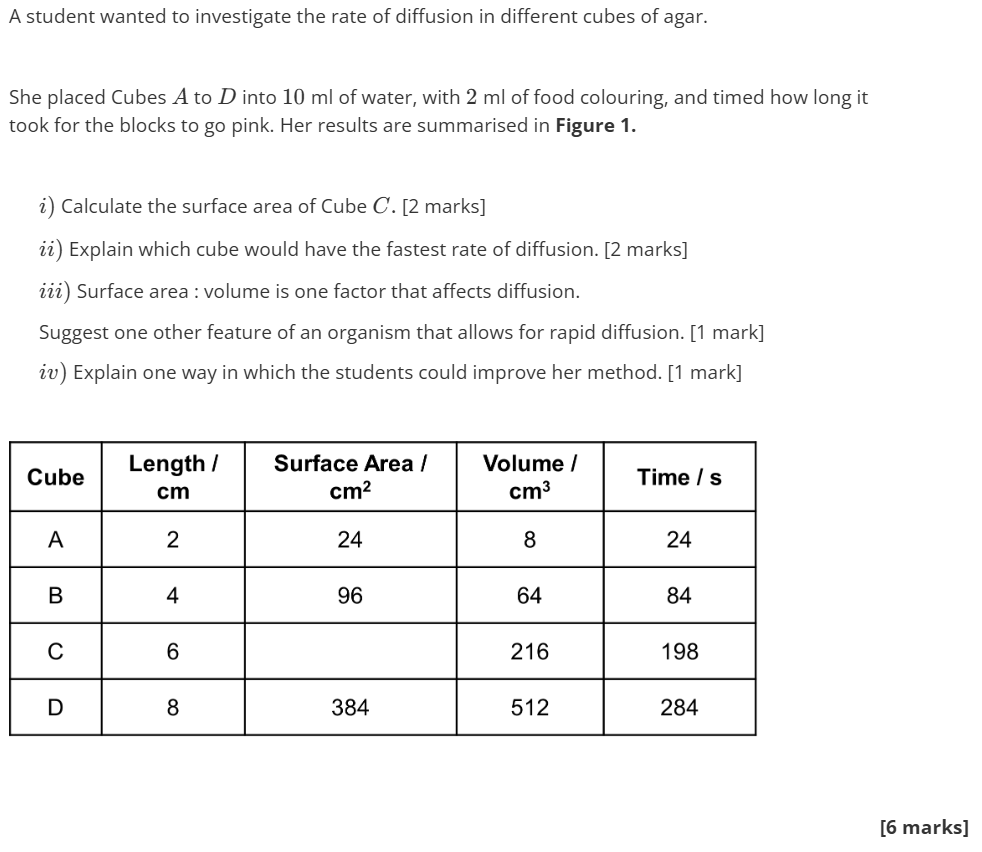
Answer:
i) 216
ii) Cube A has the fastest rate of diffusion. Because it has the largest surface area to volume ratio.
iii) One other feature that allows for rapid diffusion is a short diffusion pathway.
iv) The student could improve her method by repeating the experiment and calculating an average.


Answer:
A tadpole has a higher surface area to volume ratio than a frog. This means that a tadpole does not need lungs because there is rapid gas exchange through the skin of the tadpole.

Answer:
Single-celled organisms have a large surface area to volume ratio. This ensures a short diffusion pathway, which allows for the fast diffusion of gases through the surface of single-celled organisms.

Answer:
ATP is broken down through a hydrolysis reaction into ADP and an inorganic phosphate ion. This reaction is catalysed by ATP hydrolase. During ATP hydrolysis, energy is released. The inorganic phosphate ion can bind to, or phosphorylate, other compounds in the cell.

Answer:
i) As the concentration of ATP increases, more energy is released. The more energy that is available, the more muscle contraction can take place, which causes the length of the muscle tissue to shorten.
ii) The volume of the ATP solution must be kept the same. Additionally, the temperature of the ATP solution must also be kept the same.
iii) It takes longer for the muscle to break down glucose into ATP, which provides energy for muscle contraction.

Answer:
Facilitated diffusion and active transport both use carrier proteins and they both transport substances across membranes. In contrast, facilitated diffusion is passive whereas active transport requires ATP. Additionally, facilitated diffusion occurs down a concentration gradient, whereas active transport occurs against a concentration gradient. Another difference is that facilitated diffusion uses carrier and channel proteins, whereas active transport only uses carrier proteins.

Answer:
i) X is simple diffusion and Y is active transport.
ii) Active transport uses carrier proteins to move molecules. Once all carrier proteins are in use, the rate of uptake can’t increase.
iii) The concentration of solute inside the cell exceeds the concentration of solute outside the cell, meaning solutes no longer mainly diffuse into the cell. This causes the rate of simple diffusion to fall.