BIOL 438 exam 2 Lecture 26
 Call Kai
 Learn
 Practice Test
 Spaced Repetition
 Match
 Flashcards
 Knowt Play
1/35

There's no tags or description
Looks like no tags are added yet.
36 Terms
What is Transduction
Transfer of bacterial genes by viruses
What are the basic components of a viron
Genetic material (DNA or RNA)
a protein coat (the capsid)
an outer envelope (ocasionally)

What is a Bacteriophage (Phage)
a virus that infects and replicates within bacteria and archaea

How much bacteriophages are there on the planet
more than 1031 bacteriophages on the planet, more than every other organism on Earth, including bacteria, combined.
anatomy of a bacteriophage

How does the virus in transduction aquire genetic material in the first place
During viral assembly, random fragments of host chromosomal DNA are packaged into phage particles

transducing particles
random fragments of host chromosomal DNA that are packaged into phage particles

What is the process of Generalized transduction
A bacteriophage attaches to a bacterium and injects its DNA.
the phage takes over the bacterial cell, and the host bacterial DNA is broken into smaller pieces, while new phage DNA and proteins are produced
When new phages are assembled, one accidentally packages a piece of the bacterial DNA instead of phage DNA. (transducing phage)
The transducing phage infects another bacterium
The transferred DNA can exchange matching sections with the recipient bacterium's chromosome.
The recipient now has new genetic information from the original donor bacterium!

What can transuction help with
Is very useful in the laboratory to determine the linkage (cotransduction) of genes and for strain construction

What is linkage?
Linkage = two genes are located on the same chromosome and are close enough, so they tend to be inherited together.
if they are on the same chromosome, they are linked.
If not, they are unlinked

what is Specialized Transduction
Process in which specific host DNA sequences are covalently attached to phage DNAs and transferred between cells as by the phages

Process of Specialized Transduction
the phage genome inserts itself into the bacterial chromosome via site-specific recombination
In normal exision, when the pahge tries to leave, it removes ONLY its own DNA.
In error in exision, The phage accidentally cuts out some neighboring bacterial DNA, and also loses some of its own DNA.

Whats the difference between generalized and specialized transduction
bacteriophages can take any portion of the host genome in generalized transduction, whereas bacteriophages pick up only a specific part of the host’s genome in specialized transduction.
DNASE effect on transduction
Usually resistant: transferred DNA is protected inside the phage capsid
how does antibiotic resistance happen

What can happen once antibiotic resistance originates in a bacterial population
it may be transmitted to other bacteria
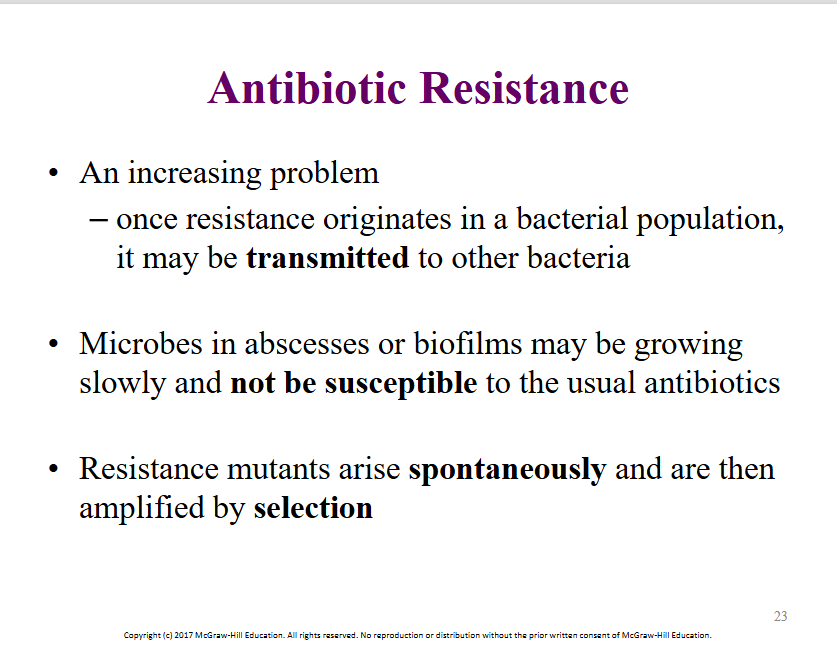
What is unique about Bacteria hiding in biofilms or abscesses in terms of resistance
Antibiotics often work best against actively growing bacteria. Therefore, these bacteria may survive normal antibiotic treatment due to the fact that they grow slow.
What is a good example of an antibiotic resistant superbug
Staphylococcus aureus
What is Staphylococcus aureus resistant to
vancomycin
how did Staphylococcus aureus aquire resistance to vancomycin
conjugation with vancomycin-resistant Enterococcus (VRE) aquired from one patient
Where was the Antibiotic Resistant Staphylococcus aureus isolated?
isolated from foot ulcers on a diabetic patient
what are the types of Antibiotic Resistance
can be inherent
the result of mutations
or an Acquisition of antibiotic resistance by horizontal gene transfer
What is an example of Inherent Antibiotic Resistance
Mycoplasma, which are wall-less, are resistant to β-lactam antibiotics
What is more resistant to antibiotics, Gram-negative or Gram-positives?
Gram-negative bacteria are more resistant to antibiotics than Gram-positives, because the outer membrane is a permeability barrier

What are the mechanisms of aquired drug resistance?
Mutations that affect drug entrance
modification of target
drug efflux
drug inactivation
Use of alternative pathways
increased production of target metabolite
entrance, modify, kick out, inactivated, go to alternative party, which causes increased production
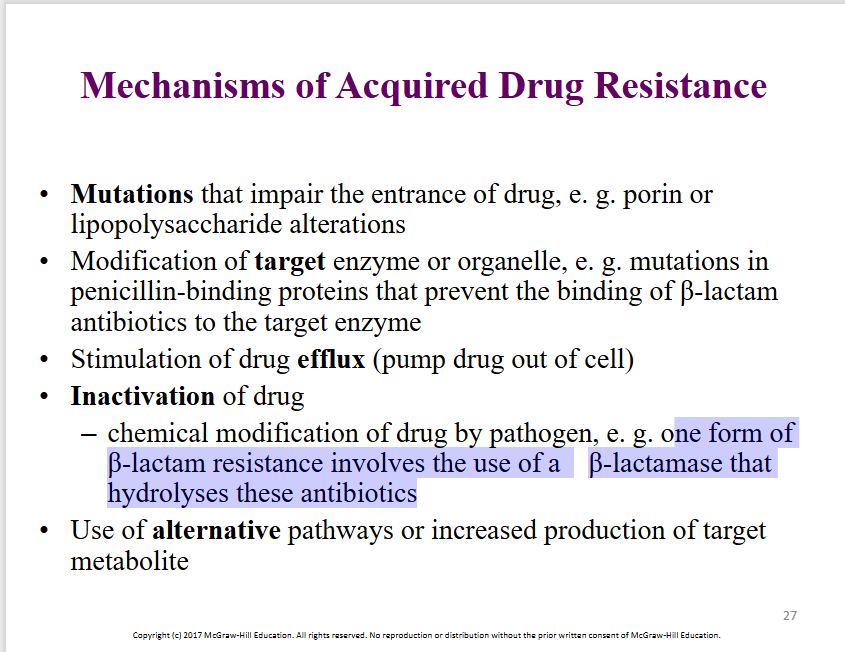
What is an example of drug resisitance which involves Modification of target enzyme or organelle
mutations in penicillin-binding proteins that prevent the binding of β-lactam antibiotics to the target enzyme

What is an example of drug resisitance which involves Inactivation of drug
ne form of β-lactam resistance involves the use of a β-lactamase that hydrolyses these antibiotics

“Immunity” genes
resistance genes that exist in nature to protect antibiotic producing microbes from their own antibiotics, transferred immunity genes from antibiotic producers to non-producing microbes can cause resistance

Where can Resistance genes can be found on
bacterial chromosomes
plasmids
transposons
How can Drug Resistance elements be easily exchanged between bacteria
When found on mobile genetic elements
What are resistance plasmids
can be transferred to other cells by conjugation, transduction, and transformation
– can carry multiple resistance genes

Composite transposons
Origin and Transmission of antibiotic resistance
contain genes for antibiotic resistance – some have multiple resistance genes, and can move rapidly between plasmids and through a
bacterial population
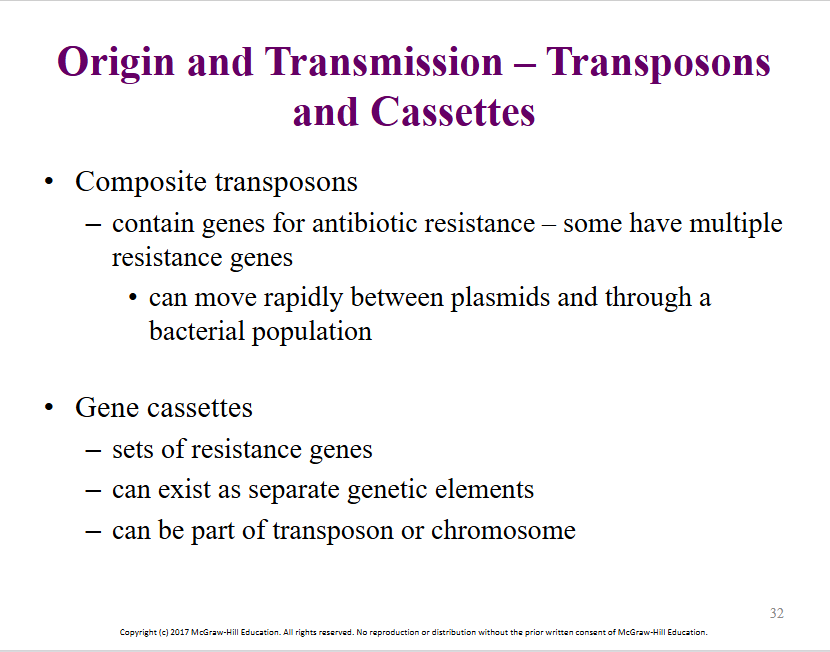
Gene cassettes
Origin and Transmission of antibiotic resistance
sets of resistance genes
– can exist as separate genetic elements
– can be part of transposon or chromosome
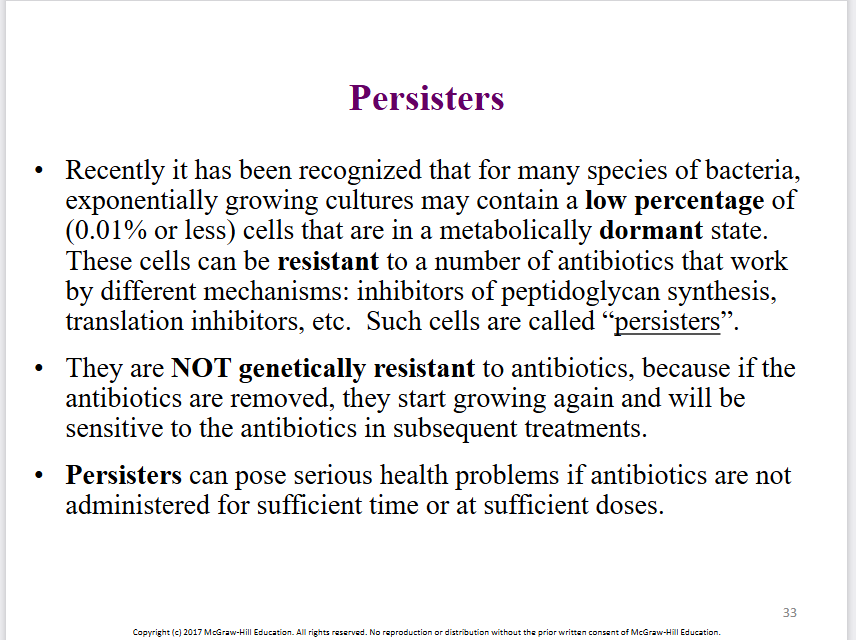
What are persisters
a low percentage (0.01%) of bacterial cells in a exponentially growing culture that are in a dormant state
Due to this they are resistant to inhibitors of peptidoglycan synthesis, translation inhibitors, etc. due to the fact they are not growing.

Are persisters genetically resistant to antibiotics?
They are NOT genetically resistant to antibiotics, because if the antibiotics are removed, they start growing again and will be sensitive to the antibiotics in subsequent treatments.
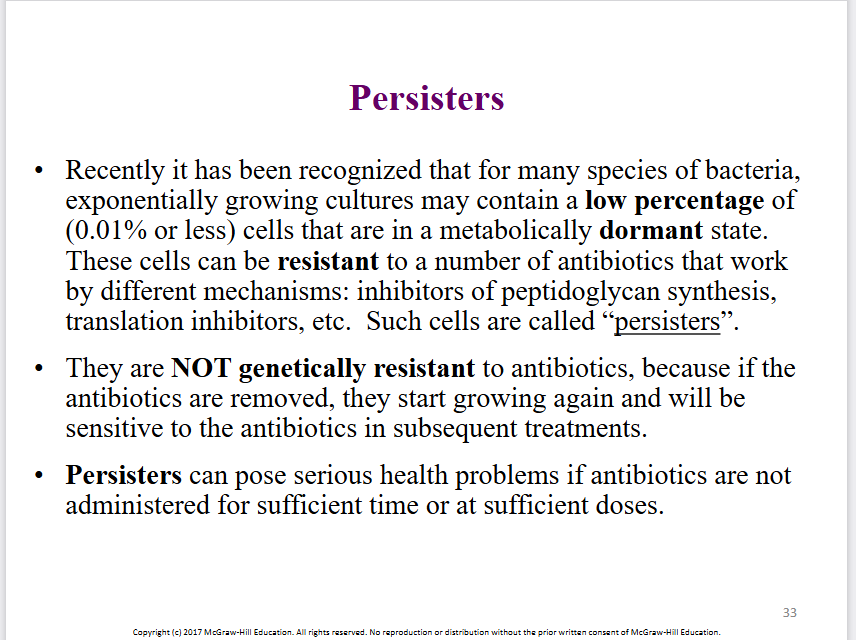
When can persisters cause serious health problems
Persisters can pose serious health problems if antibiotics are not
administered for sufficient time or at sufficient doses.