Lecture 11 - Meiosis
 Call Kai
 Learn
 Practice Test
 Spaced Repetition
 Match
 Flashcards
 Knowt Play
1/14

There's no tags or description
Looks like no tags are added yet.
15 Terms
heredity
transmission of traits from one generation to the next
variation
differences between individuals
genetics
the study of heredity and hereditary variations
gametes
reproductive cells that transmit genes from one generation to the next
asexual reproduction
single parent produces offspring
unicellular → divide
multicellular → buddy or fragmentation
in eukaryotes:
1 diploid parent → 2 diploid offspring
1 haploid parent → 2 haploid
clone production
advantages:
fast
less E required
safe
lots of offspring,
keeps adaptations (no genome dilution)
sexual reproduction
fusion of 2 gametes from different parents to form a zygote(diploid cell resulting from fertilization)
gamete(n) + gamete(n) → fertilization → zygote (2n)
not genetically identical to parents
advantages:
genetic variation; offsprings are combinations of parents’ genes and more likely to survive environmental change or stress
disadvantages:
slower
higher E requirement
dangerous
fewer offspring
genome dilution
meiosis
reduction division
4 stages, 2 cell division:
interphase
meiosis I (1st cell division)
interkinesis
meiosis II (2nd cell division
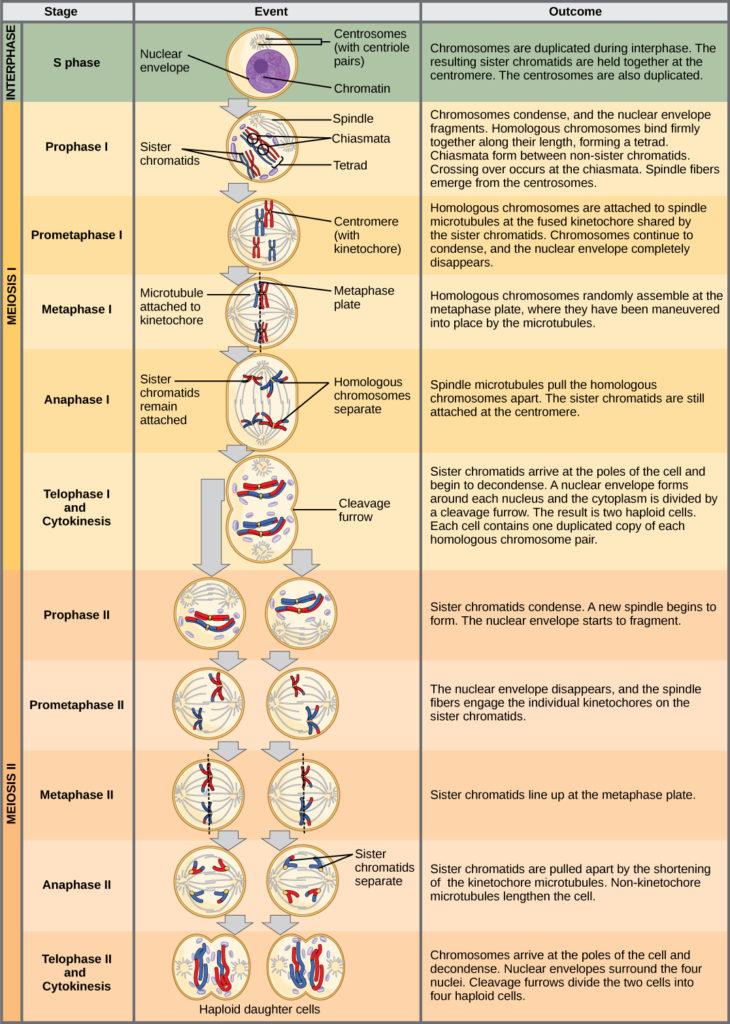
interphase
same as mitosis
cell is highly active - growth, synthesis, metabolic activity
DNA is chromatin throughout
three phases: G1, S, G2
ADDED chromosomes are duplicated
ex. in humans: 2n=46, so 46 chromosomes and 92 chromatids enter meiosis
meiosis I
first meiotic division
homologous chromosomes separate & ploidy reduced
summary:
start with 1 diploid cell with duplicated chromosomes
end with 2 haploid cells with duplicated chromosomes
crossing over in prophase I
homologous pairs separate in anaphase I
sister chromatids do not separate
ploidy is reduced
prophase I
same as mitosis
chromatin condenses into chromosomes
nucleus & nuclear envelope breaks down
mitotic spindle forms
ADDED crossing over & synapsis occurs
homologous chromosomes pair up which result in a tetrad (2 homologous chromosomes & 4 chromatids)
homologous recombination where alleles between non-sister chromatids in tetrad exchange; result in new combinations of genes and diversity
ex. in humans: 46 chromosomes, 23 tetrad, 92 chromatids
metaphase I
same as mitosis
tetrad(instead of chromosomes) align at the metaphase plate
ADDED homologous chromosomes orient towards opposite poles
anaphase I
homologous chromosomes separate (disjunction)
telophase I + cytokinesis
might go straight to cytokinesis
results in 2 haploid cells with duplicated chromosomes
ex. in human: 23 chromosomes in each cell, 46 chromatids, and 0 tetrad (haploid)
interkinesis
time between 1st and 2nd meiotic divisions
interphase-like stage
usually short
no S-phase
no DNA replication
meiosis II
2nd meiotic division
chromatids separate into daughter cells
basically mitosis