Endocrine impacts on kidney function
 Call Kai
 Learn
Learn Practice Test
 Spaced Repetition
 Match
Match Flashcards
 Knowt Play
1/24

There's no tags or description
Looks like no tags are added yet.
Name | Mastery | Learn | Test | Matching | Spaced | Call with Kai | Chat |
|---|
No analytics yet
Send a link to your students to track their progress
25 Terms
What is diabetes Mellitis
When there is high blood glucose, so an increase in osmotic diuresis, increases urination
Diabetes insipidus
increase in urine, ieither kidneys do not respond to any hormone, or the brain may have a tumour preventing the hypothalamus from producing any hormones…
What is central neurogenic diabetes insipidus
failure to prevent diuresis as no ADH
diueresis vs polydiuresis
diuresis = excessive urine production…
polydiuresis = over production of urine ~(in excessive amounts)
What is CENTRAL diabetes insipidus
failure to prevent diuresis (no ADH)
What is secondary nephrogenic diabetes insipidus..
ADH present, B~U~T action = inhibited. E>G> cortisol.. Excessive urination as no water is being absorbed back into the blood…
What 3 endocrine hormones does the kidney secrete..
Renin - poor renal blood flow, promotes circulation
Erythropoietin - renal hypoxia encourages RBC
Vitamin D (calcitrol) - conversion in kidney, Ca + P storage/ release..
What do the kidneys do (basically)
filtration, selective reabsorption, secretion
What is the key component of a kidney
Nephrons. Functionally competent and gradually drop off with age.. Many die as going. 20% cardiac output, glomerulus filters a filtrated out which then becomes filtered..

At what point can you see a rediced renal kidney fucntion
when there is 70% nephron loss (something excreted that would normally be reabsorped)
where does ultrafiltration occour…
glomerulus and the bowmans capsule..Filtratoin = under pressure due to narrow efferenet artereole.. depends on molecules waste proteins do not get through. Can caclulate the Glomerular Filtratoin rate..
Where does most reabsorption occour..
Proximal convoluted tubule.. Epithelial cells have microvilli at the luminal surface and many mitrochondria
What 3 things are removed in ultra filtrate
nitrogenous waste, ureas, phosphorous, potassium (elecrotlytes so that the balance is not damaged…)
How is waster conserved in the kidney
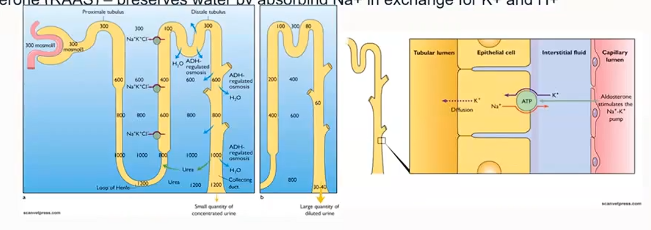
At the loop of hennle.. medullary concentration gradient… vascular network urea trapped + collecting duct… ADH allows reabsorption. High hormone influence… ?Colllecting ducts = final stage of water reabsorption..
What is glucosuria
blood glucose concentration above 14mmol/ l (obesity induced may be
) + may attract pathogensIf too high, glucose cannot be reabsorped as too much, as there is glucose then water will move into it, therefore diuresis as increased water content in the urine
Azotaemia…
Increase urea or creatine
Pre renal azotaemia (not enough blood filtered) LAck of nephrons (renal disease)
Diabetes Insipidus
ADH not being made/ action is blocked
therefore no water reabsorptoin..
Inspection, no ADH..
What is USG
Urine specific gravity, measure the how many osmotic particles are in theurine.. may bbe more or less concentrated urine… think CKD can confirm renal disease
What is the average USG in a cat
1.040
What is the average USG in a dog
1.030
What is a key sign of polyuria
polydipsia
How does glomerular filtrate occour
everything passes outinto the filtrate
PCT reabsorps all useful stuff
loop of Henle concentrates tissue fluid
OSmosisc diltrate. ADH, NA and water..
SUmmary of kidney hormones..
adh - water
alderosterone - Na pump (therefore osmosis so pressure)
Parathyroid - calcium phosphate.. increase ca from bone, increasae renal uptake.. cholecalciferol..S
secondary renal hypoparathyroidism, not getting ri dof phosphate, this then activates pth due to the imbalance..

Hypoadrenocorticism
lack of aldosterone
adrenal cortex at production site
Na not reabsorbed and K not excreted..
Hyperphosphataemia
-CKD, phosphorous retendion. parathyroid gland responds, secondary hyperparathyroidism..
excessive pth production, renal calcium retention + phosphate loss.. hyperthroudism is increased renal flow rate..