Physical Geology 1403 Exam 3 Review
 Call Kai
 Learn
 Practice Test
 Spaced Repetition
 Match
 Flashcards
 Knowt Play
1/109

There's no tags or description
Looks like no tags are added yet.
110 Terms
(I) Stratigraphy
The study of strata (layers) in rocks
(I) Absolute Age
Actual number of years between event and now
(I) Relative Age
Age of one geologic event in relation to another
(I) Stratigraphic Succession
Chronological ordered set of strata
(I) Paleontology
The study of ancient life forms.
(I) Principle of Original Horizontality
Sediments are deposited in horizontal layers.

(I) Principle of Superposition
Each layer of undeformed sedimentary sequence is younger than the one beneath it and older than the one above it.

(I) Principle of Faunal Succession
Sedimentary strata (layers) in an outdrop contain fossils in a definite sequence.

(I) Cross-cutting Relationships
Deformation or intrusion (dike/sills/faults) must take place after rocks were deposited.

(I) Principle of Inclusions
Inclusions are younger than the layer they are within.

(I) Unconformity
Boundary representing missing time
(I) Disconformity
Unconformity on horizontal layers.

(I) Nonconformity
Sedimentary beds overlie metamorphic or igneous rocks.
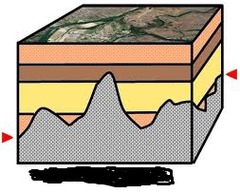
(I) Angular Unconformity
Upper beds overlie lower beds that have been folded by tectonic processes.

(I) Geologic Time Scale
Developed prior to absolute dating- which causes certain boundaries to be determined by mass extinctions (short intervals where large proportion of species disappeared from the fossil record).
- Eons were added AFTER absolute dating.
(I) Eras
1. Paleozoic (Old Life)
2. Mesozoic (Middle Life)
3. Cenozoic (New Life)
(I) Hadean
- 4.56 billion to 3.9 billion
- First recorded rocks (Canadian Shield: 4 billion)
Earth bombarded by material, some grains survive (4.4 billion - Western Australia)
(I) Archean
- 3.9 billion to 2.5 billion
- Start of plate tectonics & first life
(I) Proterozoic
- 2.5 billion to 542 million
- Modern plate tectonics and climate systems
- Increase oxygen in atmosphere
(I) Phanerozoic
- 542 million to present
- Includes the Paleozoic, Mesozoic, Cenozoic eras
(I) Isotopic Dating
Use of naturally occurring radioactive elements to determine the ages of rocks.
- Radioactive isotopes spontaneously decay
- Parent isotope decays to the daughter isotope
(I) Half-Life
The time required for half of parent atoms to be transformed into daughter atoms.
- Half life is not affected by temperature, pressure or environment.

(I) Issues with Absolute Dating
- Daughter isotope could be lost
- Daughter atoms may not start at zero
- Must be able to identify metamorphism vs. original crystallization
- Mineral needs to be present that contains isotope in useful isotope system for dating
(II) Bedrock
Solid rock underneath soil
(II) Outcrop
Exposed bedrock

(II) Formation
Group of rock layers than can be identified throughout a region by their physical properties.

(II) Deformation
Folding, faulting, shearing, compression, extension of rocks by plate tectonic forces.

(II) Tensional Forces
Pull rocks apart (dominant at Divergent boundary)

(II) Compressive Forces
Squeeze and shorten rock (dominant at Convergent boundary)

(II) Shearing Forces
Rocks slide past each other (dominant at transform boundary)
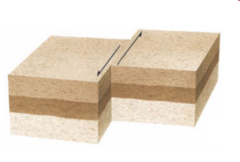
(II) Brittle
Breaks suddenly under stress with little deformation.
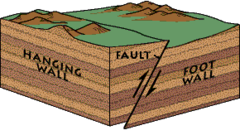
(II) Ductile
Deforms under stress (does not break or snap back)

(II) Brittle vs. Ductile Behaviors Determined by:
- Metamorphism
- Rock Type (Harder rocks are more brittle; igneous, metamorphic. Softer rocks are more ductile: sedimentary)
- How long deformation takes
- Type of stress: brittle behavior is more likely under tensional forces than compressional forces.
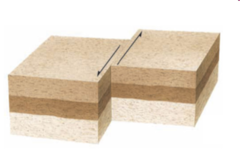
(II) Faults
Fracture that displaces rock

(II) Normal Fault
Tensional forces, hanging wall moves down relative to footwall.

(II) Reverse Fault
Compressional forces, hanging wall moves up relative to footwall.

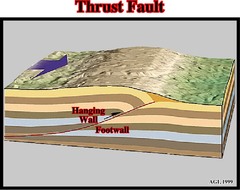
(II) Thrust Fault
Low angle reverse fault.
(II) Strike Slip
Shear forces; two types: Left lateral and right lateral.
(II) Anticlines
Layers bent upwards into arches.
- Oldest rock layer is at the center/core of the fold.

(II) Synclines
Layers bent downwards into troughs.
- Youngest layers are at the center/hinge.

(II) Fold Axis
Line made by dividing fold symmetrically.

(II) Types of Folds
- Horizontal folds
- Plunging folds
- Symmetrical
- Asymmetrical
- Overturning

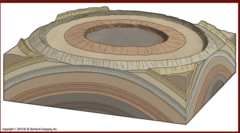
(II) Basin
Bowl shaped synclinal depression
- Youngest rock is in center.

(II) Dome
Anticlinal, circular upward structure.
- Oldest rock is in the center.
(II) Joints
Crack in rock formation where there has been no movement.
- Caused by cooling or release of pressure.

(II) Fault Breccia
Brittle rock fragments within a brittle fault.

(II) Mylonite
Metamorphic rocks formed by shearing forces.

(II) Strike
Compass direction of rock layer where it intersects with horizontal surface.
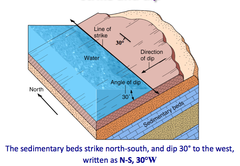
(II) Dip
Amount of tilting.

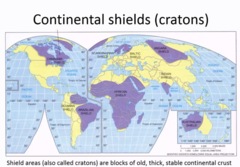
(III) Cratons
Stable parts of continental lithosphere.
(III) Orogens
Elongated mountain belts.

(III) Active Margins
Tectonic processes continue to deform crust.

(III) Passive Margins
Oceanic and continental crust that are not near plate boundaries.

(III) How Continents Grow:
- Magmatic Addition: Vertical transport of felsic material. This can occur at Subduction zones (fluid induced melting creating magma chambers), magmatic differentiation, and melting crust making felsic magma. Ex. Volcanic Island arcs- Ocean to Ocean convergence.
- Accretion: Horizontal transport of crustal material into existing continental masses (forming accreted terranes).
(III) Canadian Shield
- Precambrian (archean)
- Granitic and metamorphic rocks
- Tectonically stable
- Basement rocks are exposed
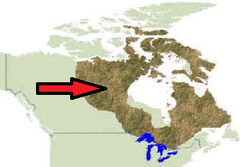
(III) Great Plains / Interior Platform
- Sediments are deposited on stable continental crust
- Flat layers of Paleozoic/Mesozoic sedimentary rocks ( < 2 km thick)
- Deposited in shallow inland seas or floodplains; wetlands and lakes.

(III) Appalachian Fold Belt
- Fold and Thrust belt
- Paleozoic
- Continent to continent collision forming of Pangea from 470 to 270 million years ago
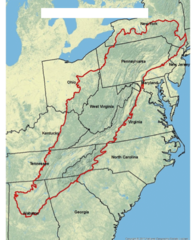
Coastal Plain and Continental Shelf
- Mesozoic (Jurassic age and younger)
- Rifting breaking up Pangaea (180 million years ago)
- Opening up Atlantic ocean forming thermal subsidence basin (sediments 5 km thick)

(III) North American Cordillera
- Cenozoic
- Includes Coast Range, Sierra Nevada, Basin and Range, Colorado Plateau and Rocky Mountains
- Subduction of Farallon plate (now the Juan de Fuca and Cocos Plates) 150 to 50 million years ago, 2nd event 15 to 20 million years ago lifting Rocky Mountains 1.5 to 2 km.
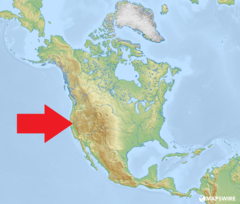
Basin and Range
- Cenozoic
- Uplifting and stretching of crust
- Heating of lithosphere by convection currents in mantle 15 million years ago (wide zone of normal faulting)
- Volcanically active

(IV) Ore
Deposits of minerals that are profitable to recover, usually concentrated in a limited area of Earth's crust.
(IV) Metal Use
Wiring, cell phones, batteries, brass, steel, computers, lightbulbs, paint, solder, jewelry, coins, paint, etc.
(IV) Limestone, Shale, Slate, Sand and Gravel Use
Housing, roofs, concrete, fill
(IV) Clay Use
Ceramics, kitty litter
(IV) Phosphate Use
Fertilizers
(IV) Gypsum Use
Drywall
(IV) Silica Use
Glass
(IV) Halite Use
Table salt
(IV) Gemstone Use
Jewelry
(IV) Hydrothermal Deposits
- Hydrothermal solutions circulate water in contact with a magmatic intrusion and carry off elements and ions
- Minerals may be deposited as veins (precipitated in fractures and cracks) and disseminated deposits (minerals are present throughout the rock).

(IV) Igneous Deposits
- Minerals crystallize, settle and accumulate at the base of a magmatic intrusion
- Form pegmatites, which are extremely coarse grained rock in which minerals present in trace amounts are concentrated

(IV) Sorting via Water (Placers, Glacial, Rivers)
- Placers are sedimentary ore deposits concentrated by sorting of rivers (diamond mines, gold rush)
- Rivers/oceans separate sediments by size (sand, silt, clay)

(IV) Evaporation
Evaporite minerals: halite, gypsum

(V) Fossil Fuels
Hydrocarbons used as fuel. Ex. Coal, oil and natural gas.

(V) Renewable Energy
An energy source that is replenished faster than it is used.

(V) Non-renewable Energy
An energy source that is replenished slower than it is used.

(V) Porosity
Amount of pore space in a rock, soil or sediment.
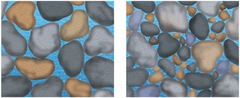
(V) Permeability
The ability of gas or liquid to flow through a rock; soil or sediment.
(V) Oil and Gas Formation and Extraction: Deposition
1. Deposition of high organic matter material in sedimentary basins with low oxygen.
(V) Oil and Gas Formation and Extraction: Lithification
2. Compaction or cementation into sedimentary rocks that creates source and reservoir rocks.
(V) Oil and Gas Formation and Extraction: Heating
3. 140 - 210 for oil and 210 - 285 for natural gas (methane)
- Organic matter converts to hydrocarbons within source rock
- Simple hydrocarbon (methane, natural gas)
(V) Oil and Gas Formation and Extraction: Migration
4. Goes to more permeable layers (sandstone and limestone) due to lower density.
(V) Oil and Gas Formation and Extraction: Accumulation
5. Oil trapped in a reservoir rock capped by cap rock (oil trap)
- Oil Traps: Anticline, faults, salt domes and pinchout.
(V) Oil and Gas Formation and Extraction: Extraction
6. Pumped from the ground.
- If created in low permeable rock, hydraulic fracturing may be used (artificially increasing permeability of rock.
(V) Coal Formation and Extraction: Creation
1. Plant material in a wetland environment is buried and partly decayed.
(V) Coal Formation and Extraction: Heat and Pressure
2. Increase carbon content
- Peat
- Lignite: 70% carbon
- Coal
- Anthracite: 90% carbon
(V) Coal Formation and Extraction: Extraction
3. Mining (strip mining, mountaintop removal mining, subsurface mining, open pit mining.)
(V) Limitation of Fossil Fuels
- Landscape destruction during mining
- Mining is dangerous
- CO2 emission when burning
- Disposal of coal ash
- Resources are not evenly distributed
- Transportation of oil and gas involves risk of spills
- Fossil fuels are a non-renewable resource
(V) Types of Alternative Energy
- Nuclear
- Hydropower
- Geothermal
(V) Nuclear Energy
- Most Uranium is U-238. U-235 is an isotope that will undergo fission and is only .7% of all uranium.
- Enriching uranium involves isolating the U-235.
- Fission of U-235 releases heat to make steam, steam is used to boil water and drive turbines which generate electricity.
- Uranium is a trace element.
Limitation: Disposal of Radioactive wastes, nuclear security, and safety. Uranium is a non-renewable resource.
Uses: Only electricity.

(V) Hydroelectric
- Energy produced from water moving under force of gravity, usually a dam.
- Water movement moves a turbine which powers a generator.
- Renewable resource.
- Most abundant renewable energy in use.
Limitations: dams drowning farmland, change of natural wildlife patterns and ecosystems.
Uses: Only electricity.

(V) Geothermal
- Pumping hot water from ground and using it to power a generator or put through a heat pump.
- Renewable Energy.
- More cost effective in areas that are tectonically active due to a lower geothermal gradient.
Limitations: Regional subsidence and disposal of hydrothermal waters.
Uses: Electricity, heating and cooling.
(VI) Stream
Any body of water that flows over the land surface.
(VI) River
Major branch of a large stream.

(VI) Water Reservoirs on Earth:
- Salt Water (Oceans & Seas): 95.96%
- Fresh Water: 4.04%
Ex. Glaciers and polar ice, groundwater, lakes and rivers, atmosphere, and biosphere.
(VI) Basin
Area of land bounded by divides that funnels all water into the network of streams draining that area.

(VI) Divide
Ridge of high ground along which all rainfall runs off down one side or the other.

(VI) Network
All streams in the drainage basin (smaller tributaries to larger). Zones of erosion, transportation and deposition.

(VI) Channel
Area where the water runs.

(VI) Bedrock Channels
Streams cut into bedrock.
