ch 10 g
 Call Kai
 Learn
Learn Practice Test
 Spaced Repetition
 Match
Match Flashcards
 Knowt Play
1/55

There's no tags or description
Looks like no tags are added yet.
Name | Mastery | Learn | Test | Matching | Spaced | Call with Kai | Chat |
|---|
No analytics yet
Send a link to your students to track their progress
56 Terms
What is genetic linkage?
Genes located on the same chromosome that tend to be inherited together.
How does linkage relate to Mendel's law of independent assortment?
Linked genes do not assort independently because they are located on the same chromosome.
Why did Mendel not observe linkage?
The traits he studied in his reported dihybrid crosses assorted independently.
What are parental or nonrecombinant gametes?
Gametes containing the original combinations of alleles found in the parents.
What are recombinant gametes?
Gametes containing new allele combinations produced by crossing over.
What is a linkage ratio?
The relative frequencies of parental and recombinant gametes.
What is a map unit (mu)?
A unit of genetic distance equal to 1% recombination.
What is a centimorgan (cM)?
Another name for a map unit; 1 cM = 1% recombination.
What is a single crossover (SCO)?
One exchange of genetic material between nonsister chromatids of homologous chromosomes.
What is a double crossover (DCO)?
Two crossover events occurring between homologous chromosomes.
What is a genetic map?
A map showing the relative order and distances between genes based on recombination frequencies.
What is a physical map?
A map showing the actual physical locations and distances between genes on a chromosome.
What are restriction fragment length polymorphisms (RFLPs)?
DNA sequence variations that produce different-sized restriction fragments and can be used as genetic markers.
How does genetic distance affect recombination frequency?
The farther apart two genes are, the greater the likelihood of crossing over between them.
Why are closely linked genes less likely to recombine?
There is less distance between them for a chiasma to form.
What does a low recombination frequency indicate?
Genes are close together and strongly linked.
What does a high recombination frequency indicate?
Genes are farther apart or assort independently.
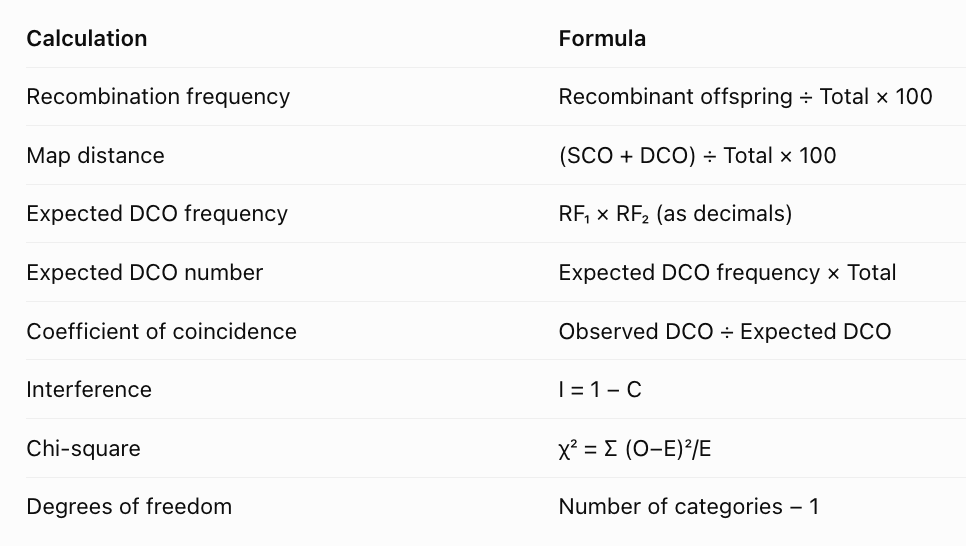
How do you calculate recombination frequency?
(Number of recombinant offspring ÷ Total offspring) × 100.
How do you convert recombination frequency to map distance?
1% recombination = 1 map unit = 1 cM.
Why can recombination frequency never exceed 50%?
Recombination cannot produce more than 50% detectable recombinant gametes; independent assortment also produces 50%.
What recombination frequency indicates complete linkage?
0% recombination.
What recombination frequency indicates independent assortment?
50% recombination.
What gamete ratio is expected with independent assortment?
1:1:1:1 for the four gamete types. AB, Ab, aB, and ab
What gamete ratio is expected with complete linkage?
Two parental gamete types, each representing 50% of the total.
How does linkage with recombination affect gamete frequencies?
Parental gametes are more frequent than recombinant gametes.
Why are recombination frequencies additive?
Distances between adjacent genes can be added to estimate the total genetic map distance.
If A-B = 10 cM and B-C = 15 cM, what is A-C?
25 cM, assuming B is between A and C.
What is the purpose of a three-point cross?
To determine the order and genetic distances of three linked genes.
How do you set up a three-point testcross?
Cross an individual heterozygous for all three genes with a homozygous recessive individual.
What are the three types of offspring in a three-point cross?
Parental (NCO), single crossover (SCO), and double crossover (DCO).
Which offspring are most frequent in a three-point cross?
Parental or noncrossover offspring.
Which offspring are least frequent in a three-point cross?
Double crossover offspring.
Why are DCOs less frequent than SCOs?
Two crossover events must occur, making them less probable than one.
What is the product law for double crossovers?
The probability of two independent crossover events occurring together equals the product of their probabilities.
How do you identify the middle gene in a three-point cross?
Compare parental and DCO genotypes; the gene that switches relative to the other two is in the middle.
How do you calculate genetic distance in a three-point cross?
(SCOs in the interval + DCOs) ÷ Total offspring × 100.
Why must DCOs be counted in both genetic map intervals?
A double crossover involves one exchange in each interval.
How do you calculate the expected frequency of DCOs?
Multiply the recombination frequencies of the two intervals as decimals.
What is the first step in determining whether two genes are linked?
Perform a testcross and compare observed offspring ratios to the expected independent assortment ratio.
How do you set up a two-gene linkage testcross?
Cross a double heterozygote (AaBb) with a double homozygous recessive (aabb).
What offspring ratio is expected in a two-gene testcross if genes are unlinked?
1:1:1:1.
What is the purpose of a chi-square test in linkage analysis?
To determine whether observed offspring ratios differ significantly from expected independent assortment ratios.
What is the chi-square formula?
χ² = Σ[(Observed − Expected)² ÷ Expected].
How do you calculate expected offspring numbers for a 1:1:1:1 ratio?
Divide the total number of offspring by 4 for each category.
How do you calculate degrees of freedom for chi-square?
Number of categories − 1; four categories give df = 3.
What does p < 0.05 indicate in a chi-square linkage test?
Reject independent assortment; the observed deviation is statistically significant.
What is the coefficient of coincidence (C)?
The ratio of observed DCOs to expected DCOs.
What is the formula for coefficient of coincidence?
C = Observed DCOs ÷ Expected DCOs.
What is interference (I)?
The effect of one crossover on the occurrence of another nearby crossover.
What is the formula for interference?
I = 1 − C.
What does positive interference mean?
Fewer DCOs occur than expected; C < 1 and I > 0.
What does negative interference mean?
More DCOs occur than expected; C > 1 and I < 0.
What does complete interference mean?
No DCOs occur; C = 0 and I = 1.
Why do multiple crossovers cause inaccurate genetic maps?
Some crossovers restore parental allele combinations and are not detected as recombination.
Why does genetic mapping become less accurate as gene distance increases?
Multiple undetected crossovers become more likely, causing recombination frequency to underestimate map distance.
One important distinction: A 50% recombination frequency does not prove that genes are on different chromosomes. Genes very far apart on the same chromosome can also appear unlinked.
For this lecture, I would spend more time practicing three-point crosses, chi-square tests, and interference calculations than memorizing definitions. Your professor's slides 24–38 walk through gene order and genetic distances, while slides 42–45 cover interference and chi-square. Those are particularly useful practice examples.