Threats to internal validity
 Call Kai
 Learn
 Practice Test
 Spaced Repetition
 Match
 Flashcards
 Knowt Play
1/12

There's no tags or description
Looks like no tags are added yet.
13 Terms
internal validity
The ability to rule out alternative explanations for a causal relationship between the IV and the DV
perfect internal validity
there is no alternative explanation for the change in the DV’
The IV is the only thing that has changed
single-blinded or masked experiment
either the participant or the observer does not know which condition they are in
Need to specify whether the participant or the observer is blind
double-blind experiments
neither the observer nor the participant knows which condition they are in
threats to internal validity
observer bias
demand characteristics
selection effects
order effects
design confounds
testing effects
attrition
placebo effect
maturation
maturation
history
instrumentation
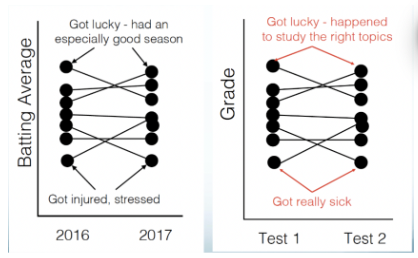
regression to the mean
selection effects (selection bias)
participants in each group may have pre-existing differences that affect results
Can also occur in sampling, not representative of greater population
Solutions: random assignment (not perfect)
Larger sample size
design confounds
a confounding variable that changes alongside the IV
Unable to tell if changes are due to IV or design confound
Solutions: random assignment
Control for other variables, keep constant across groups
attrition
when participants drop out of a study
A possible issue in all studies, but mostly longitudinal work
Causes a decrease in sample size
One group may appear to change over time, but this is only because the most extreme cases dropped out
Solutions: difficult because participants have a right to drop out of a study at any point
Oversampling (recruit more participants than you need)
Try to keep people in the study
Check if pretest scores differed for the group of participants who dropped out and the group who didn’t
Only analyze data from the group that did not drop out

placebo effect
when participants believe that there is a positive effect from the treatment, but in reality, there is no effect
Solutions: have a placebo condition for the control group that participants think is equally likely to produce an effect
Can see if one group actually has an effect just in case
Double-blind if possible
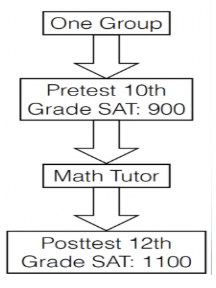
maturation
a group changes over time only because of natural development (can improve or get worse)
This is a problem for longitudinal studies, especially those on learning
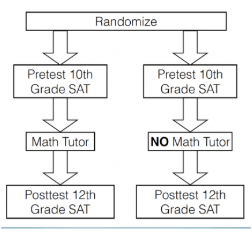
solution: see image
history
a group changes over time because of an external factor or event that affects all or most members of the group

instrumentation
A group changes over time, but only because the measurement technique has changed
Change in instructions, number of items, response options, etc.
regression to the mean
The tendency for people’s scores to shift towards the mean from pre-test to post-test
Why? Because the random events that caused the extreme pretest scores do not recur the same way at posttest
“Special” performances are exactly that – they are “special”
Ex: People who do very well or very poorly on an exam are likely to move toward the class mean on the next exam