7. Neurological Disorders - Systemic Disease Fall 2026
 Call Kai
 Learn
 Practice Test
 Spaced Repetition
 Match
 Flashcards
 Knowt Play
1/149

There's no tags or description
Looks like no tags are added yet.
150 Terms
What is Multiple sclerosis (MS)?
chronic, immune mediated multifactorial inflammatory, demyelinating disease of the CNS
What is the epidemiology of MS?
-Young adults (20-40yo)
-Women > Men
-2.8 million worldwide
True or False:
MS is the most common cause of disability in young people
true
MS (increases/decreases) with increasing distance from the equator d/t lower Vit D levels
increases
What is the pathophysiology of MS?
Immune mediated destruction of myelin and damage to oligodendrocytes
What is the function of myelin?
insulation for nerve signals
What is the effect of demyelination?
-Damaged nerves
-Results in slow conduction of signals
-Axonal loss
What is the effect of axonal loss d/t demyelination by MS?
Irreversible disability
Where are the CNS lesions of MS likely found?
in the white matter of the brain and spinal cord (optic nerve, spinal cord, paraventricular areas, brain stem, cerebellum)

What is Clinically Isolated Syndrome (CIS)?
First demyelinating episode
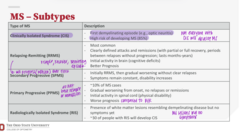
After CIS, what is the risk of developing MS?
High risk (85%)

True or False:
Everyone with CIS will develop MS
False -- but most will

Most common subtype of MS
Relapsing Remitting MS
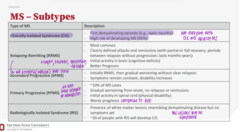
What is Relapsing Remitting MS defined by?
Attacks and remissions (with partial or full recovery, period of time between relapses without progression)

How long does Relapsing Remitting MS last?
months to years

Does relapsing-remitting or primary progressive MS have a better prognosis?
R/R

Where is the initial activity of R/R MS?
in the brain

Describe secondary progressive MS
R/R MS that gradually worsens without clear relapses or remissions

Describe the symptoms of secondary progressive MS
Symptoms remain constant, disability will increase

What % of cases will start as primary progressive MS?
10%

Describe primary progressive MS
Gradual worsening from the onset of disease, no lapses or remissions
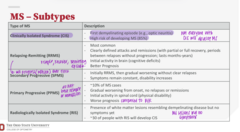
Where is the initial activity of primary progressive MS?
in the spinal cord (physical disability very fast)

What is Radiologically Isolated Syndrome and how does it relate to MS?
Presence of white matter lesion resembling demyelinating disease but no symptoms yet

____% of people with RIS will develop MS
30
What are the common systemic signs/symptoms of MS?
-Fatigue (complete exhaustion)
-Malaise
-Loss of energy
-Weight loss
-Numbness/Tingling
-Motor weakness
-Gait imbalance/Ataxia
-Bladder Dysfunction
-Lhermitte Sign
What is Lhermitte Sign?
Electric shock down spine when the head is bowed forward; indicates the cervical spinal cord is involved
____% of MS patients will develop optic neuritis
50
In ____% of MS patients, optic neuritis is the FIRST SIGN
20
What is optic neuritis?
Destruction of the myelin sheath and nerve fibers of the optic nerve
What are the common symptoms of optic neuritis?
-Unilateral vision loss
-Develops suddenly or over days
-Pain with eye movement
-Decreased color vision
-Reduced contrast sensitivity
-(+) APD
What is the appearance of retrobulbar optic neuritis?
Normal optic disc appearance
Do swollen optic discs sometimes present with optic neuritis?
Yes but more rare
True or False:
Patients with optic neuritis will have a visual field defect
true
What is the most common VF defect with optic neuritis?
central scotoma
What are 2 sequelae of MS?
-Internuclear Ophthalmoplegia (INO)
-Nystagmus
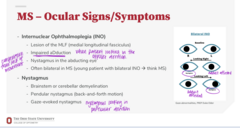
What is INO?
Lesion of the MLF (Medial longitudinal fasiculus)

What does INO impair?
Impaired adduction

What does INO cause?
Nystagmus of the contralateral eye (abducting eye)

Often INO is (unilateral/bilateral) in MS
bilateral

What is the cause of nystagmus with MS?
Brainstem or cerebellar demyelination

Describe the types of nystagmus that are common with MS lesions
-Gaze evoked nystagus
-Pendular nystagmus (back and forth motion)
____ is very important in MS as it allows for early therapeutic intervention to stop the progression of the disease
Early diagnosis
What is the Macdonald Criteria for diagnosis of MS?
-Lesions disseminated in space
-Lesions disseminated in time
How can lesions be disseminated in space?
Lesions in >/- 2 CNS regions
How can lesions be disseminated in time?
New areas of demyelination lesions on follow up MRI

What is the gold standard for diagnosis of MS?
MRI

What are we looking for to diagnose MS by MRI?
White lesions on white matter of the brain (periventricular, juxtacortical, intratentorial) or spinal cord
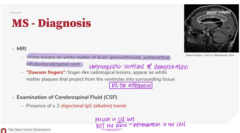
What is Dawson fingers finding on MRI?
Finger-like radiological lesions, appear as white matter plaques that project from the ventricles into the surrounding tissue

What is the goal of examination of the CSF in order to dx MS?
Presence of >/- 2 oligoclonal IgG bands
**bands present in the CNS but not the blood indicate inflammation in the CNS
How can evoked potentials be used for Dx of MS?
-Electrical potentials generated by the nervous system; evoked by certain short sensory stimuli
-Slowing of conduction through the affected area up to complete block of conduction through the demyelinated areas
-VEPs are often abnormal in individuals with MS d/t delayed conduction
What will be the appearance of an ocular examination of MS?
-Unilateral (+) APD
-Normal appearance of disc (retrobulbar neuritis) or edematous disc (intraocular neuritis)
-Optic disc atrophy later stages
What can OCT be used for during examination of a patient with MS?
OCT to detect changes and monitor for progression
What is the management of optic neuritis?
-High Dose IV corticosteroids
-Followed by oral corticosteroids
What is the benefit found in the Optic Neuritis Treatment Trial (ONTT) from IV then oral corticosteroids?
Accelerated visual recovery but provides NO LONG TERM VISUAL ACUITY BENEFIT
True or False:
In the ONTT, standard dose oral prednisone alone improved the visual outcome and was associated with declined rates of Optic neuritis attakcs
False - DID NOT IMPROVE visual outcome and increased rate of new optic neuritis attacks
When does visual recovery begin with optic neuritis without any treatment?
rapidly (2 weeks) in most cases
Improvement in visual outcome will improve in patients with optic neuritis over ____
1 year
Most patients with optic neuritis will recover to what VA?
20/20 (or near)
True or False:
Many patients with optic neuritis still have symptomatic deficits in vision
true
Do steroids improve visual outcome of optic neuritis?
No
Approx ____% of patients experiences a recurrent optic neuritis in either eye in 5 years after 1 episode of optic neuritis
25
What are the features associated with a low 5 year risk of MS in O.N. patients with NO BRAIN LESIONS?
-Lack of pain
-Optic disc edema
-Peripapillary hemes
-Retinal exudates
-Mild visual loss
How to treat the acute relapse of MS?
-High dose IV methylprednisolone 3-5 days
-60-80mg oral prednisone w/ taper
How to treat the chronic phase or prevent relapse of MS?
-Important to start treatment early
-Injectables: Interferon B
-Orals: Dimethyl fumerate, Fingolimod
-Monoclonal Antibodies
What is the risk of using Fingolimod for prevention of MS relapse?
FAME (associated macular edema)
How to manage the symptom of fatigue with MS?
amantadine, stimulants
How to manage the symptom of spasticity with MS?
Balofen, Diazepam, Tizanidine, Botulism toxin
How to manage the symptom of bladder dysfunction with MS?
anticholinergics
How to manage the symptom of mobility/daily living with MS?
physical therapy, occupational therapy
What is Neuromyelitis Optica (NMO)?
Severe autoimmune inflammatory disease that primarily affects the optic nerves and spinal cord
Is NMO distinct from MS?
Yes
What is the epidemiology of NMO?
-women > men
-More common in African, Asian, and Latin Americans
-Age ~40yo
Which is more severe?
NMO or MS
NMO
What is the pathophysiology of NMO?
Autoantibodies against Aquaporin-4 found on astrocytes in the optic nerve, spinal cord, medulla, hypothalamus, and periventricular regions
What does binding of AQP4-IgG lead to in NMO?
complement activation, astrocyte destruction, secondary demyelination, necrotizing inflammation
NMO is a _______
astrocytopathy (astrocyte injury)
Myelin loss occurs (primarily/secondarily) in NMO
secondarily
MS is a demyelinating disease of _____
oligodendrocytes
What are the common symptoms of NMO?
Fatigue, weakness, pain, impaired bladder/bowel function, cognitive impairment, depression
What is transverse myelitis related to NMO?
Longitudinally extensive spinal cord lesion (>3 vertebral segments)
What are the symptoms of transverse myelitis d/t NMO?
-severe weakness
-sensory loss
-bladder/bowel dysfunction
What is Area Postrema Syndrome?
lesions in the dorsal medulla d/t NMO
What are the symptoms of Area Postrema Syndrome d/t NMO?
-Persistent hiccups
-Intractable nausea and vomiting
What are the brainstem/hypothalamic symptoms possible with NMO?
-Narcolepsy
-Hypothermia
Is optic neuritis possible with NMO?
Yes
Describe the signs of optic neuritis d/t NMO
-Often bilateral (can be unilateral)
-Retrobulbar or intraocular (marked disc edema)
-More severe than MS related optic neuritis
What are the common symptoms of optic neuritis d/t NMO?
-Bilateral (or unilateral) vision loss that develops suddenly or over days
-Pain with eye movement
-Decreased color vision
-Reduced contrast sensitivity
-Central scotoma
-(+) APD
Describe the visual recovery after an NMO attack
Poor visual recovery leading to permanent blindness
True or False:
Most patients develop blindness in at least one eye within a few years of diagnosis
true
The AQP4-IgG antibody is present in _____% of individuals
70-80
Is the AQP4-IgG antibody highly specific for NMO?
Yes
How is MRI used in the diagnosis of NMO?
-Optic nerve involvement, chiasm involvement possible
-Longitudinally extensive transverse myelitis (LETM) on spinal cord
-Brain often normal or shows lesions in medulla, hypothalamus, and preipendymal regions
What notable features will be absent and present in the CSF?
-Oligoclonal bands absent
-Neutrophils may be present
Describe the ocular signs of NMO
-APD positive
-Normal disc appearance (retrobulbar neuritis) or edematous disc (intraocular neuritis)
-Optic disc atrophy later
What testing should be done on suspected NMO patients?
-OCT
-Visually Evoked Potential
What is the role of OCT in NMO patients?
RNFL and Mac Thickness will detect changes and monitor atrophy
What is the role of VEP in NMO patients?
Reduction in amplitudes and/or prolongation of latencies with disease
What is the most common treatment for acute NMO attacks?
-High Dose IV methylprednisolone for 3-5 days
-Oral prednisone taper may be used
-Plasma exchange with poor repsonse to steroids
What is the goal of long term immunosuppression with NMO?
prevent relapse, because each relapse will cause permanent damage

MS vs NMO
Usually unilateral
MS