Reaction Rates
 Call Kai
 Learn
 Practice Test
 Spaced Repetition
 Match
 Flashcards
 Knowt Play
1/12

There's no tags or description
Looks like no tags are added yet.
13 Terms
List the factors that may affect the rate of a chemical reaction
concentration (solutions or gases)
temperature
catalyst
surface area
pressure (only gases)
What must happen for a chemical reaction to occur?
particles must collide in the correct orientation with sufficient energy (activation energy)
How can the pressure of a gas also be increased without decreasing the volume of a container?
having more molecules/particles in the same space

List the steps for this method
hydrogen peroxide added to conical flask and bung is replaced
record initial volume of gas in measuring cylinder
manganese dioxide catalyist quickly added to conical flask and bung is replaced
start stop clock simultaneously
record volume of gas produced in measuring cylinder at regular intervals
reaction complete when no more gas is produced

List the steps for this method
measure 10g of calcium carbonate using a mass balance, measure by difference
measure out 250cm3 HCl using measuring cylinder
add HCl to conical flask
place conical flask to balance, zero balance
add calcium carbonate to conical flask
start stop watch
measure mass loss every 10s
plot a graph, mass loss (y axis) vs time (x axis)
draw tangents to calculate rate at different times by calculating gradient
What is the activation energy?
What is the activation energy?
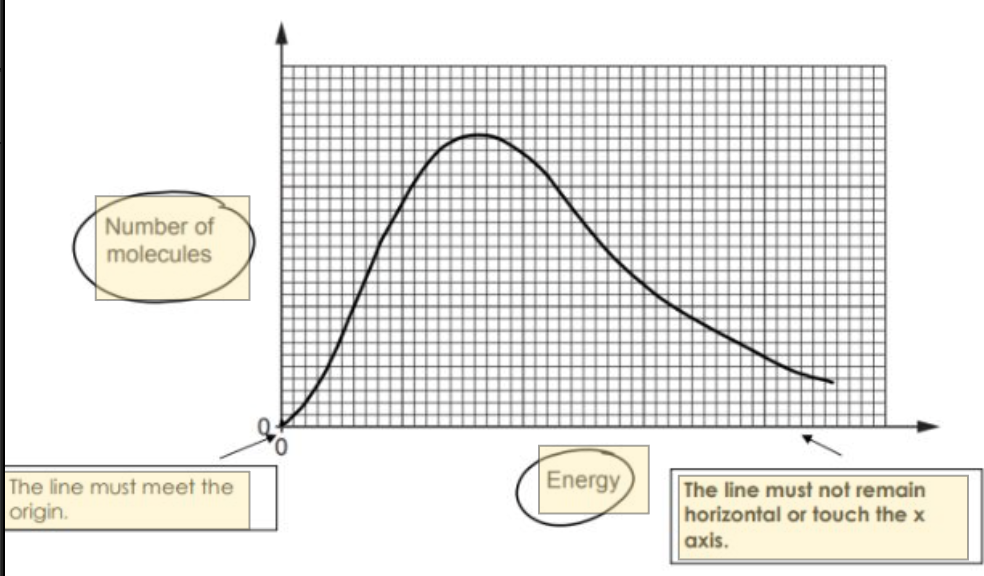
Increase in temperature, increases the rate of reaction, explain why

at higher temperatures T2
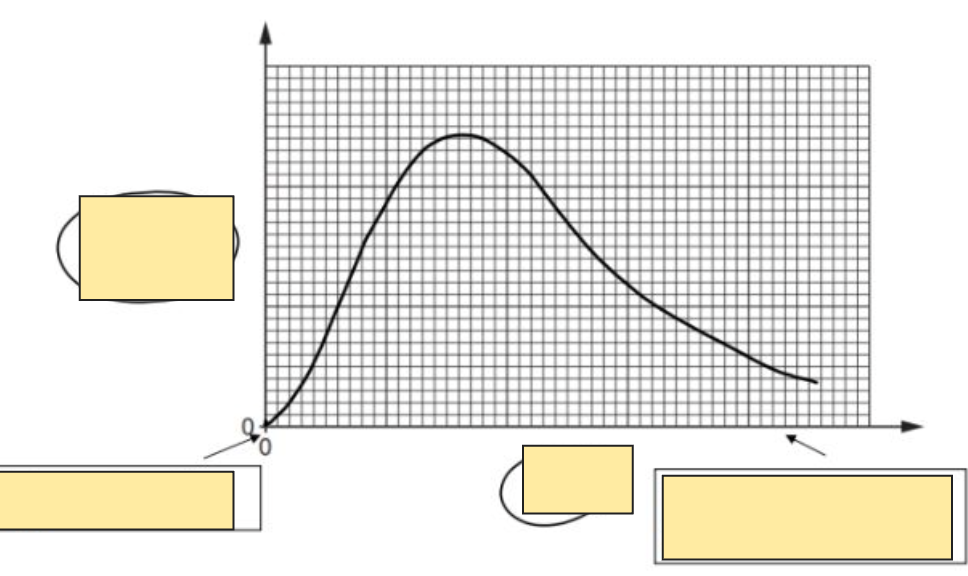
more molecules have E>Ea
more successful collisions per unit time
rate increases
How does a catalyst affect the reaction rate?

with catalyst, more molecules have E > Ea
more frequent successful collisions
rate increases
What is a homeogeneous catalysis?
the catalyst is in the same state as the reactants
What is a heterogeneous catalysis?
the catalyst is in a different state from the reactants
Why are catalysts used in industrial processes?
increase sustainability by allowing lower operating temperatures to be used
reduces energy demand needed from combustion of fossil fuels
reducing carbon dioxide emissions