Midterm 3 Synaptogenesis Part 2
 Call Kai
 Learn
 Practice Test
 Spaced Repetition
 Match
 Flashcards
 Knowt Play
1/9

There's no tags or description
Looks like no tags are added yet.
10 Terms
Overview
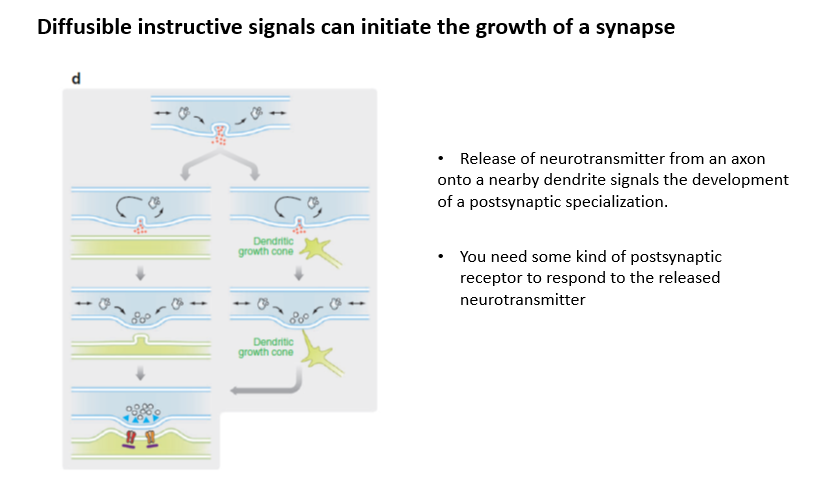
Release of neurotransmitter from an axon onto a nearby dendrite signals development of a postsynaptic specialization

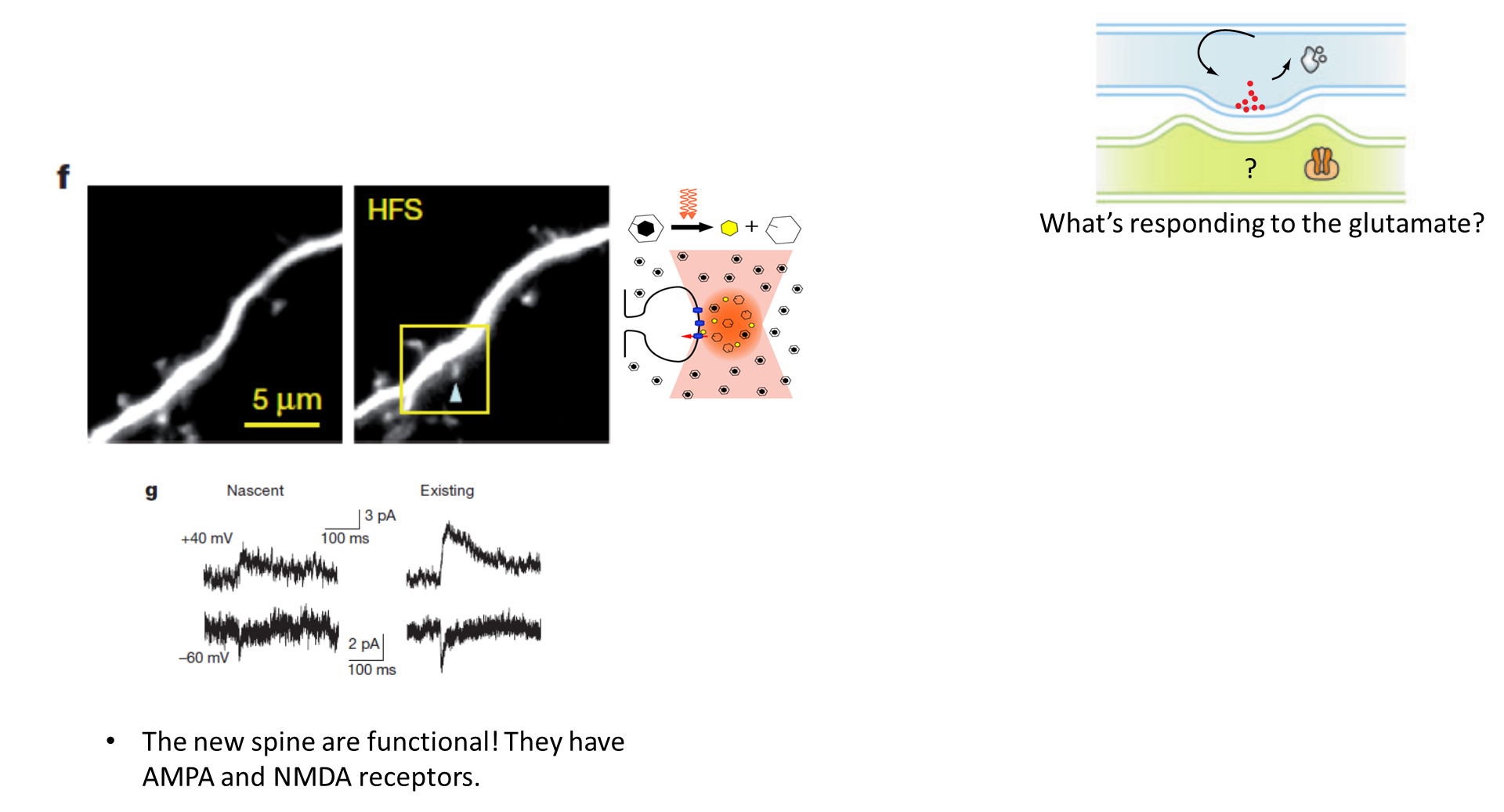
Describe the experiment with caged glutamate
Caged glutamate was made; made glutamate inert, when you aim a laser is pointed at it, it can become activated
NMDA receptors are responsible for spine development, so glutamate


How do you get actin to grow?

In contrast to clearin and trio which are found in glutamatergic synapses all over the brain, where is Tiam1 found?
What happened when you get rid of TM1 in the dentate gyrus vs in the CA1 Pyramidal neurons?
TM1 is only found in the dentate gyrus of the hippocampus.
When you get rid of TM1 in the dentate gyrus spines became filopodia
When you get rid of the min the CA1-CA3 Pyramidal neurons there is no effect
TM1 is selectively required for synaptic maturation in the dentate gyrus

How do neurexins/neuroligins work?
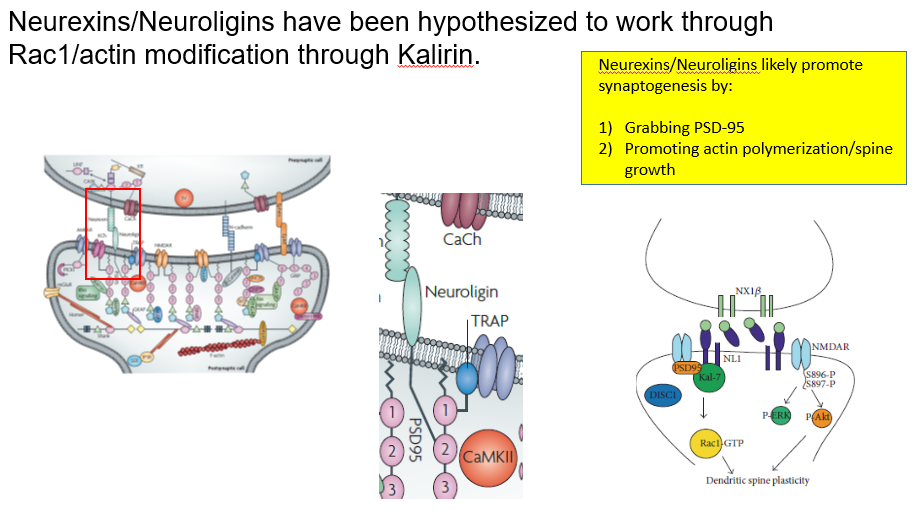
Neurexins/Neuroligins have been hypothesized to work through Rac1/actin modification through Kalirin.
Neurexins/Neuroligins likely promote synaptogenesis by:
1)Grabbing PSD-95
2)Promoting actin polymerization/spine growth
What does neuroligin 1 require for synaptogenesis?
There are a bunch of Kalirin
We use an RNAi to reduce the expression level of kalirin and trio in the neuron and put back kalirin 7 wild type in and we see that AMPA currents are normal and whhen we express neurlagin on top of that we got big increases in AMPA and big increases in NMDA
When we got rid of kalirin and trio and put back kalirin 5 we didn’t get back stuff

How does inhibitory synapses work? What does neuroligin 1,2, and three do?
In inhibitory synapses you dont have a spine
Neuroligin 1 expression in fibroblasts recruits axons from excitatory (glutamate releasing) neurons
Neuroligin 2 expression in fibroblasts recruits axons from Inhibitory (GABA releasing) neurons
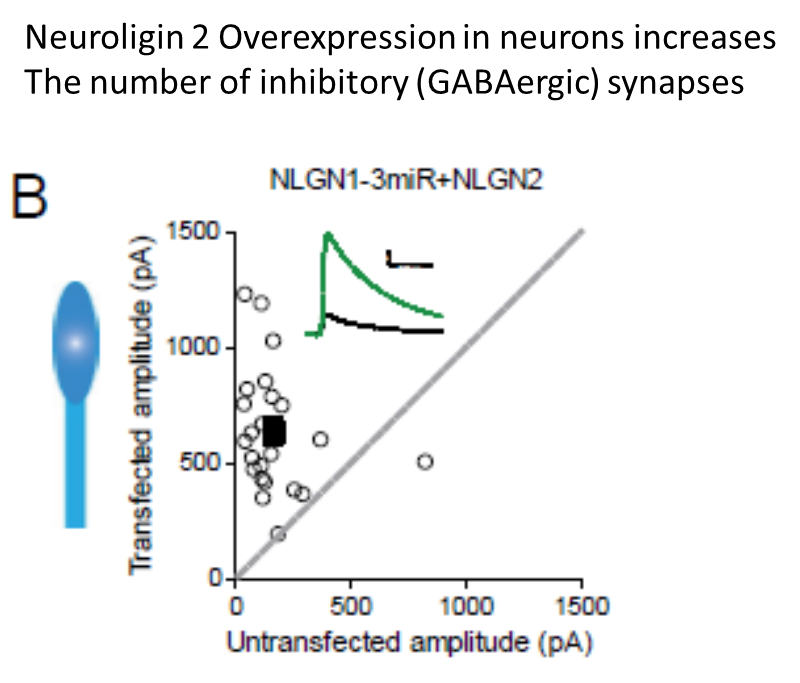
Neuroligin 2 Overexpression in neurons increases
The number of inhibitory (GABAergic) synapses

How does neuroligin-2 promote inhibitory synaptic formation? What is its equivalent in glutamatergic synapses?
Neuroligin-2 promotes inhibitory synaptic formation by
recruiting Gephyrin.
Gephyrin is the PSD-95 of inhibitory synapses
Neuroligin 2 binds to gephyrin through its “gephyrin binding domain” allowing it to recruit gephyrin to sites of Contact between GABA releasing axons and the postsynaptic dendrites
Gephyrin grabs and holds GABA receptors in place so that
they can be activated by released GABA.
Does GABA do the same thing as glutamate where if its released onto a dendrite it will create a dendritic spine?
Caged GABA exists; it was was uncaged onto a dendrite
LAST SLIDE