Chapter 3: Broadband Transmission, Baseband Transmission
 Call Kai
 Learn
 Practice Test
 Spaced Repetition
 Match
 Flashcards
 Knowt Play
1/72

There's no tags or description
Looks like no tags are added yet.
73 Terms
What are some of the differences between analog and digital signals?
Analog Signals:
Are continuous
Have an amplitude, period, and phase
Digital Signals:
Are discrete and use finite values to represent their amplitudes.
Have a bit duration, bit length, and bit rate.
What is a Channel?
A channel is the portion of a transmission medium used to carry a signal.
What are the two different approaches to sending digital data through a channel?
#1. Baseband Transmission
#2. Broadband Transmission
These are both different techniques of getting digital data through a channel.
What is Baseband Transmission?
Baseband Transmission is when we send the digital signal directly through a channel.
There is no modulation, no carrier wave, nothing. We just transmit the digital signal directly.
In more precise terms: Baseband Transmission is when we directly transmit a digital signal through a low pass channel.
Explain how we would send the bits: 10110 using Baseband Transmission
If we want to send the bits 10110, we convert the bits into a digital signal, and then place this physical signal directly on the cable.
The receiver then observes that signal and recovers: 10110 exactly.
Nothing was modulated or altered in any way in order to be transmitted.
Why doesn’t every channel support Baseband Transmission?
What kind of channel does Baseband Transmission need?
Not every channel supports baseband transmission because it operates on very low frequencies close to 0Hz, and most modern channels aren’t commonly designed to carry this range.
For this purpose, Baseband Transmission requires a type of channel known as a low-pass channel, which is capable of accepting frequencies near to 0Hz.
What is a low-pass channel?
A low pass channel is a channel that allows frequencies starting as low as 0H going up to some maximum value. The idea is that the channel is capable of including frequencies near 0Hz.
What is a bandpass channel?
A bandpass channel is a channel that can only transmit signals with frequencies beginning at a value greater than 0 up to a certain maximum. The idea is that it does not support frequencies near to 0 Hz.
An example of a bandpass channel is: 1000Hz to 5000Hz.
What is Broadband Transmission?
Broadband Transmission is transmitting digital data over a bandpass channel by first converting the digital signal into an analog signal.
Why does Broadband Transmission require a conversion back to an analog signal?
It requires a conversion back to an analog signal because it uses a bandpass channel, which can only take frequencies greater than 0. Since digital signals tend to operate at 0 Hz, this forces us to modulate the signal into an analog signal in order to shift the information to a higher frequency.
What are some examples of Broadband Transmission?
Modems, because they perform modulation and demodulation.
Dial up internet.
Note: We will define modulation in Chapter 5.
What is an ideal digital signal?
What’s the problem with ideal digital signals?
An ideal digital signal is a perfectly constructed digital signal with perfectly sharp transitions, capable of switching between 0s and 1s instantaneously.
The problem is that these signals don’t exist, and are purely theoretical because they are impossible to recreate in real life. The other problem is that if these signals did happen to exist, they would require an infinite amount of bandwidth, which is not feasible.

If ideal digital signals don’t exist, then how are digital signals represented in the real world?
Real digital signals have slightly rounded corners, not perfect sharp transitions, and they only use a finite amount of bandwidth. Usually this is sufficient for the receiver to interpret the bits correctly.

What is theoretical bandwidth?
Theoretical bandwidth refers to infinite bandwidth, or the amount of bandwidth you would need in order to represent a perfect digital signal.
What is effective bandwidth?
Effective Bandwidth refers to the finite amount of bandwidth used by real digital signals in order to reproduce the digital signal accurately enough for successful communication (to produce a digital signal with rounded corners).
What is an example of Baseband Transmission?
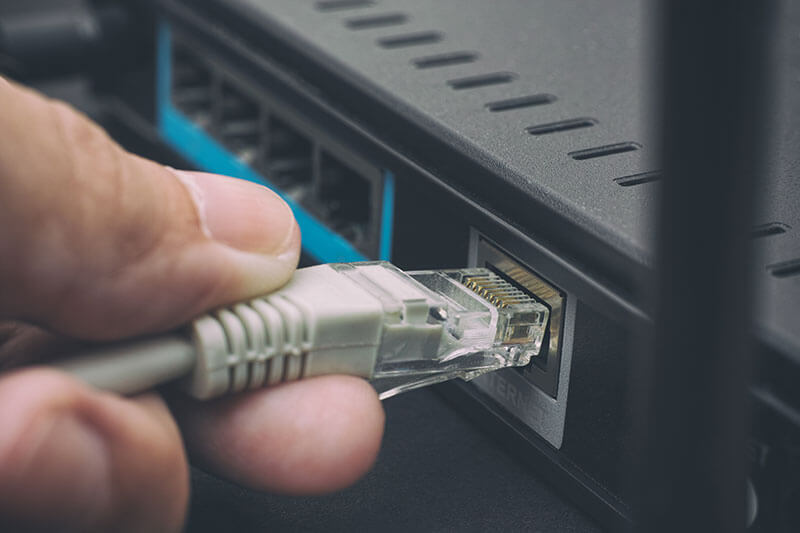
One example of Baseband Transmission is Ethernet.
Ethernet is a LAN (Local Area Network) that uses cables like twisted copper wire or fiber optic to transmit digital signals between local devices such as computers, printers, etc.
It’s an example of Baseband Transmission because it sends raw digital signals across a cable and use the entire effective bandwidth of the transmission medium to send the data. It never modulates the bits or uses a carrier signal.
How come a wider bandwidth of a channel improves accuracy?
If a channel is only capable of carrying signals with a frequency of 0 to 100 khz, this means that only some of the frequency components survive, while others are lost.
Whereas if a channel is capable of carrying between 0 and 100 MHZ, now more frequency components survive, and the received signal resembles the original waveform more accurately.
Why does a higher bit rate correspond to a higher bandwidth?
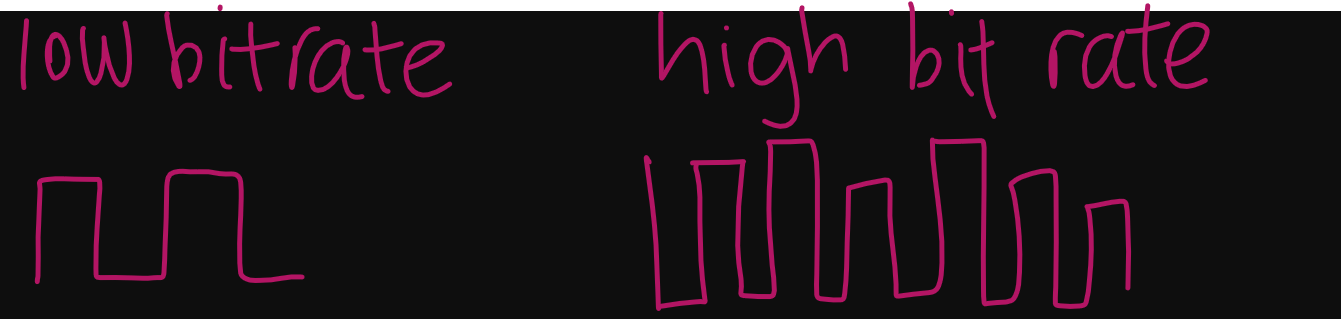
A higher bit rate means we will have a higher signaling rate (more changes per second), which also means that the range of frequencies will increase, and therefore, the bandwidth, which represents this range, also increases.
Why can't a computer transmit abstract bits directly through a cable?
Because cables are only capable of carrying actual physical signals in the form of voltage pulses, light changes, etc.
Suppose a channel can only carry frequencies between:
0Hz→50kHz
Would you expect it to reproduce a digital signal more accurately than a channel that only carries:
0Hz→5kHz
Why?
Yes. This is because a greater range of frequencies means that more of the frequencies in the original transmitted signals survive, and therefore, the received signal is more accurate/true to the original.
Why do signals become damaged?
Signals can become damaged as a result of materials being imperfect.
Copper has resistance, air contains interference, electromagnetic fields impact nearby wires, equipment can generate random electrical activity.
What is Attenuation?
Attenuation is a loss of signal strength.
Give an example of attenuation in a real life scenario and in a cable scenario:
In real life, attenuation can happen when you shout across a room. Your voice reaches the other side, and the information is still there, but its much quieter.
Similarly, with an electrical signal, you may start off with a strong signal, but as soon as it starts moving through a cable, the signal weakens.
Why does attenuation happen with wires?
It happens because whenever a current passes through a wire, such as a copper wire, the copper is naturally resistant to the flow of electricity, and as the signal moves, some of that electrical energy is lost as heat, causing attenuation.
And the further the signal travels, the more electricity is lost as heat, and the more attenuation occurs.
What does attenuation actually look like on a signal?
Let’s say we send 10 V of current.
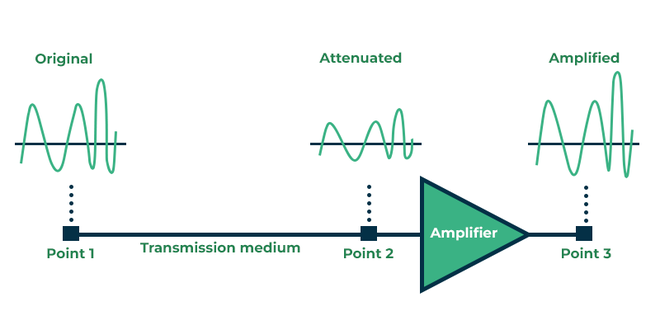
At the sender’s level, this will look like 10V, and at the receiver’s level, this may look like 5V as a result of attenuation. The image to the right shows that the signal is still there, its just weaker, represented by a lower amplitude.
How do we fix attenuation?
We fix attenuation using an amplifier.
An amplifier increases signal strength and tries to restore the original power of the signal.
What unit is used to measure signal loss?
Decibels (dB).
What does a single decibel actually represent?
A single decibel represents the ratio between two signal strengths. It compares the strength of the signal before vs after transmission.
What is the formula for calculating decibels?
Where P1 represents original power, and P2 represents the final power.

Why are losses of power negative?
Losses of power are negative because it means that P2 < P1, or in other words, the original power was greater than the final power.
As a result of this, when we do the division of P2/P1, since P1 is much greater than P2, you end up getting a decimal value. Anytime a decimal value is being multiplied by a logarithm, it results in a negative value.

So what does a negative decibel amount really mean?
A negative decibel amount means that the signal lost strength, because the final power, P2, was less than the original power, P1.
Suppose a signal travels through a transmission medium and its power is reduced to one-half. Find the attenuation (loss of power).
Using our formula: 10log10 (P2 / P1)
= 10log10((0.5 x P1) / P1)
= 10log10(0.5) The P1s cancel out.
= -3.010
Answer: Approximately -3 dB.
What does Distortion mean?
Distortion means that the shape of the signal has changed.
Why does Distortion happen?
Distortion happens because composite signals contain multiple signals with different frequencies, and the channel does not necessarily treat each frequency identically. Some frequencies may travel faster than others, which results in different phase shifts.
As a result, the original components of the frequency might recombine differently at the receiver’s end to form a different shape.
Does Distortion mean the signal has become weaker?
No! It does not mean the signal has become weaker, it only means that the signal has changed shape.
Why is distortion dangerous?
Distortion is dangerous because if the shape of the original signal changes too much, then it can be interpreted differently on the receiver’s end.
What is noise?
Noise is when unwanted energy gets added to the signal. It means the original signal is still present, but something else has mixed into it.
What are the four major types of noise?
Thermal Noise: The most common type of noise. It happens because electrical wires contain electrons, and these electrons move around randomly because of temperature, as a result, this creates unwanted electrical signals that get added to our signal. These tend to be very very small changes to the original signal, such as going from 5.00 V to 4.98 V.
Induced Noise: This usually comes from external sources such as motors, fridges, air conditioners, and power equipment. All of these sources can create unwanted electromagnetic fields that can be picked up on by nearby communication cables.
Crosstalk: When one communication wire affects another communication wire. What commonly happens is that the signals from one wire can leak into the second wire as a result of proximity, and this causes the second wire to pick up on some of this energy.
Impulse Noise: A very powerful burst of energy that generally comes from lightning, power line surges, or switching equipment. It creates one big spike of energy all at once, and this sudden burst can corrupt one or more bits.
A signal leaves the sender with power: 20W and arrives with: 10W
What is happening? Attenuation, distortion, or noise? Why?
It appears that the power has decreased significantly. This is not distortion, where the shape of the wave changes, and this is not noise either, because no small increases/decreases to the power as a result of unwanted energy is occurring.
This is Attenuation, because we can clearly see that the Power after is much weaker than the power before.
A signal arrives with exactly the same power but a different waveform shape.
Which transmission impairment is responsible?
Distortion
If a signal's power doubles, would the dB value be positive or negative?
Why?
Positive, because it would mean that P2 is greater than P1. So when you calculate decibels, and you divide P2 by P1, the result will produce a positive, non-decimal number.
And when multiplied with the logarithm, this will produce a positive value.
Remember: Only decimal values produce negative numbers when multiplied by a logarithm.
Why does a warm copper wire suggest attenuation is occurring?
It suggests attenuation (the loss of power) is occurring because the power is being lost as heat as the current flows through the copper wire and the copper wire provides natural resistance to the moving current.
Which type of noise is most likely responsible?
Lightning strike
Nearby electric motor
Random electron motion
One Ethernet cable interfering with another
Impulse Noise
Induced Noise
Thermal Noise
Crosstalk
A signal starts at: 100W and arrives at: 25W
Calculate the attenuation in dB.
Attenuation = 10log10(P2 / P1)
= 10log10(25 / 100)
= -6.02
Answer: Approximately -6 Db.
What ultimately limits how fast we can transmit data through a channel?
Is it noise, attenuation, distortion, or something else?
It is noise, bandwidth, and signal levels.
What does SNR stand for? What does it represent?
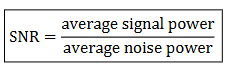
SNR represents the Signal to Noise Ratio.
It has no units, because its only a ratio, and it measures the signal power against the noise power.
What is the formula for the Signal to Noise Ratio?
SNR = average signal power / average noise power.
What does an SNR of 100 mean? Interpret this value. Is it good or bad?
An SNR of 100 means that the:
Average Signal Power = 100
Average Noise Power = 1
This is very good, it means that the average signal power was much higher than the noise.

What does an SNR of 2 mean? Interpret this value. Is it good or bad?
An SNR of 2 means:
Average Signal Power = 2
Average Noise = 1
This is very bad. It means that the noise is almost half of the average signal power.

What does an SNR of 1 mean? Interpret this value. Is it good or bad?
An SNR of 1 means:
Average Signal Power = Average Noise are equal!
This is also very bad. It means that the power in your signal is equal to the noise!
In general, what can we say about a HIGH SNR and a LOW SNR?
A high SNR is generally good, it means that the signal power tends to be a lot greater than the noise.
A low SNR Is bad, it means that the signal power is comparable to the noise.
Why do we sometimes convert SNR (Signal to Noise Ratio), which is unitless, to Decibels (dB)?
Because SNR ratios tend to get very large, and a result, many engineers prefer to convert them back into decibels.
What is the formula for converting SNR ratios to decibels?
The formula is:
SNRdb = 10log10(SNR)
Let’s say, we have a theoretically perfect channel that produces 0 noise.
What will be the value of the SNR?
If our channel produces 0 noise, this means the value of our Signal to Noise ratio will be infinite.
This is because the formula for SNR is: 10log10(P2/P1)
But, if a channel produces no noise, it means we are dividing by zero, and since this is not possible, we say that the Signal to Noise ratio gets infinitely closer to 0.
What does the Shannon Capacity calculate?
The Shannon Capacity (Also called the Shannon Limit btw) represents the theoretical maximum amount of data that can be transmitted through a noisy channel. In other words, the theoretical maximum bit rate that can be sent through a noisy channel.
What is the formula for the Shannon Capacity?
C = Blog2(1+SNR)
Where:
C = Channel Capacity (in bps)
B = Bandwidth (Hz)
SNR = Signal to Noise Ratio
Is it possible for any system to exceed the Shannon Capacity?
No, it is impossible.
What happens to Shannon Capacity if Bandwidth increases?
C = Blog2(1+SNR)
The Shannon capacity will increase if the bandwidth increases.
What happens to Shannon Capacity if SNR increases?
C = Blog2(1+SNR)
The Shannon capacity will increase.
You can tell, because you are multiplying a number greater than 1 (because 1+SNR) to your logarithm, therefore getting a larger value for the Shannon Capacity.
Why are extremely noisy channels useless?
C = Blog2(1+SNR)
If your channel is extremely noisy, say your SNR = 0, which is the worst possible signal power to noise ratio, then if you have enormous bandwidth, your Shannon Capacity will still be 0.
C = 100000000log2(1+0)
C = 0.
This means the theoretical maximum bit rate/data rate is effectively 0. The receiver cannot extract anything from your transmitted message because it was just that noisy.
What does Nyquist measure?
Nyquist measures the exact same thing as the Shannon Capacity: The maximum theoretical amount of data that can be sent across a communication channel. The difference is that Nyquist assumes the channel is completely noiseless, while Shannon Capacity takes into account all the different sources of Noise.
Additionally, Nyquist can tell us how many signal levels/voltage levels we need.
What is the Nyquist Formula?
Nmax = 2Blog2L
Where:
B = Bandwidth (in bps)
L = Number of Distinct voltage levels
Nmax = Measured in bps (because it’s the maximum theoretical data rate)
We have a channel with a 1-MHz bandwidth. The SNR for this channel is 63.
What is the appropriate bit rate and number of signal levels?
Use the formulas for Shannon Capacity and Nyquist.
Remember: Nyquist only takes into consideration ideal, noiseless channels, while Shannon Capacity is what actually takes into consideration noisy channels.
So whenever we see SNR, we know to use Shannon Capacity.
Use Shannon Capacity to solve for bit rate:
Convert 1MHz to bps:
1 MHz x 106 bps / 1 MHz = 1000000 bps
C = B log2(1+SNR)
C = 1000000 log2(1+63)
C = 6000000 bps
Use the Shannon Capacity bit rate to solve for the number of levels in Nyquist:
Nmax = 2Blog2L
6000000 = 2 × 1000000 x (log2) x L
6000000/2 = 1000000 x (log2) x L
3000000/1000000 = (log2) x L
3 = (log2) x L
To get rid of a log2, all you have to do is make the other side of the equation an exponent of base 2. Here this would mean:
23 = 2log2L
23 = L
L = 8
Answer: You would need 8 levels.
A channel has:
SNR=1000
Calculate SNRDB
Solve using the SNRDB formula:
SNRDB = 10log10(SNR)
= 10log10(1000)
= 30 db
A channel has:
B=500kHz
SNR = 31
Use Shannon to find the capacity.
C = B x log2 (1+SNR)
Convert kHz to hz:
500 kHz x 103 bps / 1kHz = 500000 hz
Use the Shannon Formula:
C = 5000000hz x log2 (1+31)
C = 2500000 bps OR 2500 kbps
What is parallel transmission?
Parallel transmission is when we have multiple channels/wires carrying each carrying a different bit, simultaneously, in parallel.
For example, instead of just having: 10110110 and sending them one at a time, instead what we do is send each bit through 8 separate communication channels so that they can all travel at the same time, and they all arrive at the same time.
What is serial transmission?
Serial transmission is when bits are sent one at at time, sequentially, through a single wire.
Is parallel transmission fast or slow?
Parallel transmission is fast. This is because if one bit takes 1 unit of time to transmit, using parallel transmission allows all of those bits to arrive in one time unit, because all the bits travel simultaneously.
In fact, parallel transmission is 8 times faster than serial transmission, if you have 8 bits to transmit.
Which is cheaper? Serial or Parallel Transmission? Why?
Which one do we use more often for this reason?
Serial transmission is much cheaper. Because each bit is sent one by one, sequentially, through a single wire, you only need one wire.
On the other hand, with Parallel transmission, if you’re trying to send 8 bits, since all 8 bits send in parallel, you are going to need 8 different wires.
As a result, we tend to use Serial Transmission much more often, primarily because it’s cheaper and less complex to manage (fewer wires).
Give an example of something that uses Serial Transmission:
USBs use Serial Transmission!
USB actually stands for Universal SERIAL Bus.
Is Serial Transmission today slow?
No, it is not slow!
Perhaps decades ago, it may have been slow, but since then, engineers discovered that using one channel is often easier and cheaper than coordinating multiple channels, so all they did to improve the speed of Serial Transmission was increase the signaling rate using modern serial links.
What does “A parallel system with n=8” mean?
It means that 8 bits can be transmitted by the parallel system in a single time unit.
Fill in the blanks:
Parallel transmission can increase the ____________ by a factor of n over _____________.
Serial transmission can decrease the ____________ by a factor of n over _____________.
a) speed of transmission
b) serial transmission
c) cost of transmission
d) parallel transmission