Unit 7 Geometry Vocab Flashcards
 Call Kai
 Learn
 Practice Test
 Spaced Repetition
 Match
 Flashcards
1/18

There's no tags or description
Looks like no tags are added yet.
19 Terms
Triangle Sum Theorem
All the measures of the interior angles of a triangle add up to 180 degrees

Exterior Angle Theorem
The measure of an exterior angle of a triangle is equal to the sum of the measures of the two opposite interior angles.

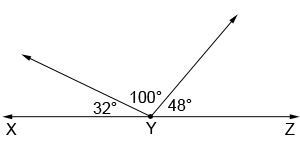
Linear Pair
Two angles that span a line and share a vertex. Their measures add up to 180 degrees.

Linear Triple
Three angles that span a line and share a vertex. Their measures add up to 180 degrees.
Congruent
Two objects that are the same object and have the same measure.
Angles with the same degrees are congruent to each other.
Segments with the same length are congruent to each other.
Triangles that are the same shape and size are congruent to each other.

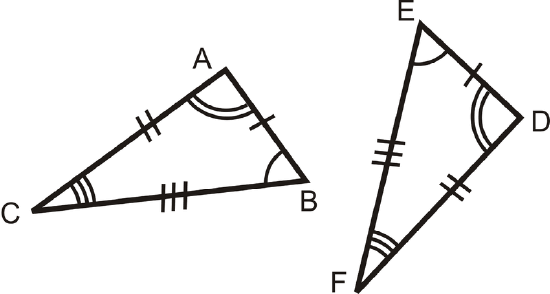
What are the 5 Triangle Congruence Theorems?
Side-Side-Side (SSS)
Side-Angle-Side (SAS)
Angle-Side-Angle (ASA)
Angle-Angle-Side (AAS)
Hypotenuse-Leg (HL)
What is the difference between AAS and ASA congruence?
ASA the congruent side is shared between the two congruent angles, while in AAS the congruent side is NOT SHARED and only touches one of the congruent angles.

Reflexive Property
Any object is congruent to itself. For example <C is congruent to itself. For example segment AB is congruent to itself.

Vertical Angles
Two angles that share a vertex and are across from each other are vertical. Vertical Angles are congruent to each other.

Alternate Interior Angles
Two angles that are on alternate sides of the transversal and are on the interior of the parallel lines are congruent.

Alternate Exterior Angles
Two angles that are on alternate sides of the transversal and are on the exterior of the parallel lines are congruent.

Corresponding Angles
Two angles that are the same side of the transversal, one angle is interior, the other is exterior.
You can also think about this as two angles in the same relative location on two different intersections on the transversal.
Corresponding Angles are congruent.

Transversal
A line that crosses through two or more parallel lines. It creates several angles, including alternate interior, alternate exterior, and corresponding angles.

We cannot use Alternate Interior Angles, Alternate Exterior Angles, or Corresponding Angles unless we have…
Two or more parallel lines crossed by a transversal.
What does CPCTC stand for and mean?
Corresponding Parts of Congruent Triangles are Congruent.
Meaning that if two triangles are congruent, each angle on one triangle has a corresponding congruent angle on the other triangle.
Additionally, each segment on one triangle has a corresponding congruent segment on the other triangle.
What does “GIVEN” mean when it comes to proofs.
Given is a piece of information you were provided at the start of a problem. This information is often used as a basis to prove further statements or relationships in a proof.
Midpoint
A point that divides a segment into two congruent halves.
In the image, point B is a midpoint of segment AC creating the two congruent halves AB and BC.

Perpendicular Bisector
A line that is perpendicular (forming right angles) to a segment at its midpoint, dividing it into two congruent parts.
In the image, line CD is a perpendicular bisector of segment AB.

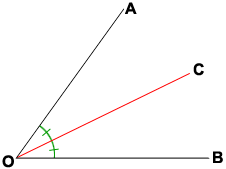
Angle Bisector
A line that divides an angle into two congruent halves.
In the image, segment OC is an angle bisector of angle AOB. The angle bisector creates the two new angles AOC and COB which are congruent to each other.