L11-Eukaryotes Micro
 Call Kai
 Learn
 Practice Test
 Spaced Repetition
 Match
 Flashcards
 Knowt Play
1/14

There's no tags or description
Looks like no tags are added yet.
15 Terms
Who are the eukaryotic microbes?
are microscopic organisms belonging to the domain Eukarya. Unlike prokaryotic cells (Bacteria and Archaea), eukaryotic microbes possess a true membrane-bound nucleus containing linear chromosomes packaged with histones, membrane-bound organelles, a characteristic cell envelope
Name three main groups of organisms that comprise the eukaryotic microbes:
Fungi
Protozoa
Algae
What compound is commonly found in the cell walls of fungi such as yeast?
cell walls contain chitin
Compare and contrast prokaryotic and eukaryotic microbes
Structural Feature | Prokaryotic Cells (Bacteria & Archaea) | Eukaryotic Cells (Fungi, Protozoa, Algae, Plants, Animals) |
Typical Size | 0.2 – 2.0 um in diameter | 10 – 100 um in diameter |
Nucleus | Absent. DNA resides in an irregular, non-membrane-bound nucleoid region. | Present. True membrane-bound nucleus containing a double-layered nuclear envelope with pores. |
Chromosomal DNA | Typically a single circular double-stranded DNA molecule; plasmids common. | Multiple linear chromosomes complexed with histone proteins. |
Membrane-Bound Organelles | Absent. (No mitochondria, ER, Golgi, lysosomes, etc.) | Present. (Mitochondria, Endoplasmic Reticulum, Golgi apparatus, vacuoles, lysosomes). |
Ribosomal Architecture | 70S total (composed of 30S small subunit and 50S large subunit). | 80S total in cytoplasm/ER (60S + 40S); 70S ribosomes within mitochondria and chloroplasts. |
Cell Wall Composition | Present in most (peptidoglycan in bacteria; pseudomurein or protein layers in archaea). | Present in fungi (chitin) and plants/algae (cellulose); absent in protozoa and animals. |
Cytoskeleton | Primitive homologues (FtsZ, MreB, CreS) regulating shape and division. | Complex, dynamic cytoskeleton (microfilaments, microtubules, intermediate filaments). |
Cell Division | Binary fission (coupled with chromosome replication). | Mitosis and Meiosis involving spindle fibers and mitotic apparatus. |
What features does yeast have in common with E. coli that make them both great model organisms for biological study?
Rapid Growth and Short Generation Times: Both organisms multiply rapidly under optimal conditions. E. coli doubles every ~20 minutes, while laboratory yeast strains double every ~90 to 120 minutes, allowing researchers to grow massive populations and observe generations of evolution or genetic selection in days.
Ease of Culturing and Inexpensive Growth Media: Neither organism requires complex, costly growth factors. Both grow easily in liquid broth (e.g., LB for E. coli, YPD for yeast) or on simple agar plates using basic carbon and nitrogen sources.
Powerful Genetic Tractability: Both have highly characterized genomes that were among the first to be fully sequenced. Both accept exogenous DNA readily (via chemical transformation, electroporation, or heat shock), and both possess comprehensive deletion collections where every non-essential gene has been systematically knocked out.
Safety and Ease of Handling: Standard laboratory strains (such as E. coli K-12 derivatives and non-pathogenic yeast strains) are safe to handle, non-virulent, and easily contained, making them ideal for high-throughput screening and undergraduate education.
What are advantages of using yeast rather than E. coli for research?
Eukaryotic Compartmentalization and Machinery: Yeast possesses a true nucleus, an endomembrane system (ER and Golgi apparatus), mitochondria, and a cytoskeleton. It is an ideal model for studying eukaryotic processes such as vesicular transport, organelle biogenesis, apoptosis, and mitochondrial bioenergetics—none of which exist in bacteria.
Introns and RNA Splicing: Unlike E. coli genes, many yeast genes contain introns. Yeast possesses the spliceosome machinery required to process pre-mRNA, making it a powerful system for studying eukaryotic transcription, mRNA processing, and splicing regulation.
The Cell Cycle and Genetics: Yeast shares the same core cyclin-dependent kinase (CDK) cell cycle machinery as humans. Furthermore, yeast can stably maintain both haploid and diploid states. Haploid cells make it trivial to isolate and analyze recessive mutations, while diploid cells allow researchers to perform classical genetic crosses and complementation tests.
Post-Translational Protein Modification: Yeast can perform complex eukaryotic post-translational modifications—such as N-linked and O-linked glycosylation, protein phosphorylation, and proper folding via endoplasmic reticulum chaperones—that prokaryotes cannot replicate.
What are advantages of using E. coli rather than yeast?
Extreme Simplicity and Speed: With a genome roughly one-fourth the size of yeast's and a doubling time three times faster, E. coli allows for lightning-fast genetic screens, cloning workflows, and selections.
Lack of Introns (Streamlined Transcription/Translation): Because bacterial genes lack spliceosomal introns, E. coli can couple transcription and translation in real time. This makes it an exceptionally clean system for studying fundamental molecular dogma, translation kinetics, and promoter mechanics without the confounding layers of nuclear export and RNA splicing.
Recombinant Protein Expression: E. coli is the global standard for producing recombinant proteins, enzymes, and therapeutic molecules (such as insulin). Its machinery can be harnessed to express massive quantities of foreign proteins quickly and cheaply, free from complex eukaryotic glycosylation patterns that might interfere with protein function.
Unmatched Mechanistic Understanding: E. coli is arguably the best-understood organism on Earth. Every metabolic pathway, operon regulation circuit (such as the lac operon), DNA replication fork protein, and repair enzyme has been mapped down to atomic resolution, providing a completely predictable experimental baseline.
Give at least 5 examples of research questions that could be studied using yeast but not E. coli.
1.) How do nuclear pore complexes selectively gate macromolecular transport between the nucleoplasm and cytoplasm?
Why E. coli cannot be used: Bacteria lack a nuclear envelope and nuclear pore complexes entirely; transcription and translation occur directly in a shared cytoplasm, precluding any study of nucleocytoplasmic transport gating.
2.) How does telomerase maintain linear chromosome ends and counteract the end-replication problem?
Why E. coli cannot be used: E. coli possesses a single circular chromosome and therefore does not face the linear chromosome end-replication problem or require telomeres and telomerase.
3.) How do COPII-coated vesicles bud from the endoplasmic reticulum and traffic proteins to the Golgi apparatus?
Why E. coli cannot be used: Bacteria lack an endomembrane system, including the endoplasmic reticulum and Golgi apparatus.
4.) How do sister chromatids establish bipolar attachment to the mitotic spindle via kinetochores during anaphase?
Why E. coli cannot be used: Bacteria undergo binary fission driven by primitive tubulin/actin homologues (like FtsZ) rather than mitotic spindle apparatuses, histones, centromeres, or true kinetochores.
5.) How are proteins transported through nuclear pores?
Yeast has a nucleus and nuclear pores; E. coli does not.
Give at least 5 examples of research questions that could be studied using E. coli but not yeast.
1.) How does transcriptional-translational coupling occur in real time on a polycistronic mRNA transcript?
Why yeast cannot be used: Eukaryotic transcription occurs inside the nucleus, while translation occurs in the cytoplasm, and eukaryotic mRNAs are strictly monocistronic (encoding a single protein), preventing simultaneous coupling.
2.) How do penicillin-binding proteins (PBPs) catalyze the cross-linking of peptidoglycan strands during cell wall synthesis?
Why yeast cannot be used: Fungal cell walls are composed of chitin, beta-glucans, and mannoproteins; they completely lack peptidoglycan and the specific transpeptidase enzymes targeted by beta-lactam antibiotics.
3.) How does the rotary motor of the bacterial flagellum (powered by proton motive force via MotA/MotB complexes) drive high-speed swimming motility?
Why yeast cannot be used: Eukaryotic microbes use whipping 9+2 microtubule axonemes enclosed in a membrane (cilia/flagella) powered by dynein, not transmembrane rotary proton motors.
4.) How do transcription factors regulate operon expression via operator sites within a polycistronic transcription unit (e.g., the lac operon)?
Why yeast cannot be used: Yeast genes are regulated individually by complex enhancer and promoter architectures rather than multi-gene polycistronic operons controlled by a single operator switch.
5.) How does bacterial chromosome segregation proceed bidirectionally from a single oriC origin using the ParABS partitioning system?
Why yeast cannot be used: Yeast chromosomes have multiple autonomous replicating sequences (ARS) acting as origins of replication and rely on centromeres and mitotic spindles for segregation, lacking bacterial partitioning systems like ParA/ParB.
What are 4 major groups of protists and generally how are they distinguished?
The 4 major groups of protists are Flagellates, Amoeboids, Ciliates, and Acipocomplexa.
They are generally distinguished by their means of motility/locomotion.
Flagellates: Flagella
Amoeboids: Pseudopodia
Ciliates: Cilia
Acicomplexa: Nonmotile (except for some stages in the life cycle).
Which protist group, includes Plasmodium, the parasite that causes malaria?
Acipocomplexa
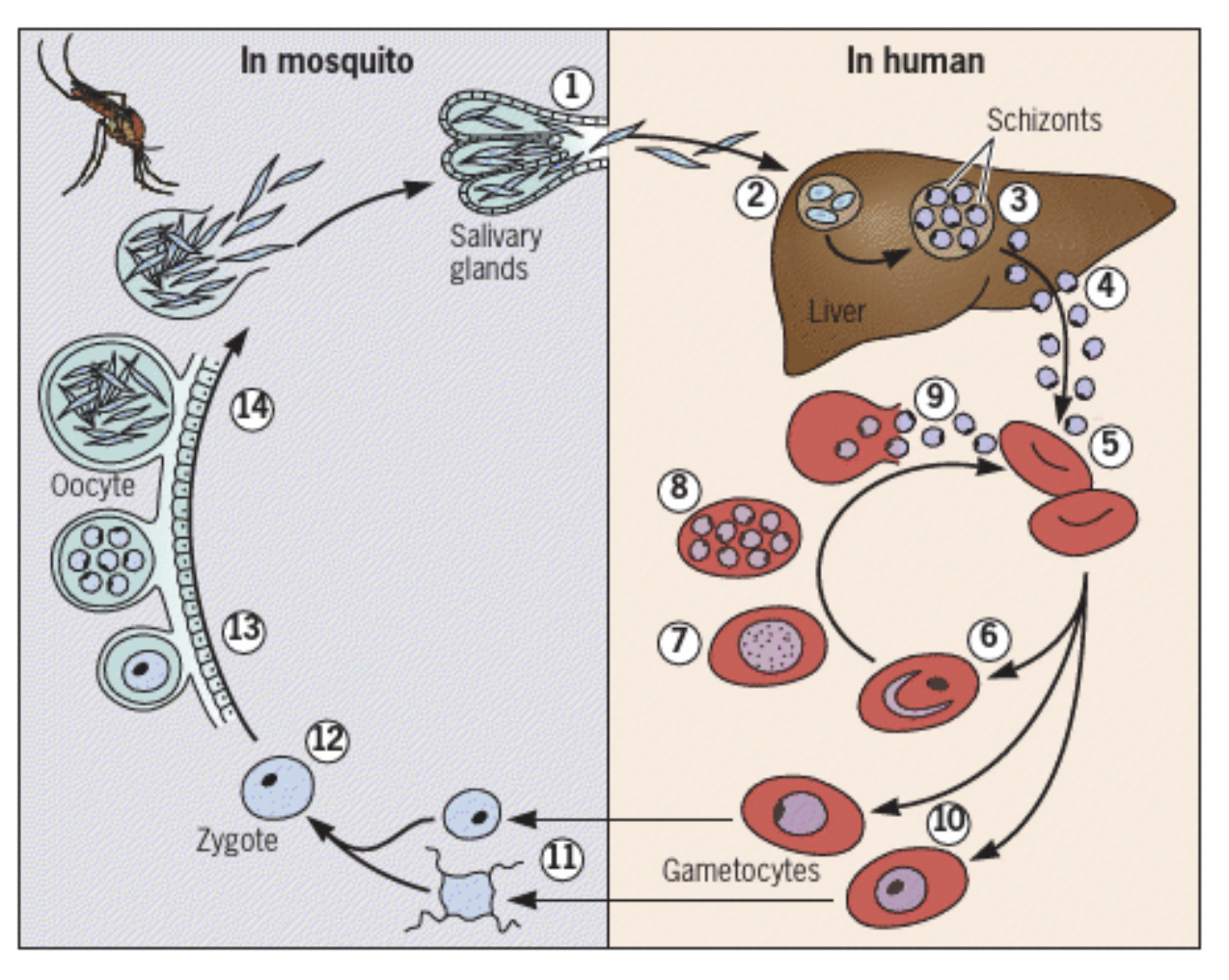
Describe the life cycle of Plasmodium.
Parasites (sporozoites) released from the salivary gland of a female mosquito are injected into a human.
They travel through the bloodstream and enter the liver (2). However, some parasites remain dormant in the liver (2). In some forms of malaria (due to Plasmodium vivax and Plasmodium ovale ), these cause relapsing fever and chills
There, they mature into cells called tissue schizonts (3).
They are later released back into the bloodstream (merozoites; 4),
where they invade red blood cells (5).
6, 7, 8.) In the red blood cells, the parasites mature into ring- shaped forms (6) and other asexual stages ( trophozoites and schizonts; 7 and 8).
9.) When fully mature, the parasites lyse the red blood cells and are released to invade uninfected red blood cells (9).
10.) Within the red blood cells, some parasites differentiate into sexual forms (gametocytes;10)
11.) When taken up by a mosquito, the gametes further differentiate (11)
12.) and mate to produce a zygote (12),
13.) which penetrates the mosquito’s gut (13) and develops into a structure called an oocyte.
14.) In time, oocytes produce cells (14) that migrate to the mosquito’s salivary glands (1) and repeat the cycle.
Inside which organs or tissues does Plasmodium multiply in?
The liver and blood cells inside humans
The midgut & salivary glands in mosquito
How does the sexual reproductive stage of the parasite, Plasmodium, occur?
Plasmodium parasite differentiates into its sexual forms (gametocytes) inside the red blood cells of humans, and when taken up by a mosquito, the gametes further differentiate and mate to produce a zygote, which penetrates the mosquito’s gut and develops into a structure called an oocyte.
Which life cycle stage of Plasmodium is targeted by the R21 and RTS,S Mosquirix malaria vaccines?
Both the RTS,S/AS01 (Mosquirix) and R21/Matrix-M malaria vaccines target the pre-erythrocytic stage (specifically the sporozoite stage) of the Plasmodium falciparum parasite.