AST Lec 05: The Heliocentric Solar System
 Call Kai
 Learn
 Practice Test
 Spaced Repetition
 Match
 Flashcards
 Knowt Play
1/25

There's no tags or description
Looks like no tags are added yet.
26 Terms
What observations were made before the time of Copernicus?
The sun, moon, and stars appear to rise and set every day, the Earth feels fixed, the stars don’t seem to change, dropped objects fall to the Earth, and the planets experience retrograde motion.
What assumptions were made before the time of Copernicus?
The heavens are perfect and incorruptible, and circles are perfect.
What conclusions were made before the time of Copernicus?
The Earth is the centre of the Universe, everything else revolves in perfect circles around it, the planets in cycles and epicycles.
A model that places the Earth in the centre of the Universe, with all celestial objects revolving around it.
The Geocentric Universe
An optical illusion that causes planets appear to turn around in their movement relative to the stars.
Retrograde Motion
A model that attempts to explain retrograde motion by suggesting that planets move in a “circles within circles” orbit.
Cycles and Epicycles
What were Copernicus’ main ideas about the Universe?
The sun is the centre of the Universe, planets orbit the sun in perfect circles, and the moon orbits the Earth.

How did Copernicus’ model of the Heliocentric Universe explain retrograde motion?
The Earth orbits the sun faster than Mars, therefore when looking up at Mars as Earth overtakes it, the change in our relative position to Mars makes it appear to wobble in the sky compared to background stars.

What is the issue with Copernicus’ explanation of Retrograde Motion, and why does it occur?
The model did not perfectly match up with Mars’ actual wobbly motion, as it did not account for orbital ellipses.
What was Tycho Brahe’s main contribution to astronomy?
Brahe made extremely precise measurements of the motion of Mars over decades, observed the appearance and disappearance of a Super Nova, and used parallax to calculate the distances of the planets.
How did Tycho Brahe’s data prove heliocentric models wrong?
They revealed that Mars did not exactly follow Copernicus’ model for Retrograde Motion, and that stars die so the “heavens” are corruptible.
What was Kepler’s main idea about the Universe?
God is an exact creator, therefore the Universe must fit into an exact model, the current options for which were incorrect. He fixed Copernicus’ model by suggesting Elliptic Orbits.
What is Kepler’s First Law?
Planets do not orbit the sun in perfect circles, rather in ellipses where the sun is at on focus and the other focus is empty.

A shape where the sum of the distances between each focus and a point on the curve is equal at any point on the curve.
Ellipse
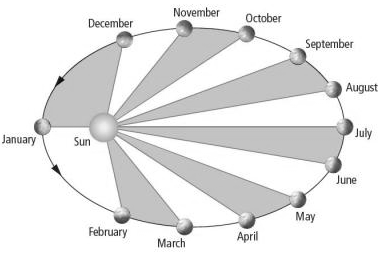
What is Kepler’s Second Law?
Planets move faster in their orbits when they come closer to the Sun, and slower when they travel farther from it, covering equal areas in equal time.
What is Kepler’s Third Law?
Planets closer to the sun orbit at a much faster speed than planets farther from the sun, obeying a precise mathematical relationship.
What do the T and the r represent in the equation for Kepler’s Third Law?
T is the orbital period in days, r is the planet’s orbital radius in AU.
According to Kepler’s Laws, which are false:
All of the above.
Which two models both fit the data that shows planets’ retrograde motion?
Geocentric with Epicycles and Heliocentric with Elipses.
What was Galileo Galilei’s main contribution to astronomy?
His observations proved that the Heliocentric with Elipses model is the superior model.
What was Galileo Galilei’s observation about the Moon, and how did that prove the heliocentric with elipses model?
The Moon has mountains and craters, which means not everything in the “heavens” are perfect circles and spheres, therefore elipses are possible.
What was Galileo’s observation about Jupiter’s Moons, and how did it prove the heliocentric with elipses model?
Jupiter has 4 moons, therefore not everything orbits the Earth.
What did Galileo Galilei observe about the Phases of Venus, and how did it prove the heliocentric with elipses model?
Venus has phases where it changes in apparent size: largest during “New Venus” and smallest during a “Full Venus”. This would not be possible in a Geocentric Model, where Venus would be the same size always, like our Moon.
What does the pattern of phases of Venus tell us about the orbit of Venus?
It must be orbiting the Sun, not the Earth.
According to Kepler’s Laws, which would be false:
The further a planet is from the sun, the faster it's orbit, because it has further to travel.
According to Kepler's Laws, which would be true about a comet orbiting the sun?
All of the above.