bio exam 3
 Call Kai
 Learn
 Practice Test
 Spaced Repetition
 Match
 Flashcards
 Knowt Play
1/214

There's no tags or description
Looks like no tags are added yet.
215 Terms
Cell division occurs for
Growth
• Cell replacement
• Healing
• Reproduction - prokaryotes
cell division in prokaryotes
dna copied
cell elongates and chromosomes separates
ring separates new daughter cells

the ring that separates the 2 cells is similar to ___
microtubules
binary fission
cell spilts in half
eukaryotes have __ chromosomes (a shape)
linear
how many chromosomes do humans have
46
is eukaryotic cell growth controlled or no
very tightly controlled in comparison to prokaryotes who divide constantly
cell cycle in eukaryotes
G0: cells not dividing
G1: growth
S phase: DNA is copied
G2: Cell checks the DNA and grows
M: mitosis and cytokinesis

bases of dna are held together by
hydrogen bonds
G-C pairs are more/less resistant to denaturation than A-T pairs
more
Semi-conservative model of DNA replication

Template strand is read in the _____
direction
3’->5
New strand is built in the ____direction
5’-> 3’
Energy to build the DNA strand comes from
the hydrolysis of the nucleotide phosphates
The enzyme that adds nucleotides is
DNA
polymerase
true or false: DNA polymerase always works by adding a
new nucleotide to an existing one – it can’t start a new strand
true
DNA is unwound to create a
replication fork.
Synthesis is begun by
RNA
polymerase (primase) creating a primer
RNA primase
binds to the 5’ end of the template strand and starts synthesis then falls off
in depth steps of DNA replication
RNA primase lays down an RNA primer
DNA polymerase III extends the RNA primer in okazaki fragments
DNA polymerase I removes the primer and replaces it with DNA
DNA ligase forms a bond joining the DNA fragments

exonuclease
An exonuclease is an enzyme that removes nucleotides one at a time from the end of a DNA or RNA strand
leading v.s lagging strands
dna polymerase is following 3’ to 5’

unwinds the
parental DNA strands.
helicase
relieves the stress of
unwinding
Topoisomerase II (jump rope example)
Single-strand binding protein
stabilizes single strands of DNA
Prokaryotic cells produce daughter cells by
binary fission
Binary fission begins with
DNA replication
Replication is initiated at a specific location on the circular DNA molecule, called the
origin of replication,
FtsZ
encodes a protein that forms a ring at the site of constriction where the new cell wall forms between the two daughter cells
FtsZ is present in the genomes of diverse bacteria and archaea, suggesting that it plays a fundamental role in binary fission
mitosis def
In eukaryotic cells, the division of the nucleus, in which the chromosomes are separated into two nuclei.
cytokinesis def
In eukaryotic cells, the division of the cytoplasm into two separate cells.
what happens first, mitosis or cytokinesis?
mitosis
the name for mitosis and cytokinesis
mitotic cell division
chromosomes
A cellular structure containing the genetic material, consisting of a single DNA molecule with associated proteins.
chromosomes in prokaryotes
organized as a single, relatively small, circular chromosome.
chromosomes in eukaryotes
much larger and is organized into one or more linear chromosomes
The DNA of prokaryotes is attached to
the inside of the cell membrane
the DNA of eukaryotes is located in
the nucleus
experiments have strongly suggested that mitosis evolved from
binary fission
2 phases of the cell cycle
interphase and M phase
M phase
when mitosis and cytokinesis happen
interphase
the cell makes many preparations for division. These preparations include DNA replication and cell growth.
3 phases of interphase
s phase, G1 phase, G2 phase,
S phase
The phase of interphase in which the entire DNA content of the nucleus is replicated
G1 phase
The gap phase of the cell cycle between M phase and S phase in which the size and protein content of the cell increase and regulatory proteins are made and activated in preparation for S-phase DNA synthesis.
growth
G2 phase
The gap phase of the cell cycle between S phase and M phase in which the size and protein content of the cell increase in preparation for M-phase mitosis and cytokinesis.
G0 phase
nothing is happening
replication fork
The site where the parental DNA strands separate as the DNA duplex unwinds.
template strand
In DNA replication, the parental strand whose sequence is used to synthesize a complementary daughter strand. In transcription, the DNA strand whose sequence is used to synthesize a complementary mRNA molecule. The template strand is also called the noncoding, antisense, and minus strand.
semiconservative replication
after replication, each new DNA molecule consists of one strand that was originally part of the parental molecule and one newly synthesized strand.
single strand bonding protein
A protein that binds single-stranded nucleic acids to prevent the template strands from comin back together
2 types of topoisomerase
type 1 ; cut one strand of DNA
type 2: cut both strands of DNA
RNA primase
synthesizes a short piece of RNA complementary to the DNA parental strand. Once the RNA primer has been synthesized, DNA polymerase takes over, adding successive DNA nucleotides to the 3’ end of the growing strand.
A second key property of DNA polymerase is that it can only add nucleotides to the____ end of another nucleotide
3’
the direction of DNA chain growth
5’ - 3’, this is because i has to be antiparallel to the 3’ end the DNA polymerase binds to
leading strand
A daughter strand that has its 3’ end pointed toward the replication fork, so as the parental double helix unwinds, this daughter strand can be synthesized as one long, continuous polymer.
lagging strand
5’ end is near the replication fork, but the strand cannot grow in that direction.
how does synthesis occur on the lagging strand
To enable synthesis of the top strand, the replication fork moving to the left creates a single-stranded region of parental DNA ranging in length from a few hundred to a few thousand nucleotides. Synthesis of the daughter strand is initiated on this single-stranded stretch of parental DNA with its 5’ end near the replication fork. Elongation of the new strand occurs at its 3’ end as usual, which means that the daughter strand grows in a direction away from the replication fork, not toward it.

okazaki fragments
fragments the lagging strand of DNA is built in
proofreading
DNA polymerase I and III can detect the mispairing and removes a bad nucleotide
Dna polymerase iii
main replication synthesis
dna polymerase i
the specialized cleaner once pol iii is done, pol i comes to remove the rna primer, removes okazaki frament primers
Dna replication in prokayotes
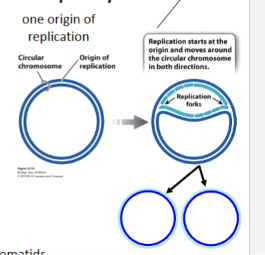
origin of replication
each point at which DNA synthesis is initiated
replication bubble
A region formed by the opening of a DNA duplex at an origin of replication, which has a replication fork at each end.

what happens when 2 replication bubbles come into contact with each other
they fuse to form one larger replication bubble
origins of replication in prokaryotes

a circular DNA molecule can/cannot be replicated completely
can
because it has no ends and the replication forks can move completely around the circle
at each round of DNA replication the ends become slightly longer/shorter
shorter
at the ends the leadin strand is able to replicate the whole template strand but the lagging strand isn’t, the last RNA primer on the lagging strand still needs to be removed.
when removed, a section of template DNA remains unreplicated, so in the next generation doesn’t have the uncoded DNA and continues to get shorter and shorter with more rounds of replication
what mechanisms solve the problem of the shortenin of DNA ends
Each end of a eukaryotic chromosome is capped by a repeating sequence called the telomere
in the chromosomes of humans and other vertebrates, it consists of the sequence 3’-GGGATT-5’ repeated over and over again in about 1500–3000 copies
The telomere is slightly shortened in each round of DNA replication but is quickly restored by telomerase

telomerase activity is fully active in
germ cells which produce egg and sperm cells.
and stem cells
is telomerase active in most cells in the body
no.
In these cells, the telomeres are nevertheless shortened by about 100 base pairs in each mitotic division.
human cells stop dividing when their chromosomes have telomeres with fewer than ___ copies of the telomere repeat
100 (supports theory for aging)
why does DNA need to be condensed into chromosomes
the length of DNA contained in the nucleus of an average eukaryotic cell is well beyond the diameter of a cell.
also to make sure it doesn’t tangle
karyotype
A standard arrangement of chromosomes, showing the number and shapes of the chromosomes representative of a species.
how many chromosomes do cells in the human body have? what about gametes?
46, 23
homologous chromosomes
Pairs of chromosomes, matching in size and appearance, that carry the same set of genes; one of each pair was received from the mother, the other from the father. (form an x)
the sex chromosomes
x y chromosomes
The number of complete sets of chromosomes in a cell is known as its
ploidy
A cell with one complete set of chromosomes is
haploid
A cell with two complete sets of chromosomes is
diploid
Some organisms, such as plants, have four (4n) or sometimes more complete sets of chromosomes. Such cells are
polypoid
centromere
middle of the x chromosome shape that keeps the sister chromatids together
what do you use to count chromosomes
count centromeres
chromosome condensation
the chromosomes condense and become visible in the nucleus
prophase
first stage of mitosis The stage of mitosis characterized by the appearance of visible chromosome
mitotic spindle
a structure that pulls the chromosomes to opposite ends of the dividing cell
they radiate from the centrosome
centrosome
structure that mitotic spindle fibers radiate from
prometaphase
the nuclear envelope breaks down and the microtubules of the mitotic spindle attach to chromosomes
kinetochores
Associated with the centromere of each chromosome are two protein complexes
one located on each side of the constriction
Each kinetochore is associated with one of the two sister chromatids and forms the site of attachment for a single spindle microtubule.

metaphase
Chromosomes align as a result of dynamic changes in the mitotic spindle.
think METAPHASE → M= middle
anaphase
Sister chromatids fully separate
The centromere holding a pair of sister chromatids together splits
The spindle microtubules attached to the kinetochores gradually shorten, pulling the newly separated chromosomes to the opposite poles of the cell.
telophase
Nuclear envelopes re-form around newly segregated chromosomes.
The microtubules of the mitotic spindle break down and disappear
As the nuclei become increasingly distinct in the cell, the chromosomes contained within them decondense, becoming less visible under a microscope.
cytokinesis
The parent cell divides into two daughter cells
In animal cells, this stage begins when actin filaments form a contractile ring, the ring contracts, pinching the cytoplasm of the cell and dividing it in two
contractile ring
structure that promotes the division of one cell into 2
the equivalent of a contractile ring in binary fission
FtsZ protein
what happens during cytokinesis for plant cells
plant cells form a cell plateinstead of a contractile ring
phragmoplast
In dividing plant cells, a structure formed by overlapping microtubules that guide vesicles containing cell wall components to the middle of the cell where the vesicles will coalesce to form the new wall (cell p late)between daughter cells
a cell may have to receive a ____ before it divides.
signal
Cyclin–CDK complexes control
Cyclin–CDK complexes control