MATH1020
 Call Kai
 Learn
 Practice Test
 Spaced Repetition
 Match
 Flashcards
 Knowt Play
1/246

There's no tags or description
Looks like no tags are added yet.
247 Terms
What is a function
is said to be one-to-one if there are no two distinct points in its domain where it takes on the same value.
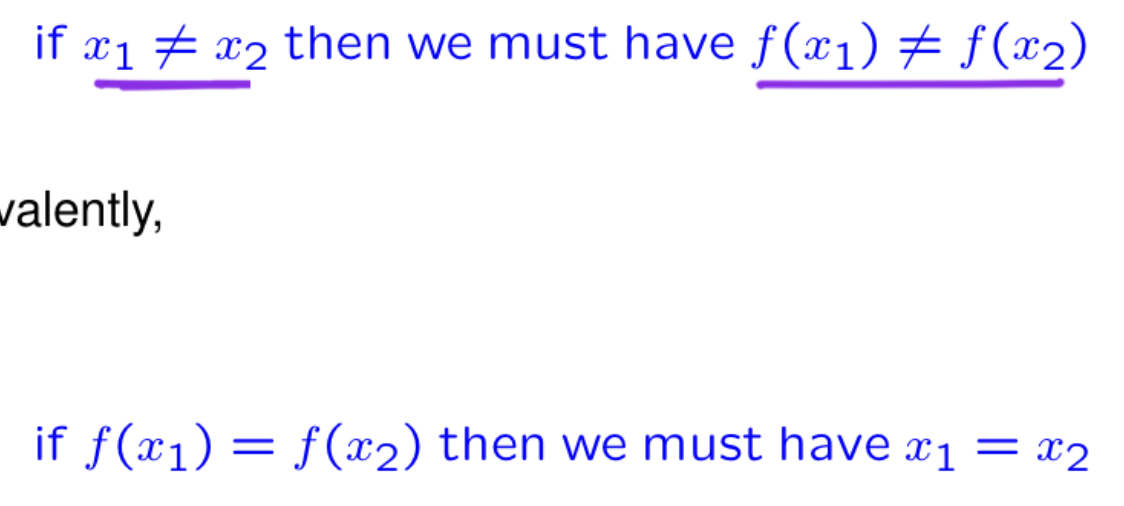
How to test if an equation is a function?
Horizontal line test
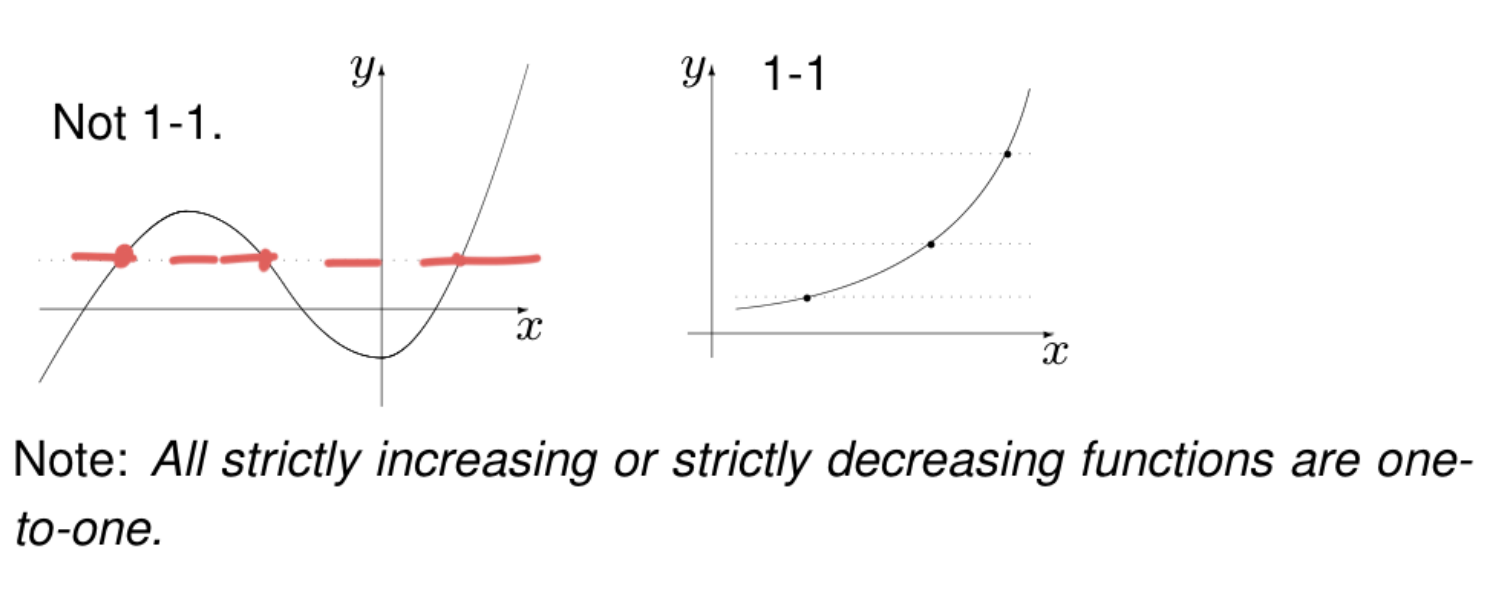
How do you make a function 1-1 though it may not originally be 1-1? Provide an example.
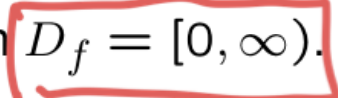
Restrict the domain. e.g. f(x) = x² —> this is not 1-1 unless you restrict the Domain to 0≤ x ≤ ∞.
Given a one-to-one function f with domain Df and range Rf, what is the definition of the inverse of f?

*Important note:
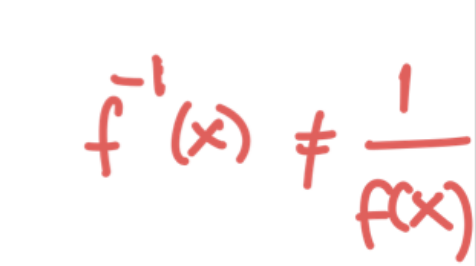
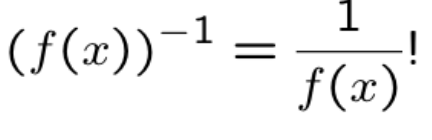
only 1-1 functions have inverses. Also, these definitions/ composition cancellations may be used to verify whether functions are inverses to each other or not.
Are trigonometric functions 1-1?
no, they’re periodic instead. So, we restrict the domain to make them 1-1.
Arcsine - what is it?
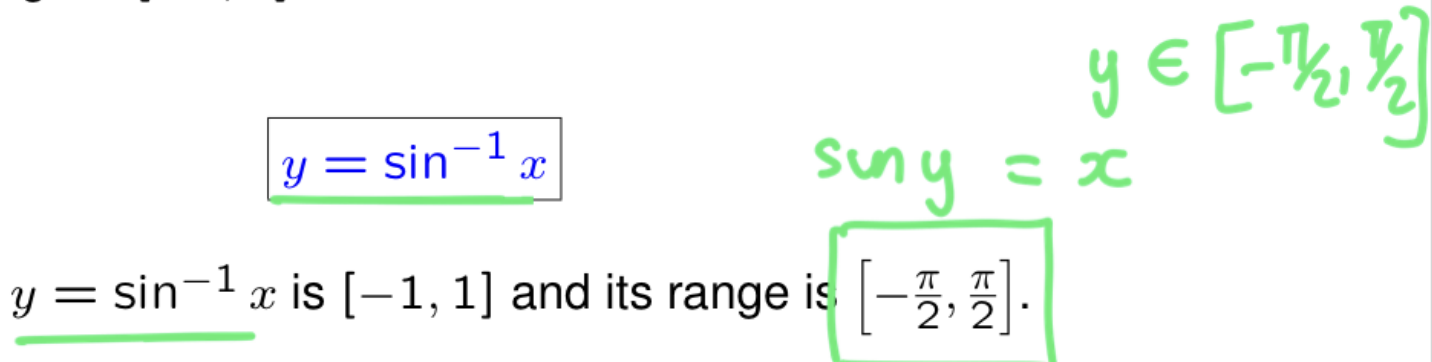
it is the inverse of y = sinx. sinx is 1-1 if domain is [-pi/2, pi/2] & on this restricted domain the range is [-1, 1]. Implicitly, the inverse is x = siny (as per the definition of inverse functions). However, we write as y = sin^-1(x). The domain and range stay the same.
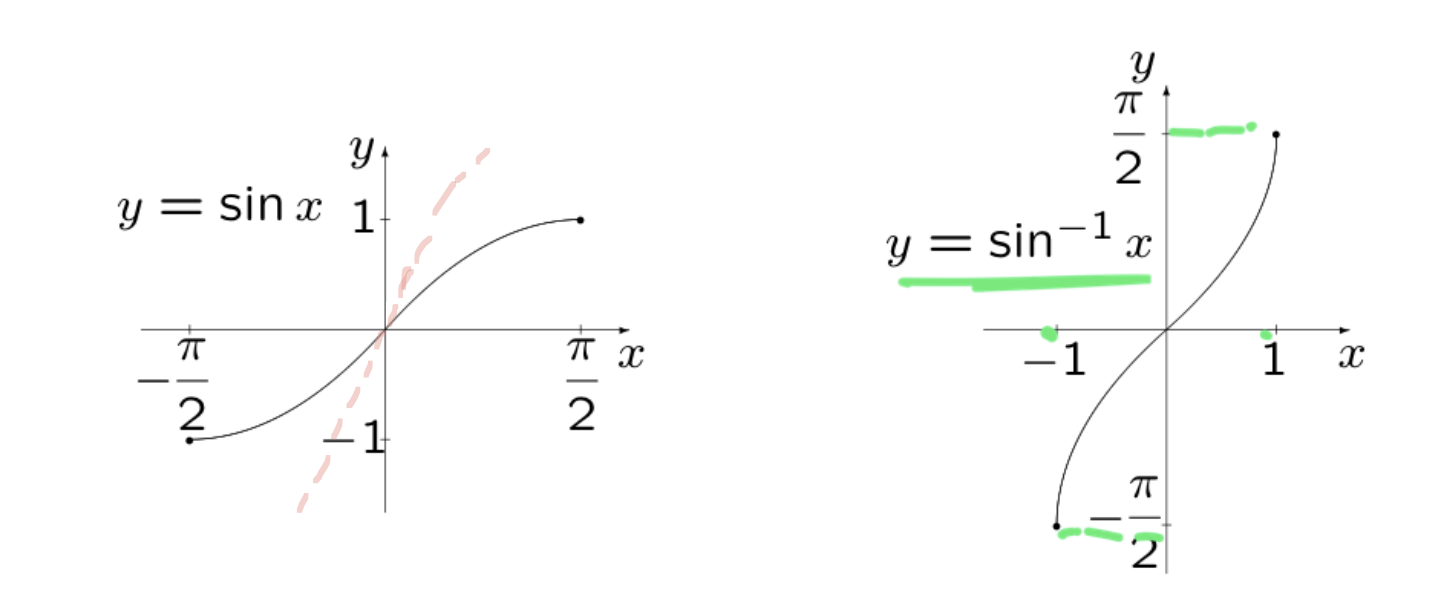
How to evaluate arcsine? Show.
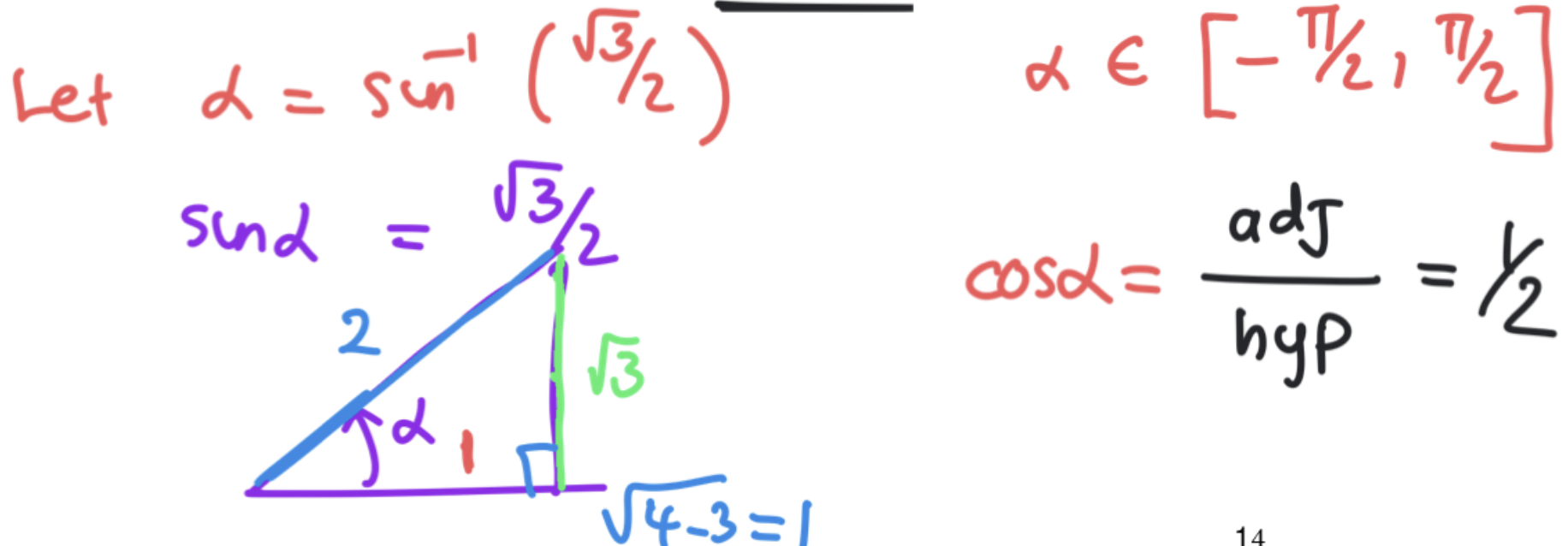
use knowledge of sine of common angles + calc. Remember that the angles fit within the domain, if you’re expecting an angles outside this intervale, you need to adjust ur answer appropriately.
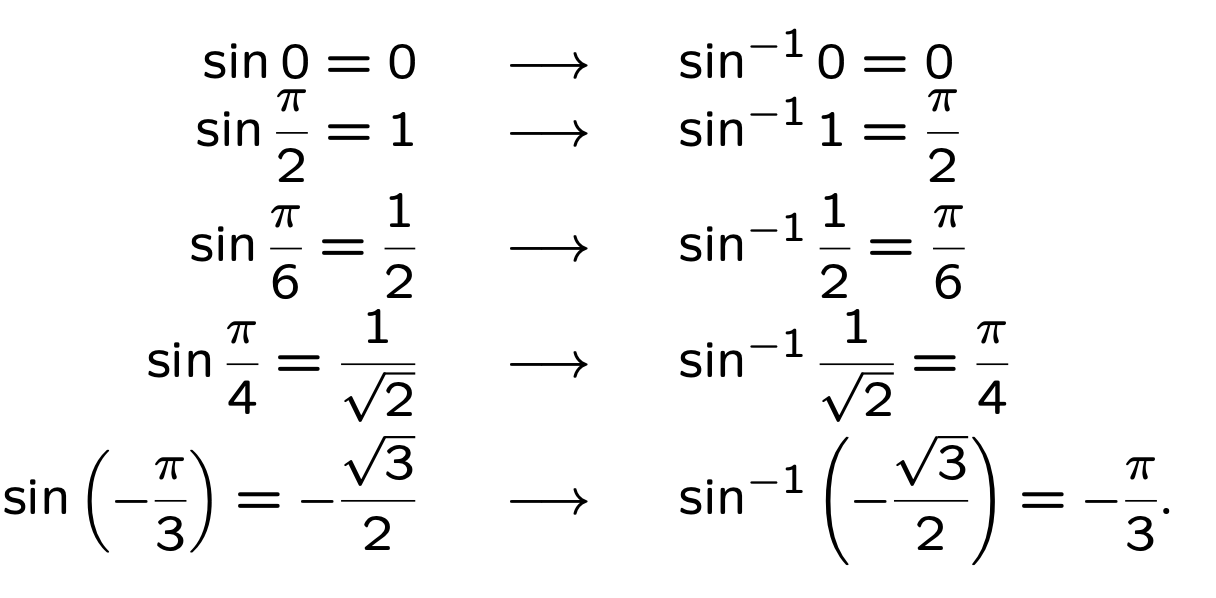
What are the cancellation equations for sine and arsine?

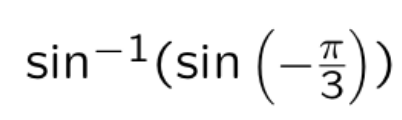
solve this
-pi/3
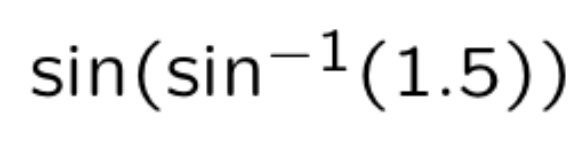
solve this
doesn’t exit for it isn’t within the RANGE [-1,1]!
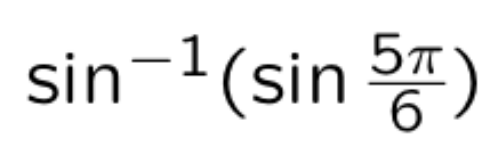
solve this
since 5pi/6 doesn’t fit within the interval [-pi/2, pi/2];

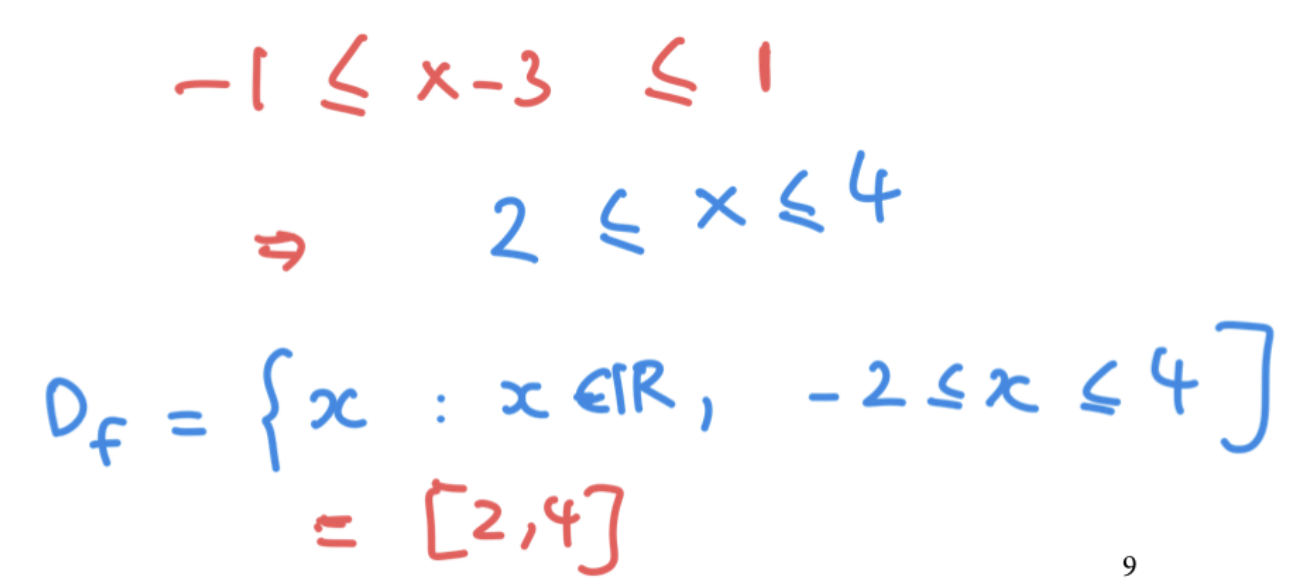
Find the domain of f(x) = sin−1(x − 3).
sin(sin^-1(0.3)). solve this

Important notes: it must fit within the RANGE not domain as part of the definition of inverse functions - see card 4 for that.
How to find the inverse of cosine function (arccosine)?
y = cosx —> restrict the domain so that it is strictly monotonic (strictly increasing/decreasing) over the domain: [0, pi]
Therefore, the range = [-1,1]

Therefore the domain for arccosine is [-1,1] and range = [0,pi]
How do you graph y = cos^-1(x) starting from y = cosx?
The graph of y = cos−1 x is easily obtained from the graph of y = cos x by reflection in the line y = x, as usual.
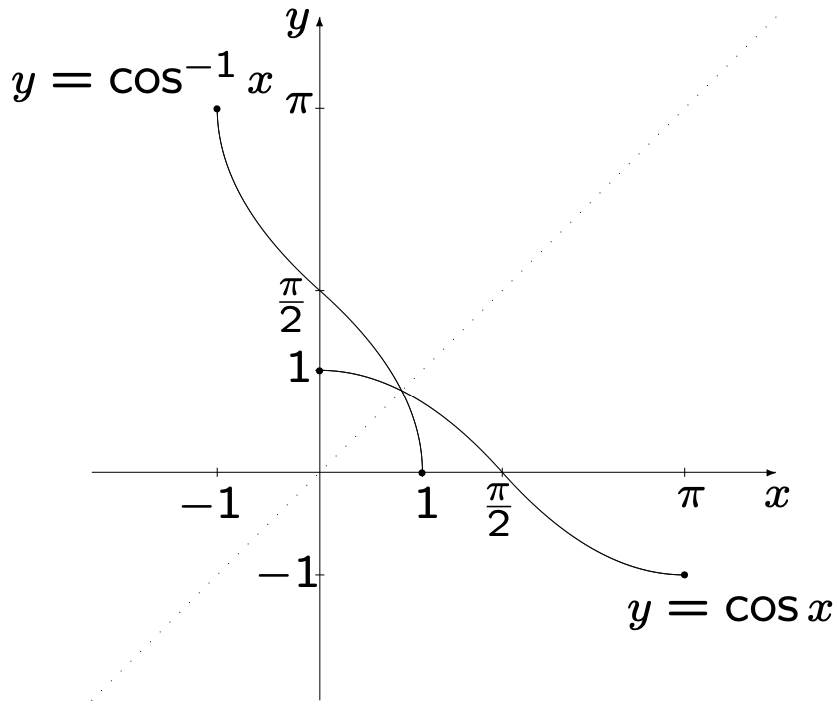
What does y = x mean? Why?
The line y = x acts as the reflection axis for functions—specifically monotonic, invertible ones—because this reflection swaps the input (x) and output (y) coordinates of every point, mapping f(x) to its inverse function f^-1(x).
The derivatice is 1 therefore it is strictly increasing.
Other facts: it’s a 45 degree line that runs through the origin.
Give examples of arccosine. Hint: start from cosine function and then follow the defninition by simply switching the variables.

What is the definition of the cosine/arccosine inverse functions cancellation method?

Once again, it follows the formal definition of inverses. Just keep in mind the domain and the range.
How to find arctan from tan? Draw graph for each of these.
y = tanx —> restrict the domain to [-pi/2, pi/2]; the range to [-∞, ∞]. Now, this is 1-1. Arctan = y = tan^-1(x) OR x = tan(y) but the 1st one is more suitable in this context.
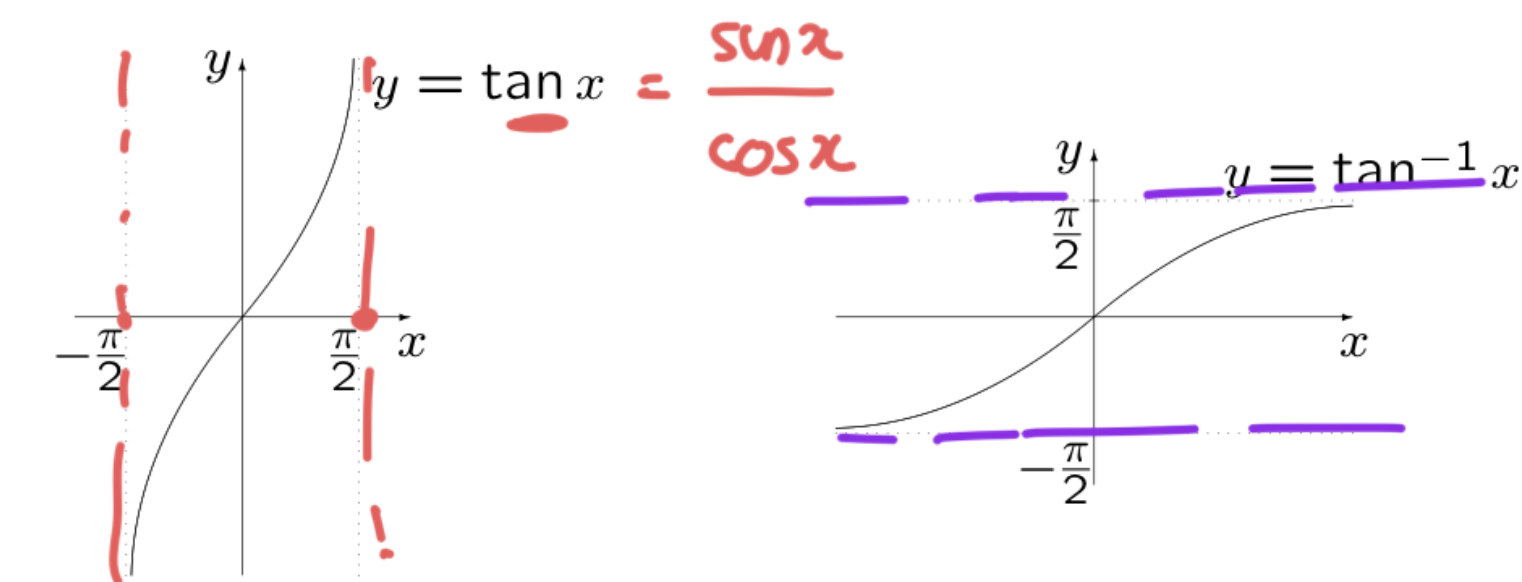
What are the following cancellation equations for tan and arctan?

Always be sure to specify the domain and range.
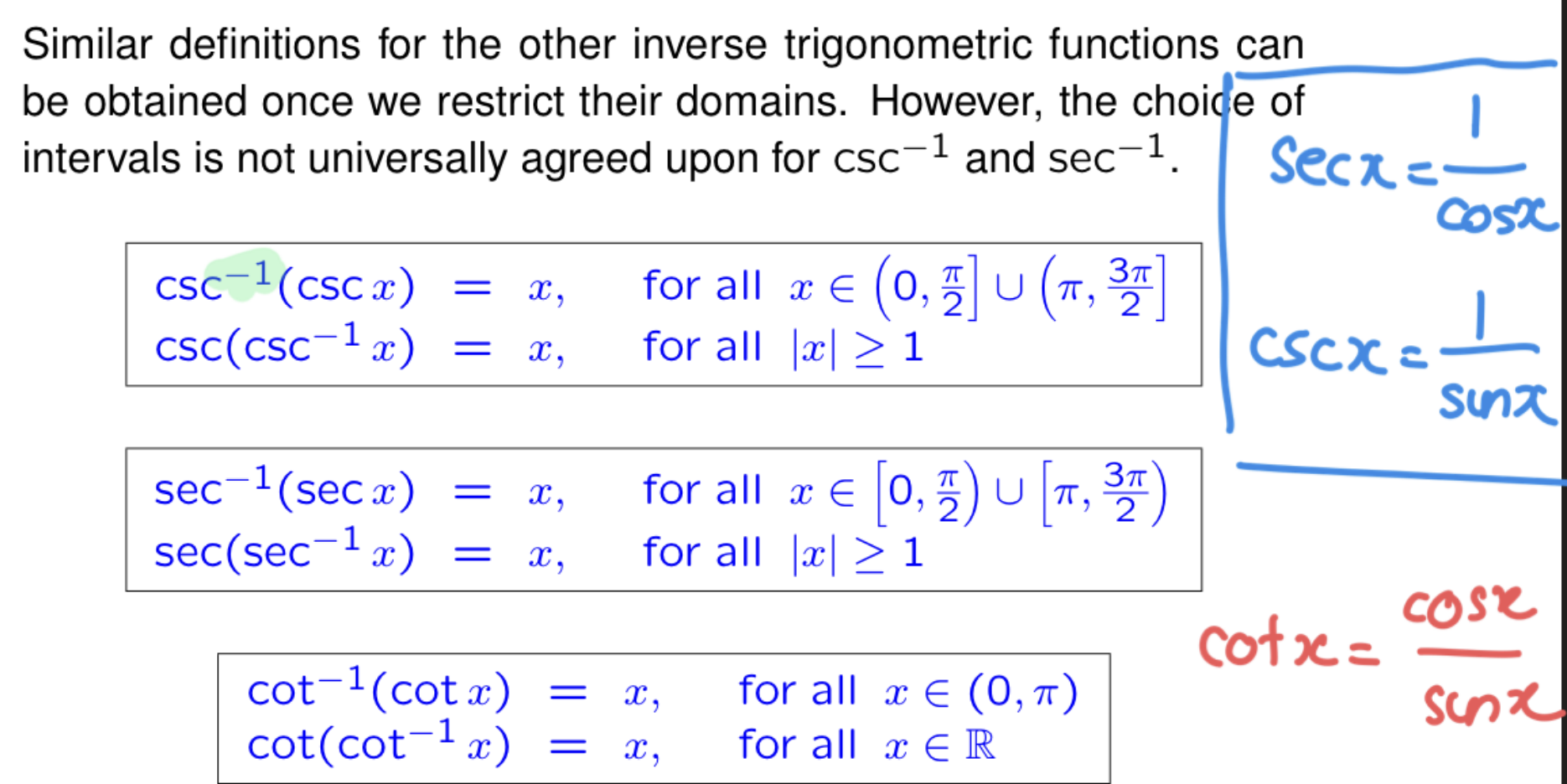
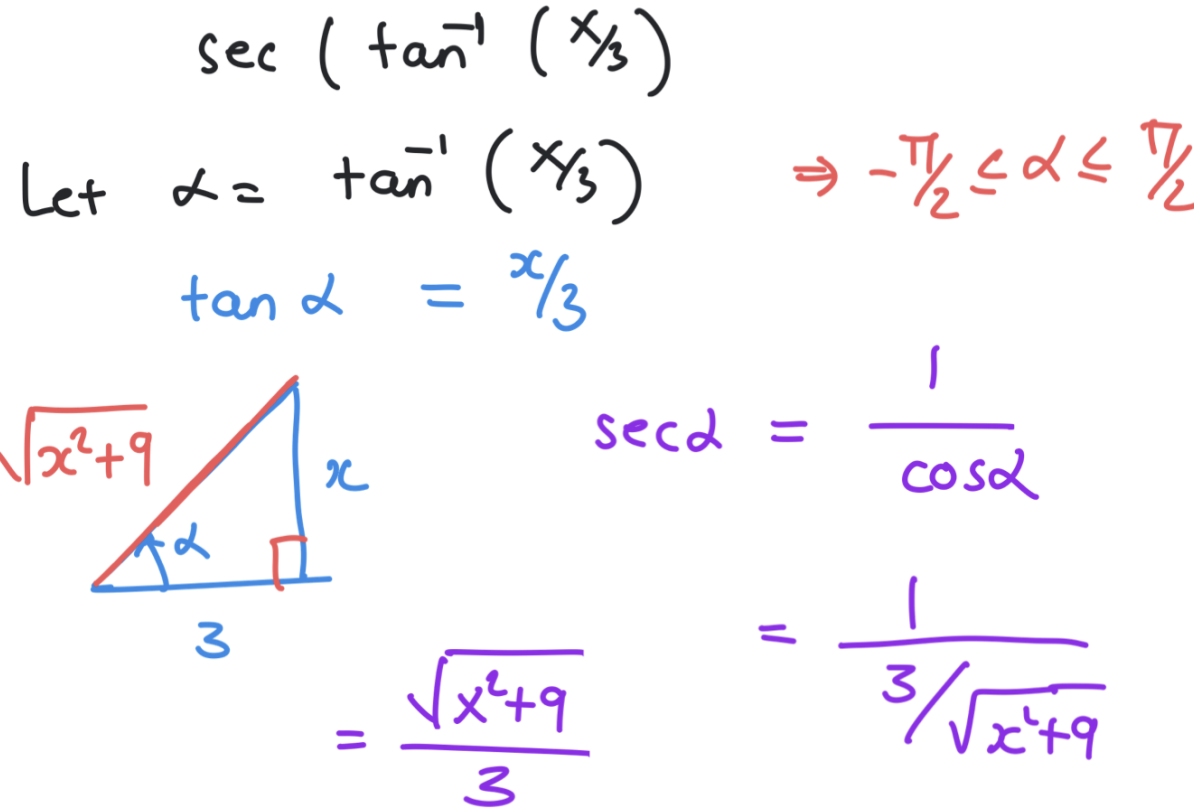
What are the definitions for sec(x) and csc(x) and cot(x) as well as their inveserses?
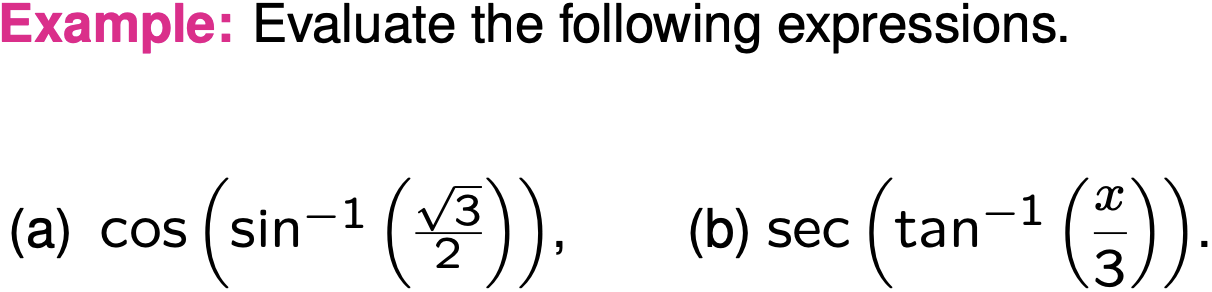
What are hyperbolic funcitons?
they are defined in terms of exponential functions. Their properties mirror that of trigonometric functions - try not to get confused!
Define sinhx
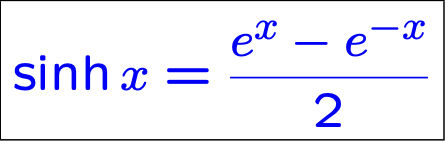
this is hyperbolic sine of x
Define coshx
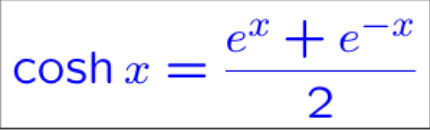
hyperbolic cosine of x.
What would the graph of sinhx & coshx look like?
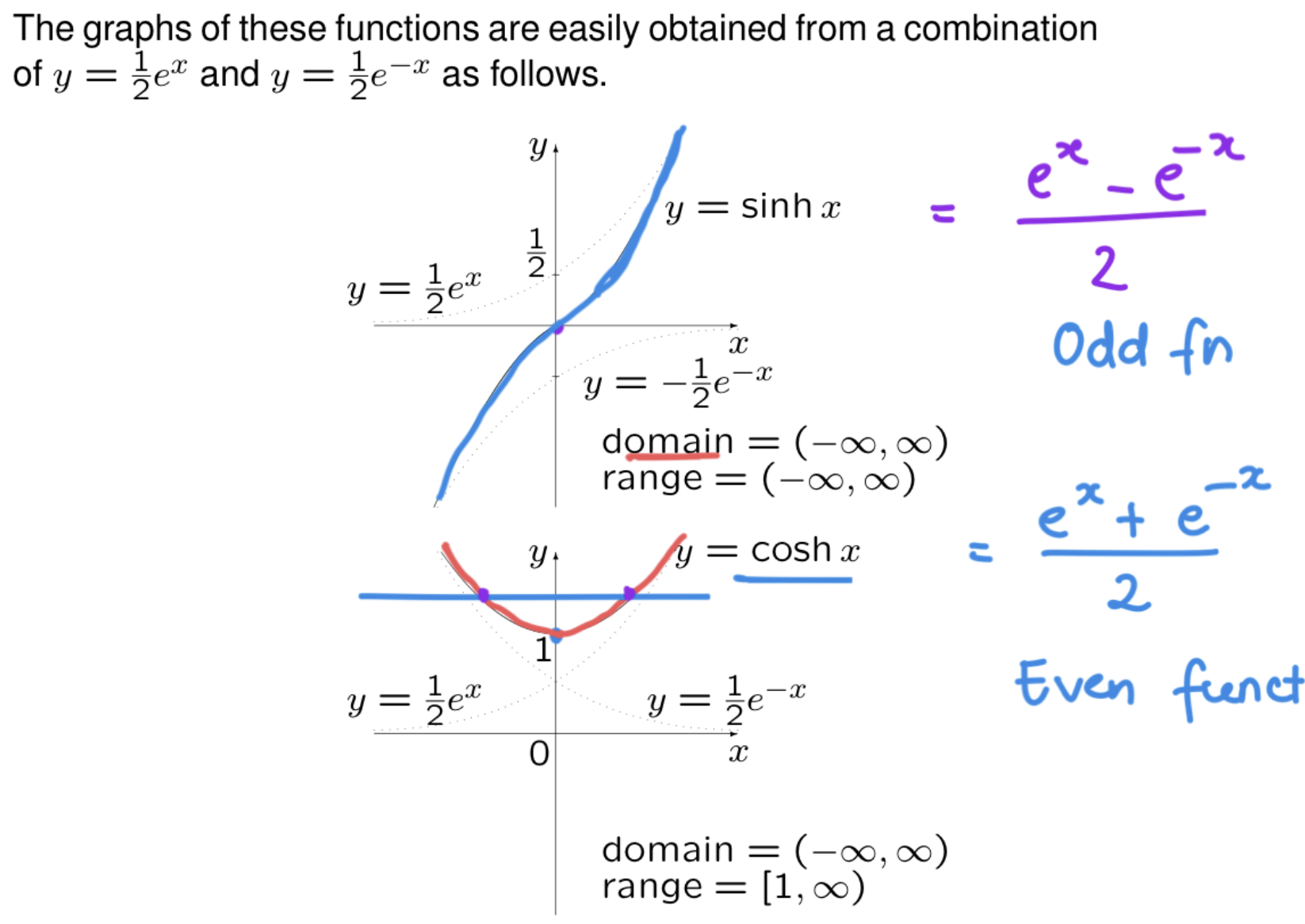
note the even & odd function as well as the y = ½ e^x & the domain + range for each.
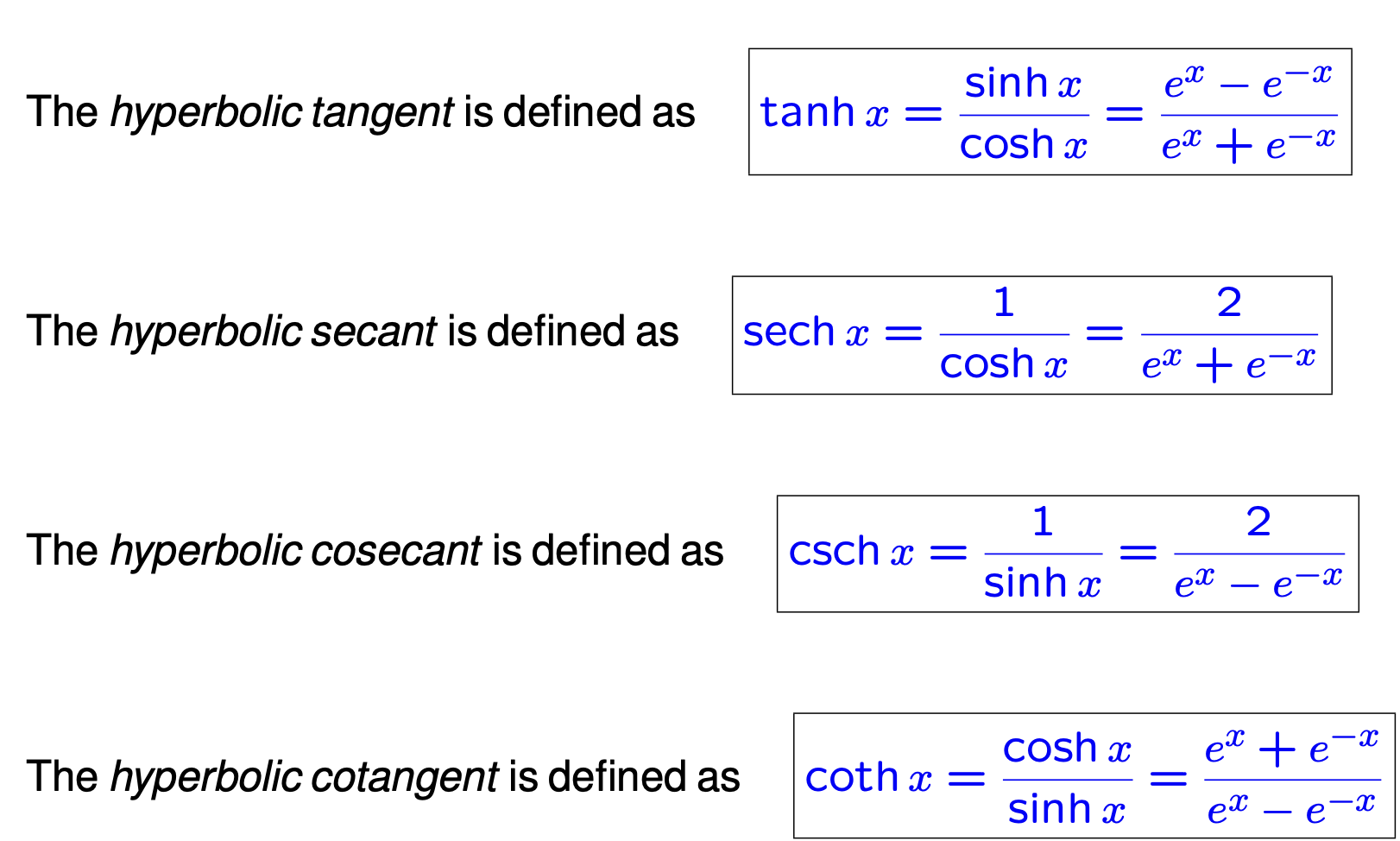
List all the other (other than cosh(x) + sinh(x)) hyperbolic functions and define each one.
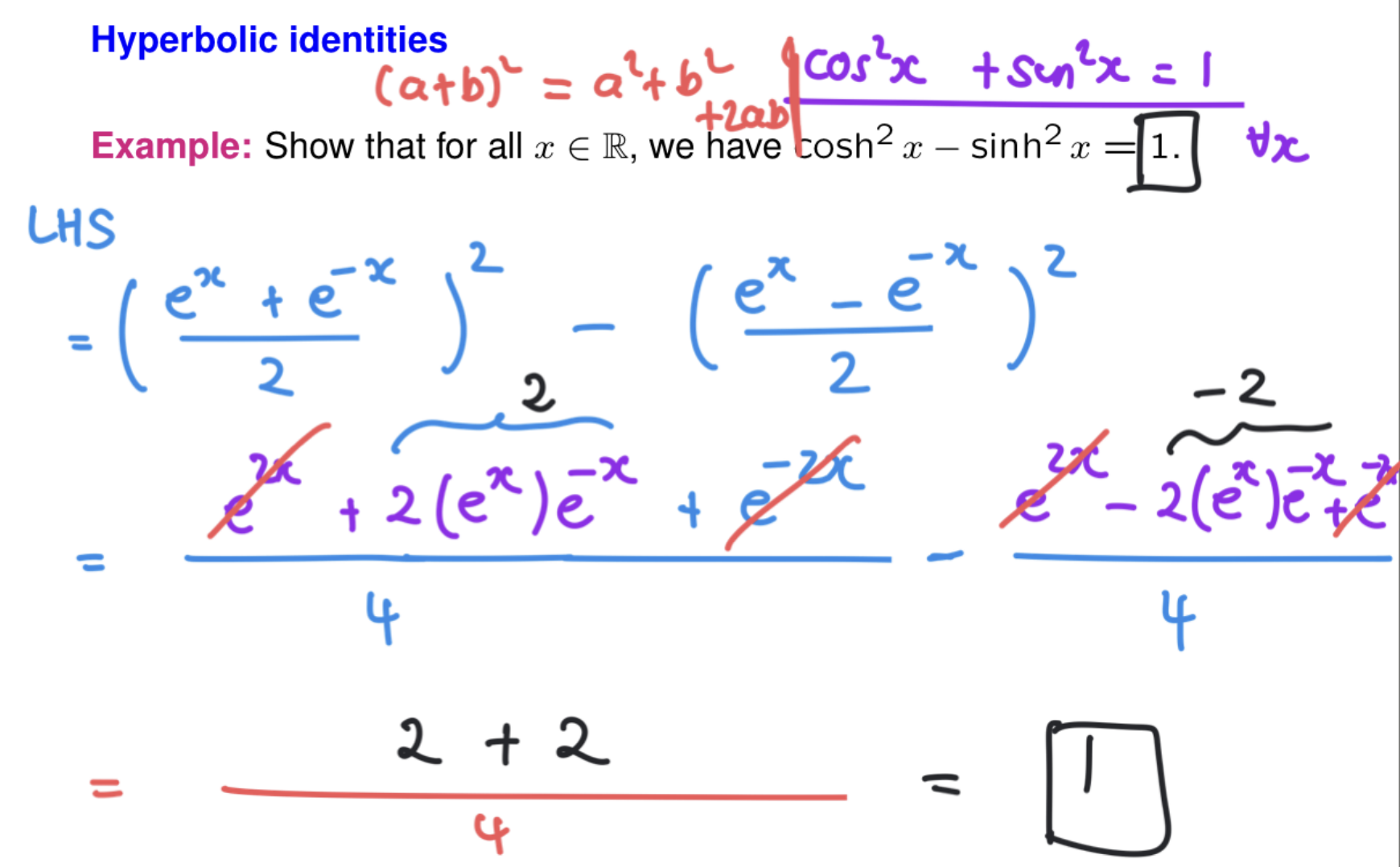
Show that for all x ∈ R, we have cosh² x − sinh² x = 1 - this is a hyperbolic identity.
*remember not to confuse hyperbolic identities with trigonometric identities.
List 3 hyperbolic identities & 3 trigonometric idenities.
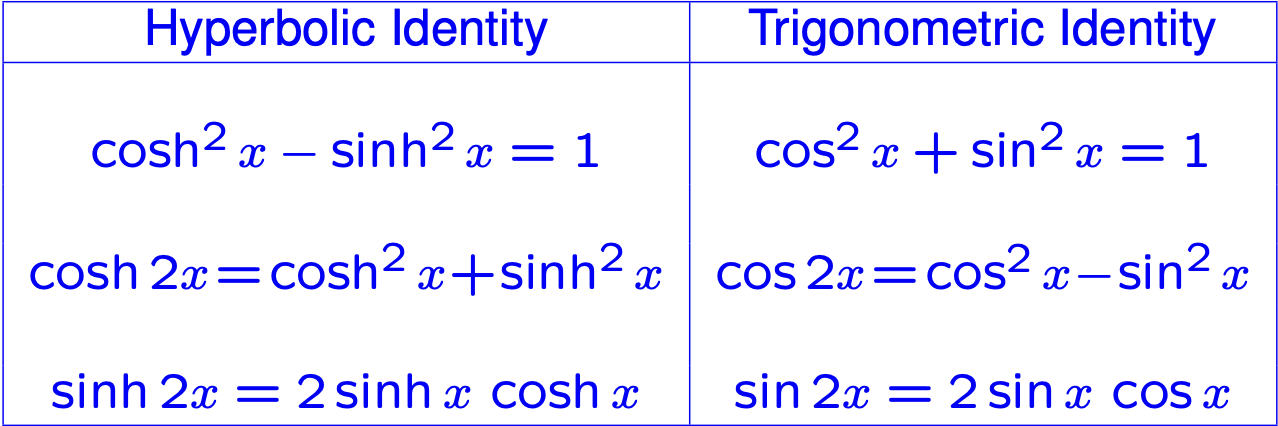
try to memorise or even deduce.
Distinct between trigonometric functions and hyperbolic functions.
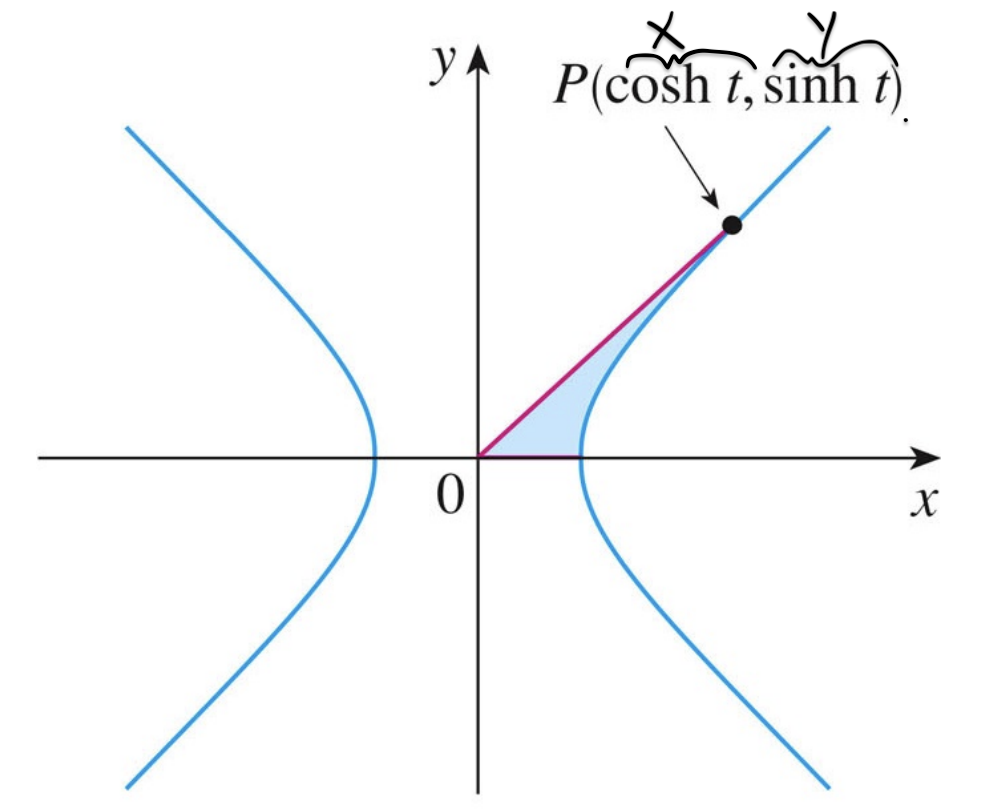
Trigonometric functions —> if t is any real number, the point P(cos(t), sin(t)) lies on the unit circle y = x² + y² = 1.
Hyperbolic functions —> if t is any real number, the point P(cosh(t), sinh(t)) lies on the right branch of a hyperbola y = x² - y² = 1 since cosh²(t) - sinh²(t) = 1.
Arc hyperbolic sine - what is it + state domain and range + draw the graph for it.
It is the inverse of sinh(x).
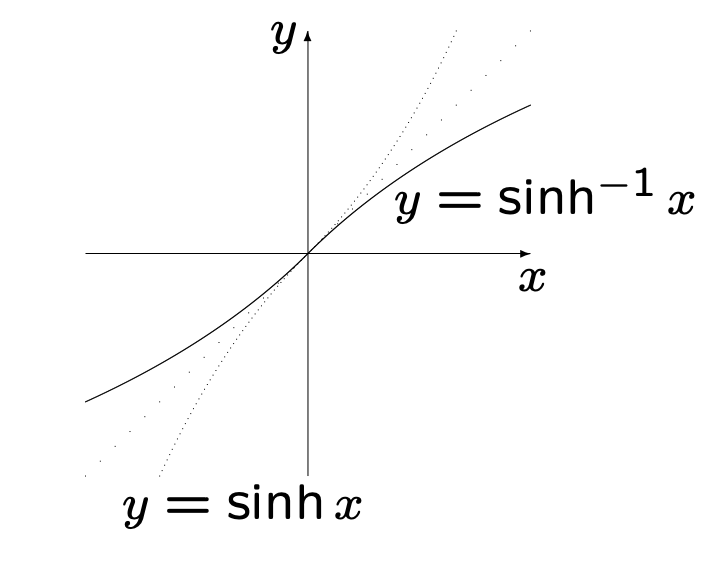
Domain = [-∞, ∞]
Range = [-∞, ∞]
It’s infinity because sinh(x) is a strictly increasing function, hence 1-1, therefore invertible.
*Note the y=x line that goes through the origin - read card 16.
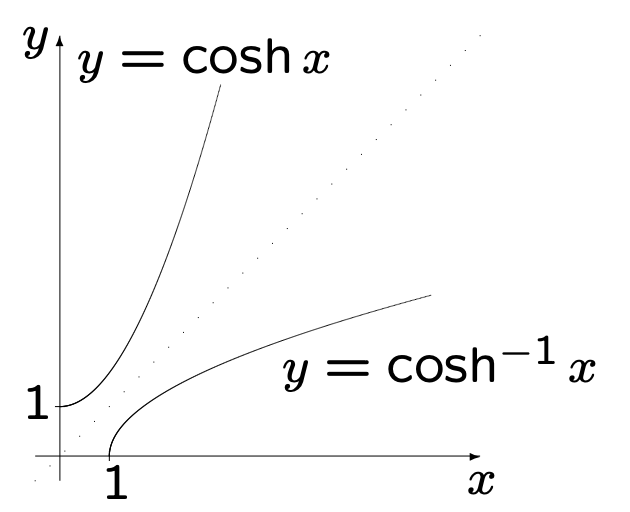
Arc hyperbolic cosine - what is it + state domain and range + draw the graph for it.
It is the inverse of cosh(x)
Domain = [1, ∞)
Range = [0, ∞)
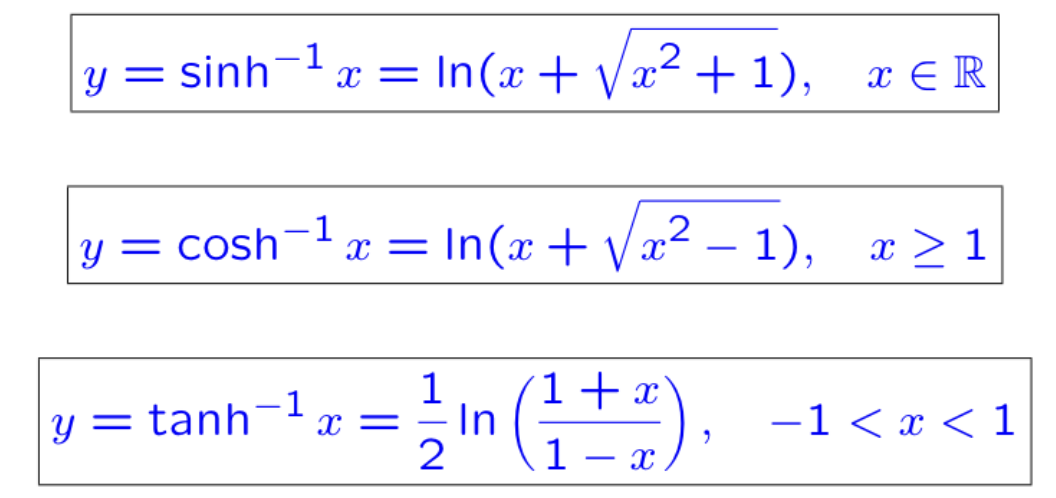
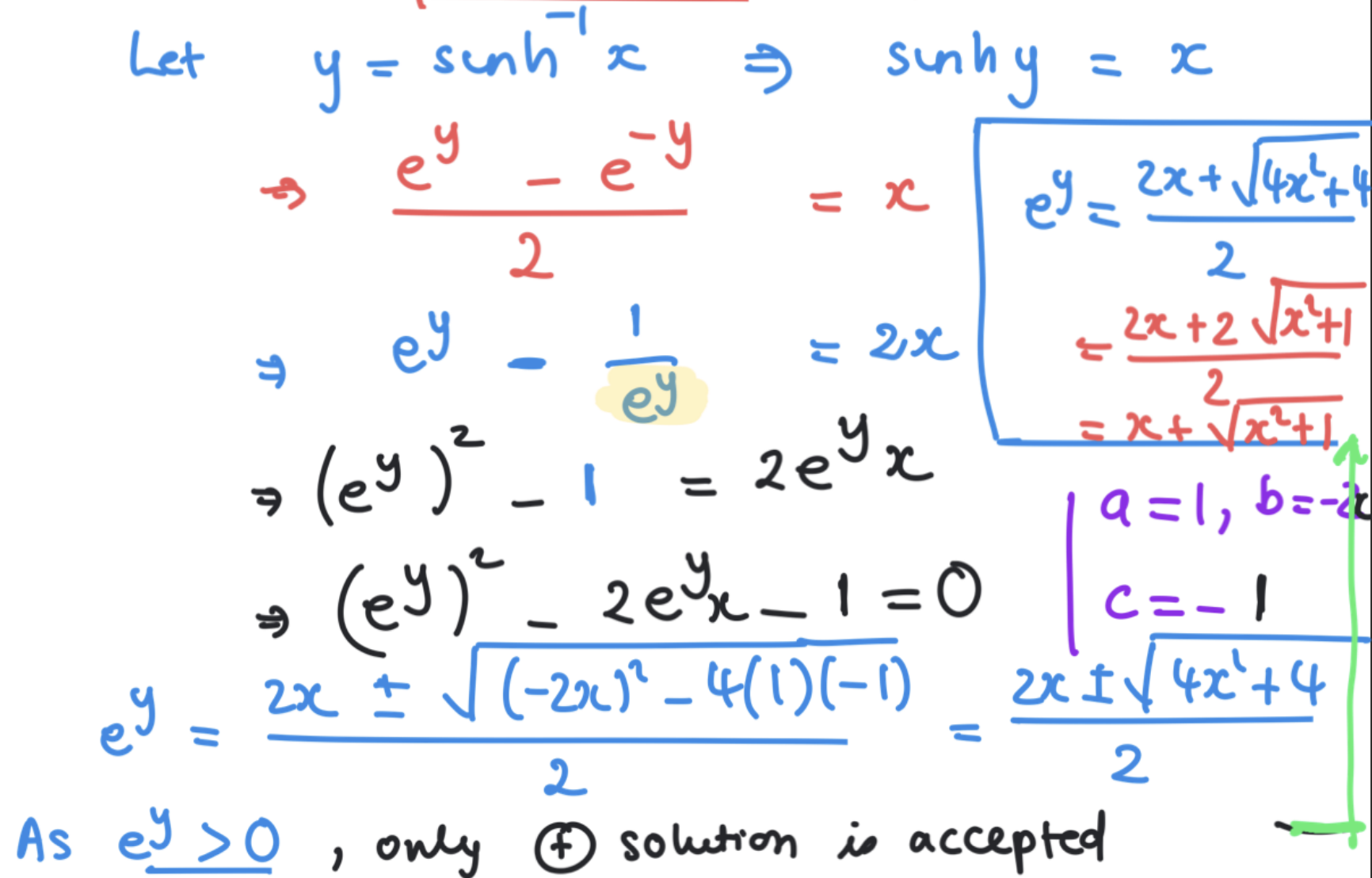
What is the inverse hyperbolic function written in their natural logarithm form?

What are conic sections?
They are the curves that can be obtained by intersecting a double right circular cone with a plane. The most important ones are circles, ellipses, parabolas, hyperbolas - we only discuss ellipses and hyperbola.

How to create an ellipses? What is an ellipse? What are the 2 fixed points called?
Intersect a plane that is slightly tilted where it only intersect one part of a double right circular cone —> this results in an ellipse.
An ellipse is the set of points in a plane whose distances from 2 fixed points, F1 and F2 in the plane have a constant sum. The 2 fixed points are called the foci of the ellipse.
Label the different part of an ellipses in a plane. Explain what they are.


Focal axis = the line that goes through the foci.
Vertices: the point where the focal axis crosses the ellipse.
Major axis = the line that contains both the foci and vertices and has a total distance of 2a (it’s the longest line & sometimes used interchangeably with the focal axis)
Centre: the point on the axis halfway between the foci.
Minor axis = the axis that isn’t the major axis.
State the standard definition of an ellipse.

What is the equation for an ellipse when the foci are in the x-axis?

What is the equation for an ellipse when the foci are in the y-axis?


the last image is what the ellipse looks like when the foci are on the y-axis.


What is a hyperbola?
A hyperbola is the set of points in a plane whose distances from two fixed points F1 and F2 in the plane have a constant difference. The two fixed points are the foci of the hyperbola.
Label the relevant points on the diagram.


Note: the +- a are the vertices of the hyperbola. It is also +- a for the vertices of an ellipse.
State the standard definition of a hyperbola.

State the equation of a hyperbola when the foci are on the x-axes.

What is the equation for the foci on a hyperbola? contrast it with the ellipse foci equation.
c² = a² + b²
The foci equation for an ellipses is c² = a²-b² or rearranging it give b² = a²-c².
State the equation of a hyperbola when the foci are on the y-axes.

State the asymptote equation of a hyperbola when the foci are on the y-axis.

How do you shift a conic?

What would the equation of a shifted ellipse elongated in the x-direction be? Add in other relevant details.

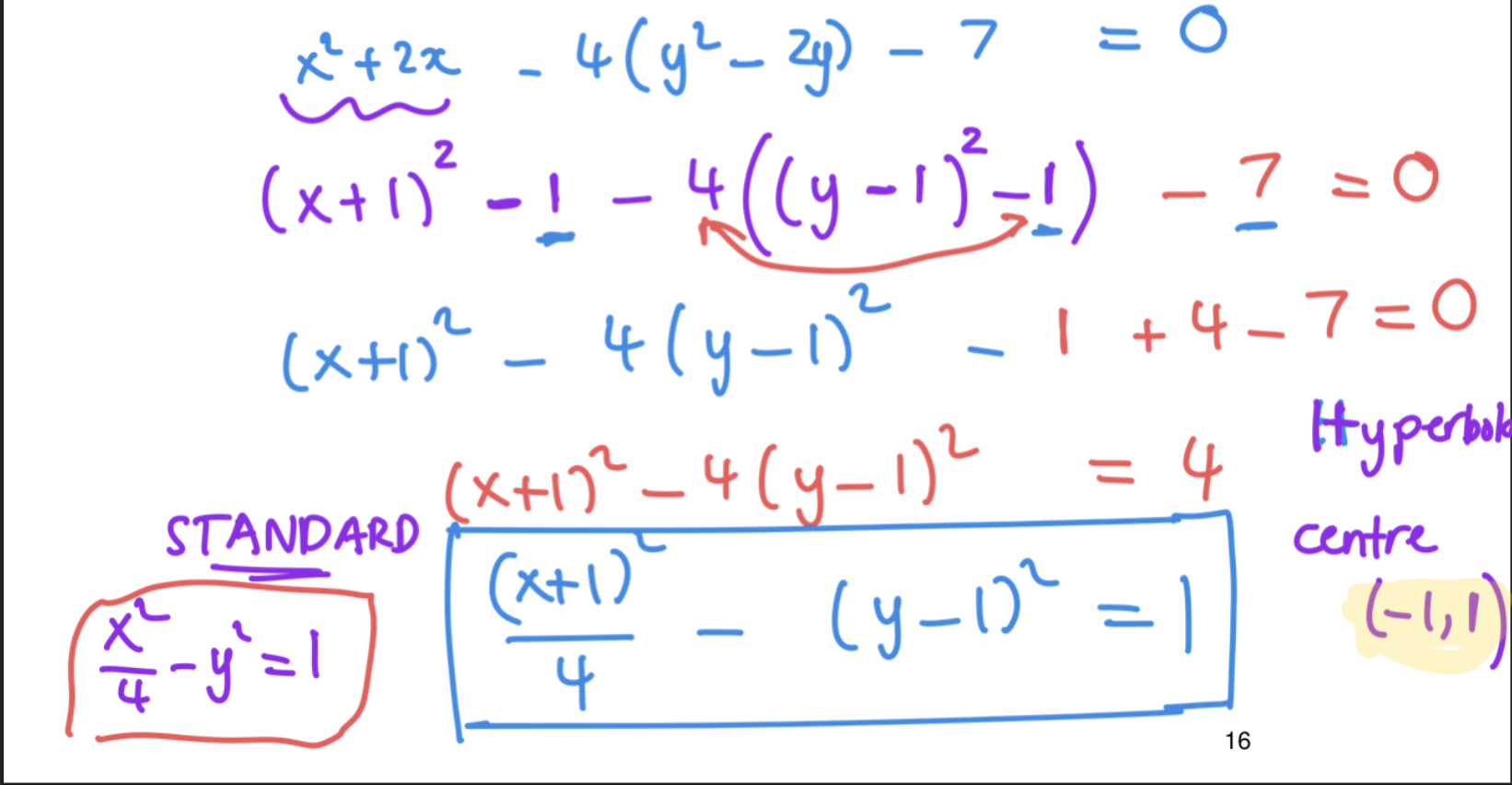
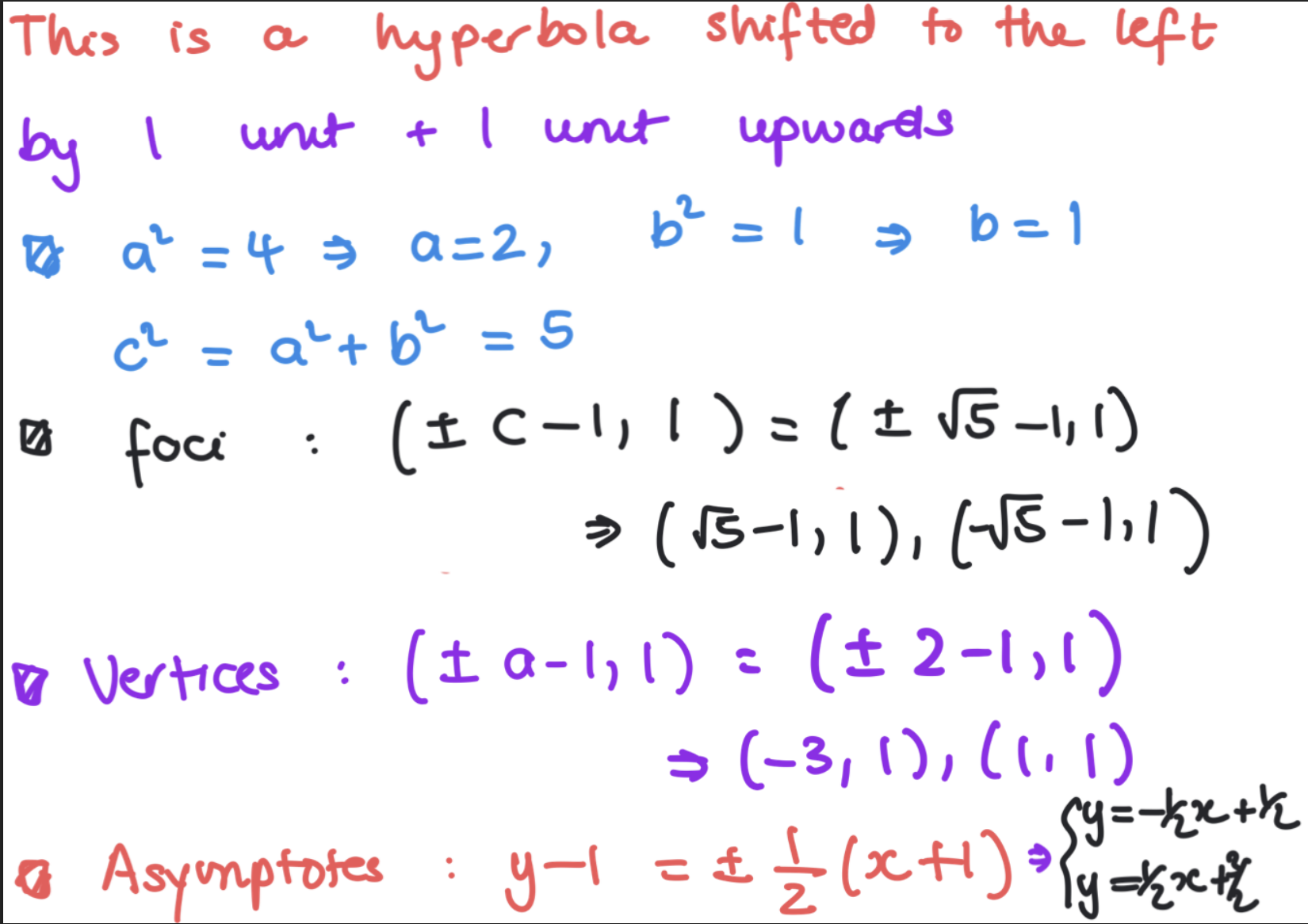
What would the equation of a shifted hyperbola with focal axis parallel to the x-axis be? Add in other relevant details.

Note: the asymptote equation for when the focal axis is parallel to y-axis is y-k = (+or-) a/b * (x-h)


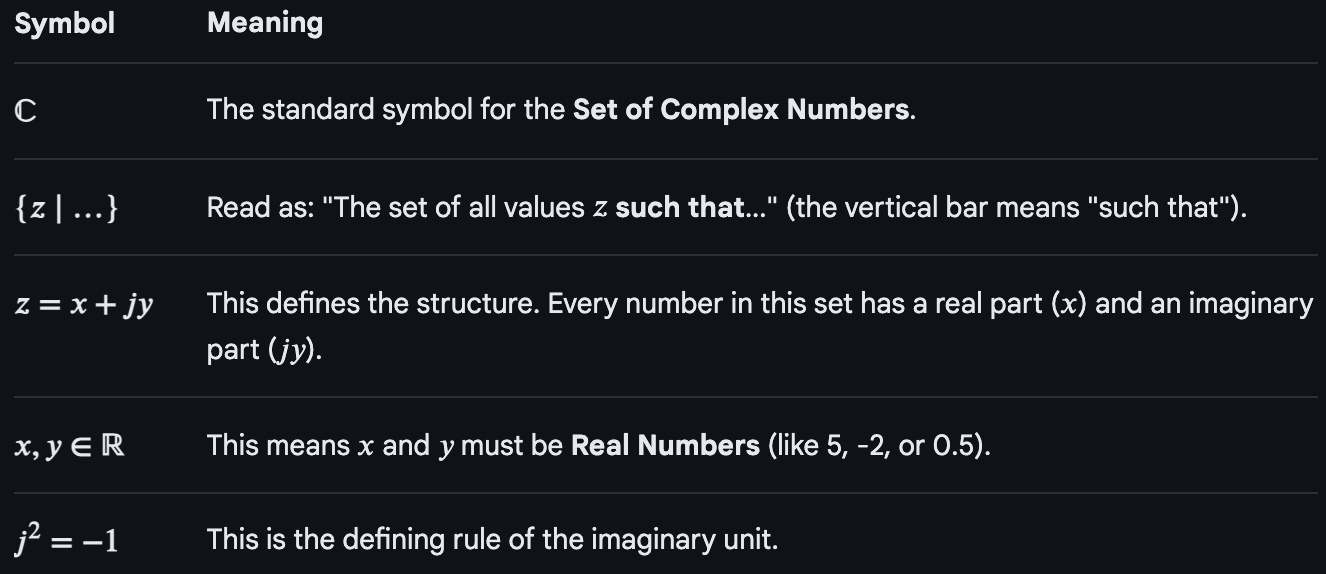
Write complex number equation. State the definition of the set of complex numbers (in set builder notation).
z = x + jy.
x & y are real numbers.
j is the imaginary unit. j²=-1.
This is referred to as the complex plane or z plane.
This is the set of complex numbers:

Note: it is bad practice to write

Note:

the curve that looks like “c” means subset. The equation will be x + j(0) = x as an element of all real numbers.
Why do complex numbers exist?
There is no real number x which satisfies the polynomial equation x²+1=0. To permit solutions of this, complex numbers are introduced hence j² = -1
For the complex number z = x + jy, state the real part of z and the imaginary part of z.
x = Re(z)
y = Im(z)
Arithmetic with complex numbers - why do we do this?
We would like to be able to work with complex numbers just as easily as we do with real numbers. Equality, addition, subtraction and multiplication are dealt with in an obvious manner, while division takes a little bit more work.
When is z1=z2?
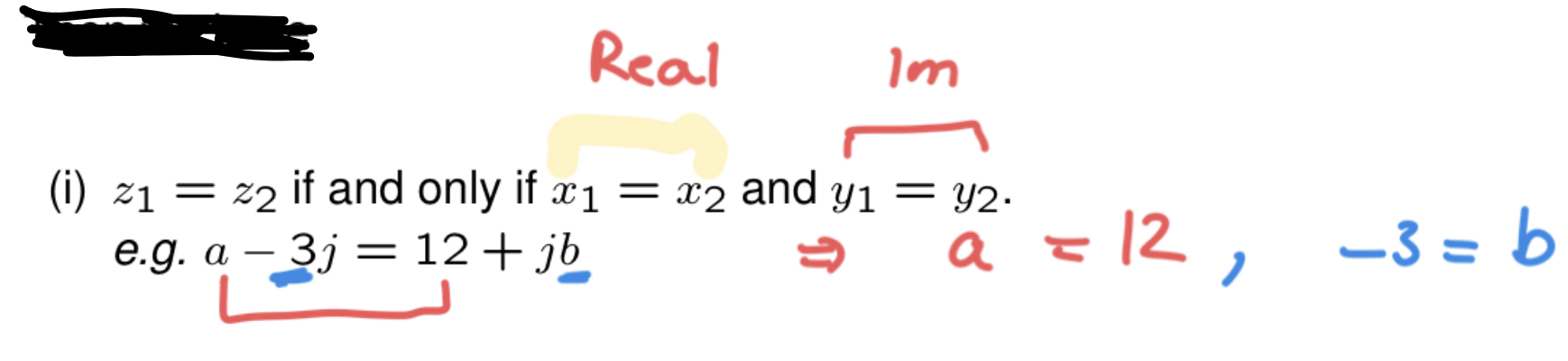
List arithmethic with complex numbers (excluding division)
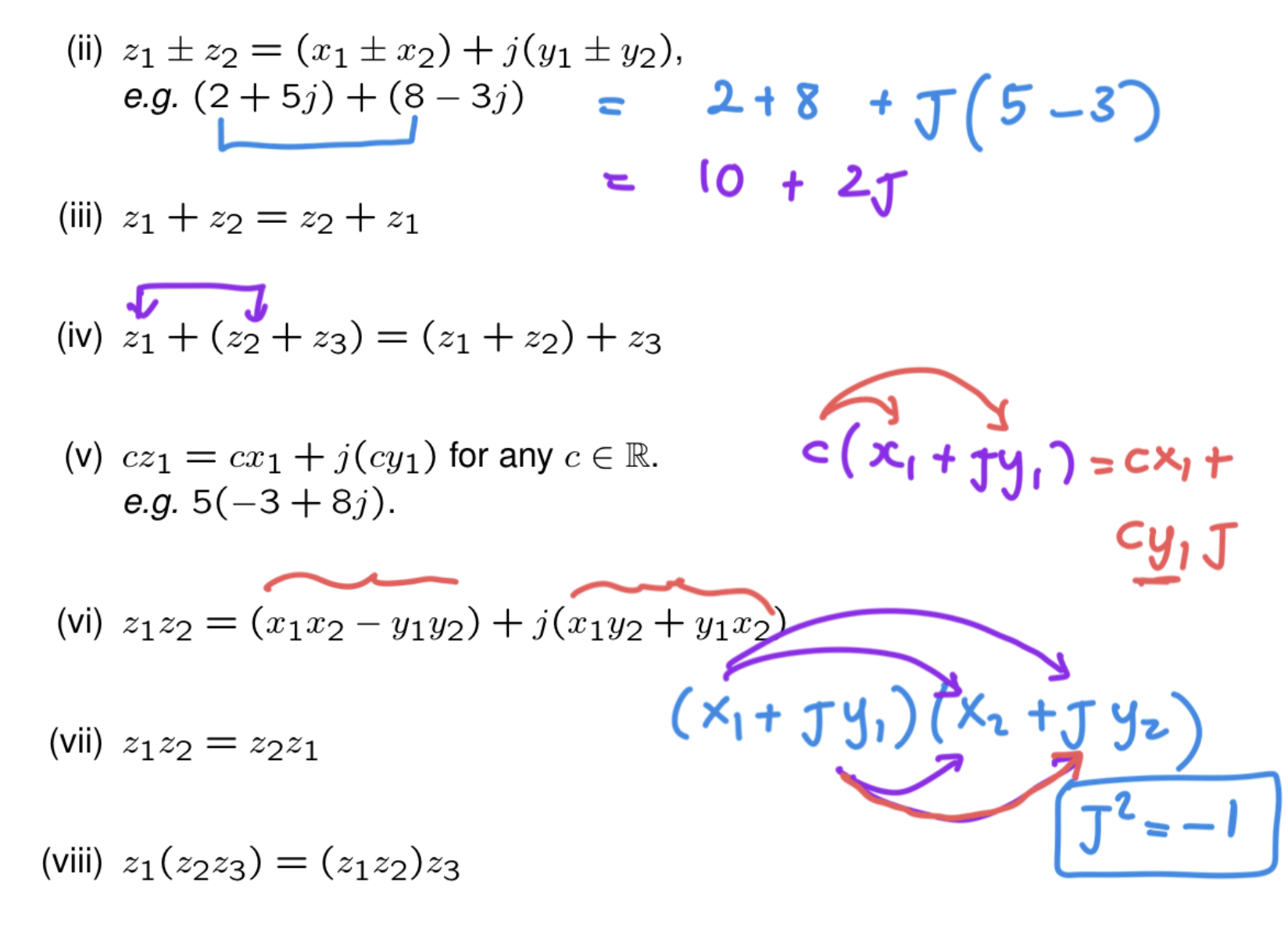

What is unique about complex numbers (than real numbers) and state what it is?
Conjugate of complex numbers:
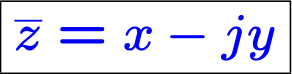

2 reasons it’s unique is 1: because it is a reflection about the real axis and the imaginary part is opposite
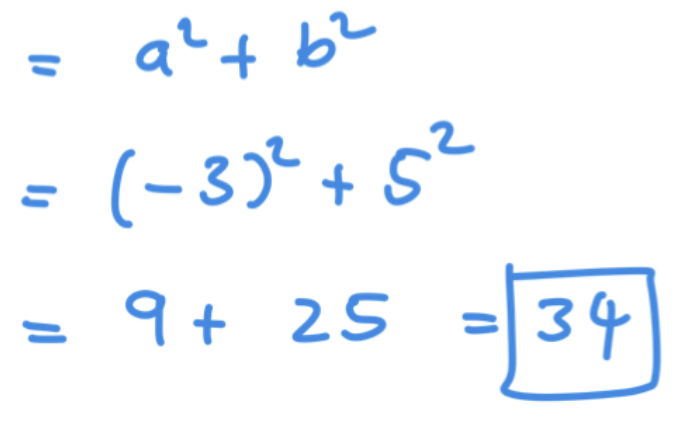
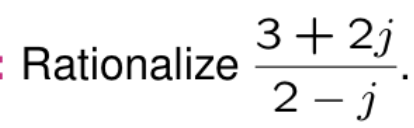
2: if you multiply the conjugate with the real number, you will get a purely real number (a²+b²). Some examples include rationalising denominators that contain imaginary parts. Also because of this, complex numbers are like 2D vectors where they have magnitude and direction and argand plane however the difference between them and standard 2D vectors is that you can use arithmetic to solve equations unlike in the standard 2D vectors.
List the properties of
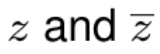

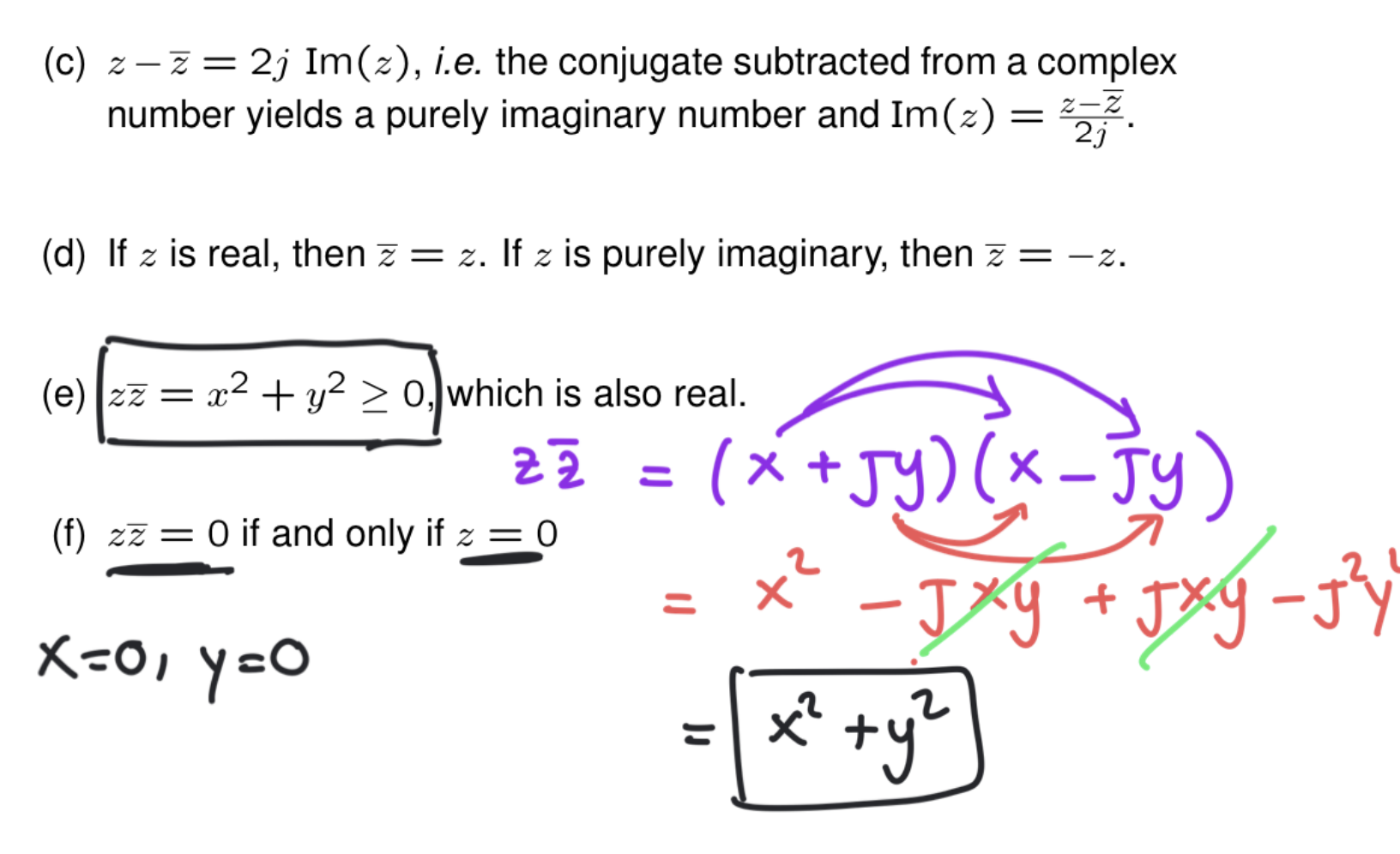
The reason why conjugate z is equal to z if z if purely an imaginary number is because it would flip on the x-axis.

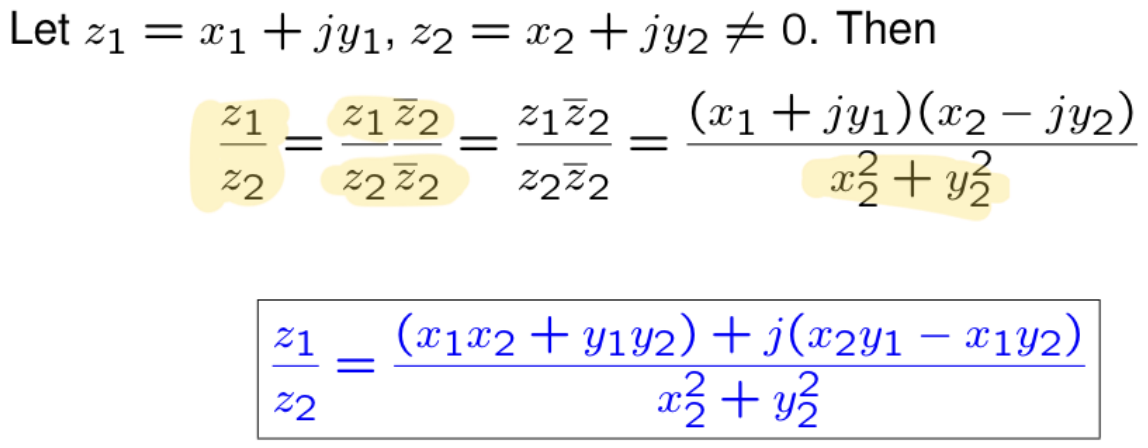
How do divide complex numbers? Derive and state the equation.
You could just simply divide however the resulting expression has an imaginary term in the denominator making it difficult to use in subsequent computations.
So, you use a process called rationalisation where you are multiplying both the numerator and denominator of the quotient by the conjugate of the denominator.


List some useful properties of the complex conjugate pair.

How to represent complex numbers graphically - label the axes and what they’re? Why do we represent it graphically? State the name of the cartesian plane.

x-axis = real axis
y-axis = imaginary axis.
We represent them graphically to get a better understanding of complex numbers and related problems.
the name of the cartesian plane is the complex plane or Argand plane.

Also note that the equation z = x+jb is the cartesian form of expressing complex numbers.
Why do we represent complex numbers in their polar representation?
It makes calculations a lot simpler especially for engineering.
Derive and state the polar representation of complex numbers.




Note that for (i), the answer has no imaginary part.
What is the absolute value or modulus of z (complex number)?

It is defined as the distance of the point (a,b) from the origin otherwise known as the distance r.


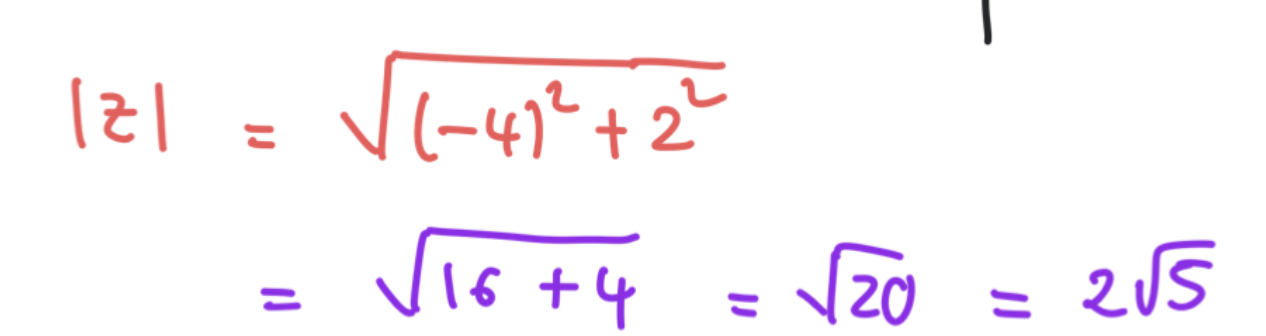
List the properties of modulus z.
If z = a + jb, then
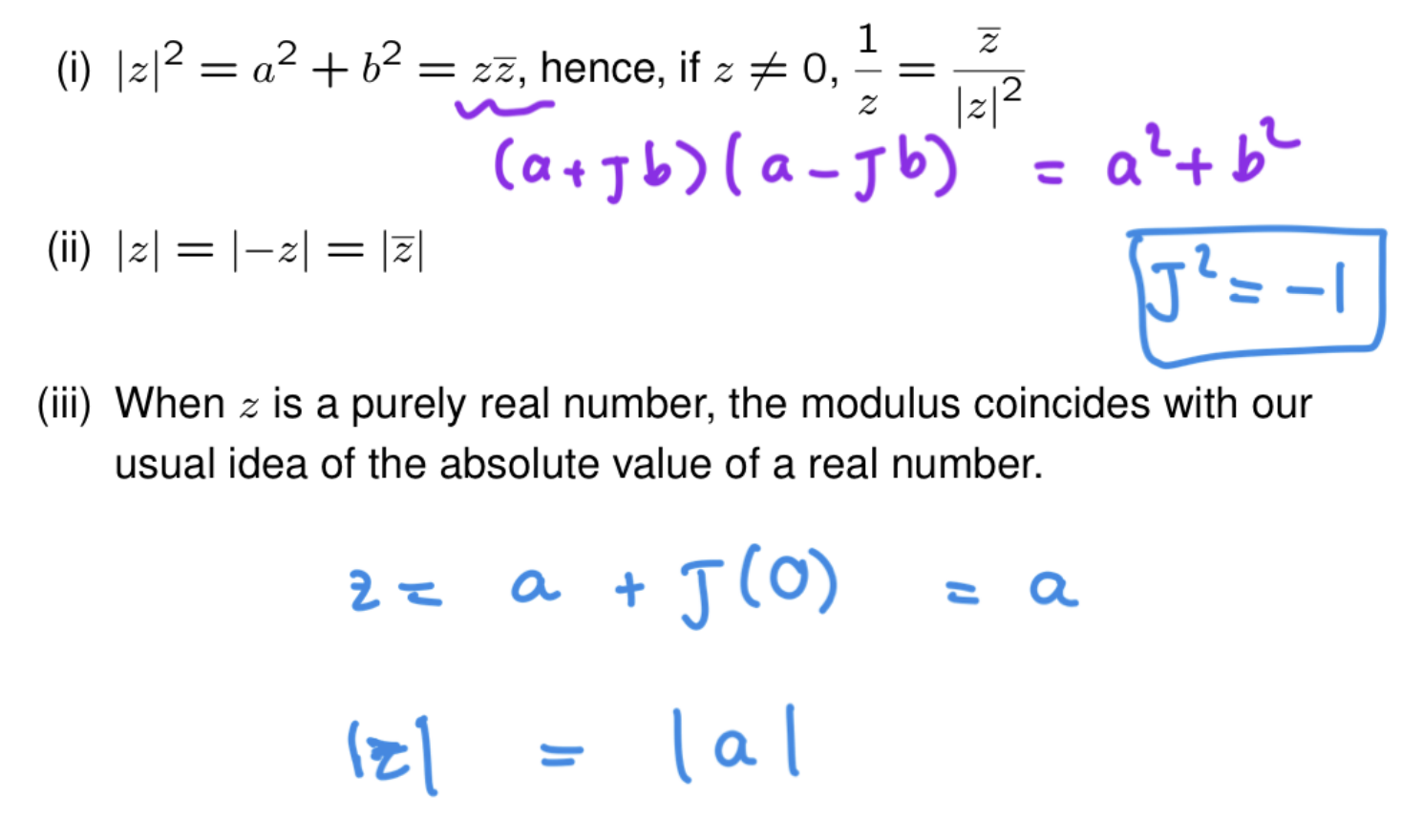
So this is to do with 1D distances.

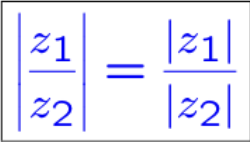

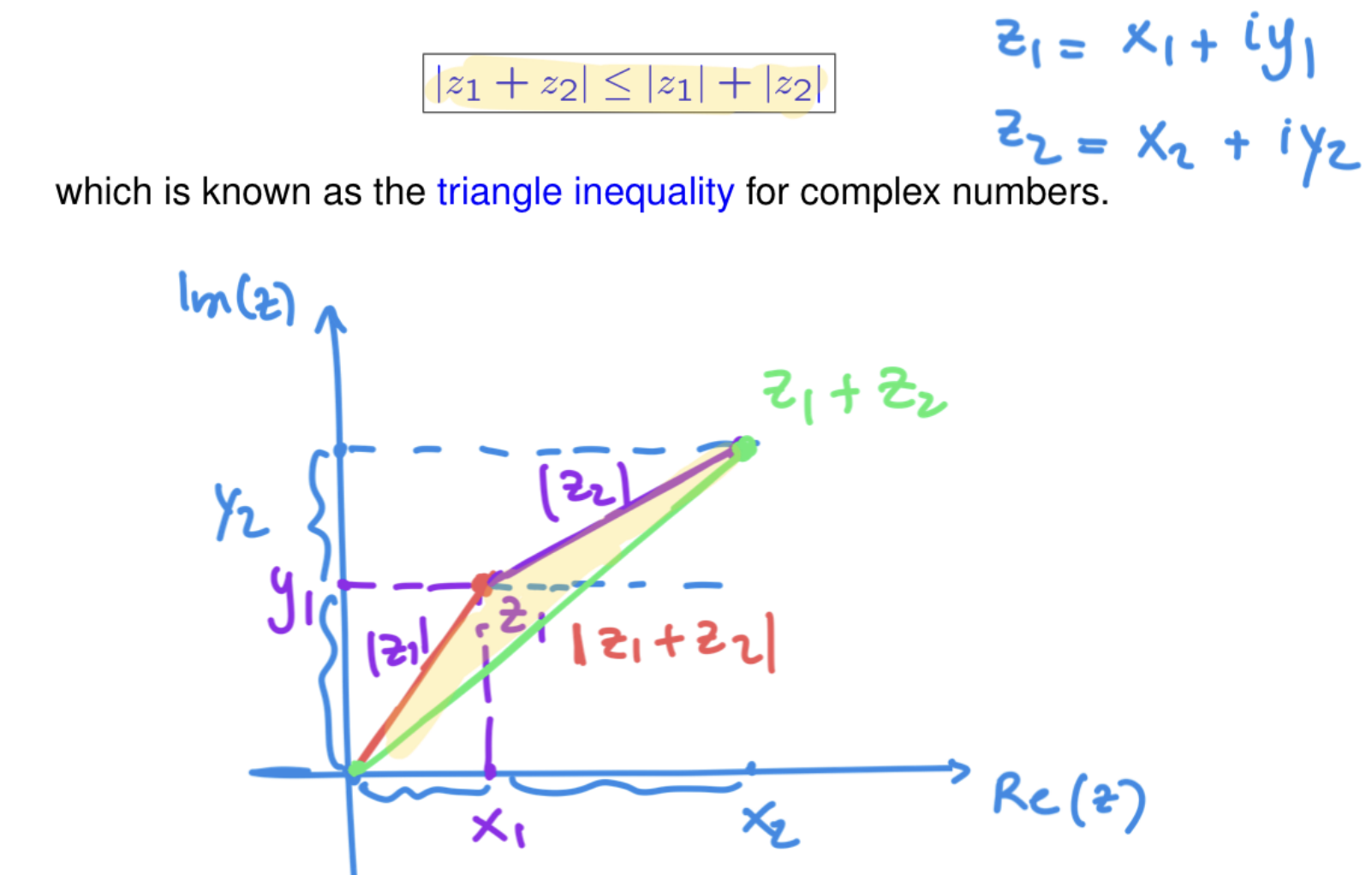
This last one is known as the triangle inequality for complex numbers.
Derive how this is true

Derive how this is true

State the triangle inequality of complex numbers. Why is it an inequality?
Complex numbers exist in 2D planes; real numbers can be ranked easily from smallest to largest (or vice versa) on a single line. Because complex numbers have 2 components (real and imaginary), there is no standard way to say one is “bigger” than the other. Instead we use the distance from 0 as a proxy for “size”.
Derive this


What is the argument of z?


What is the principal argument of z?

What must you do if z is in the 2nd or 3rd quadrant?






Describing regions in complex planes


Descibring regions of inequality for modulus z.


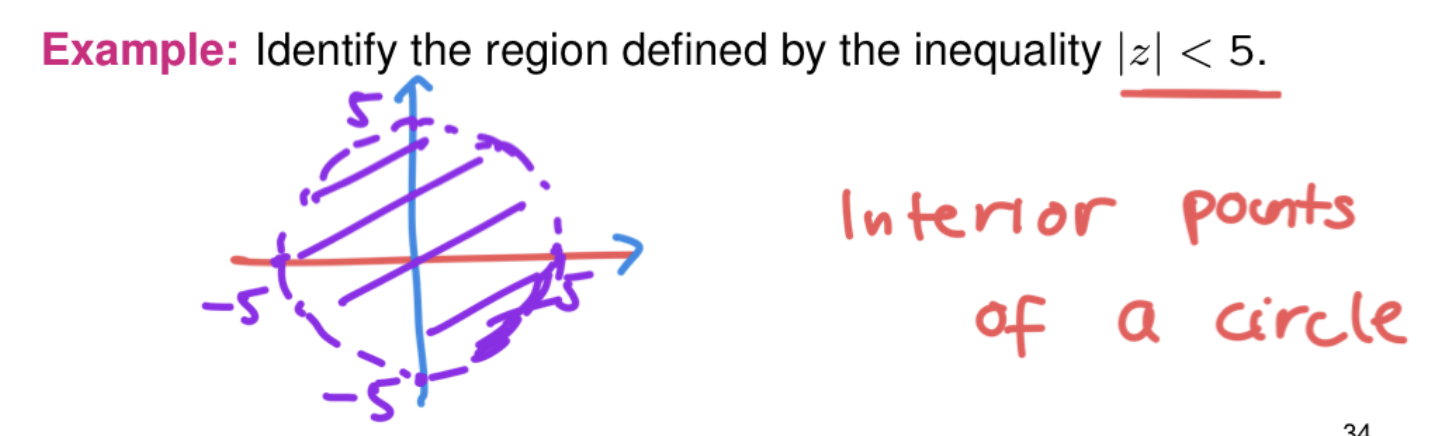


What is the 1st step we should do for describing inequalities in complex planes?
first substituting z = x+j y into the inequality and simplifying.


What is the exponential form for comlpex numbers?


What is the conjugate of the exponential form of complex numbers?

List the properties of complex numbers in their exponential form.


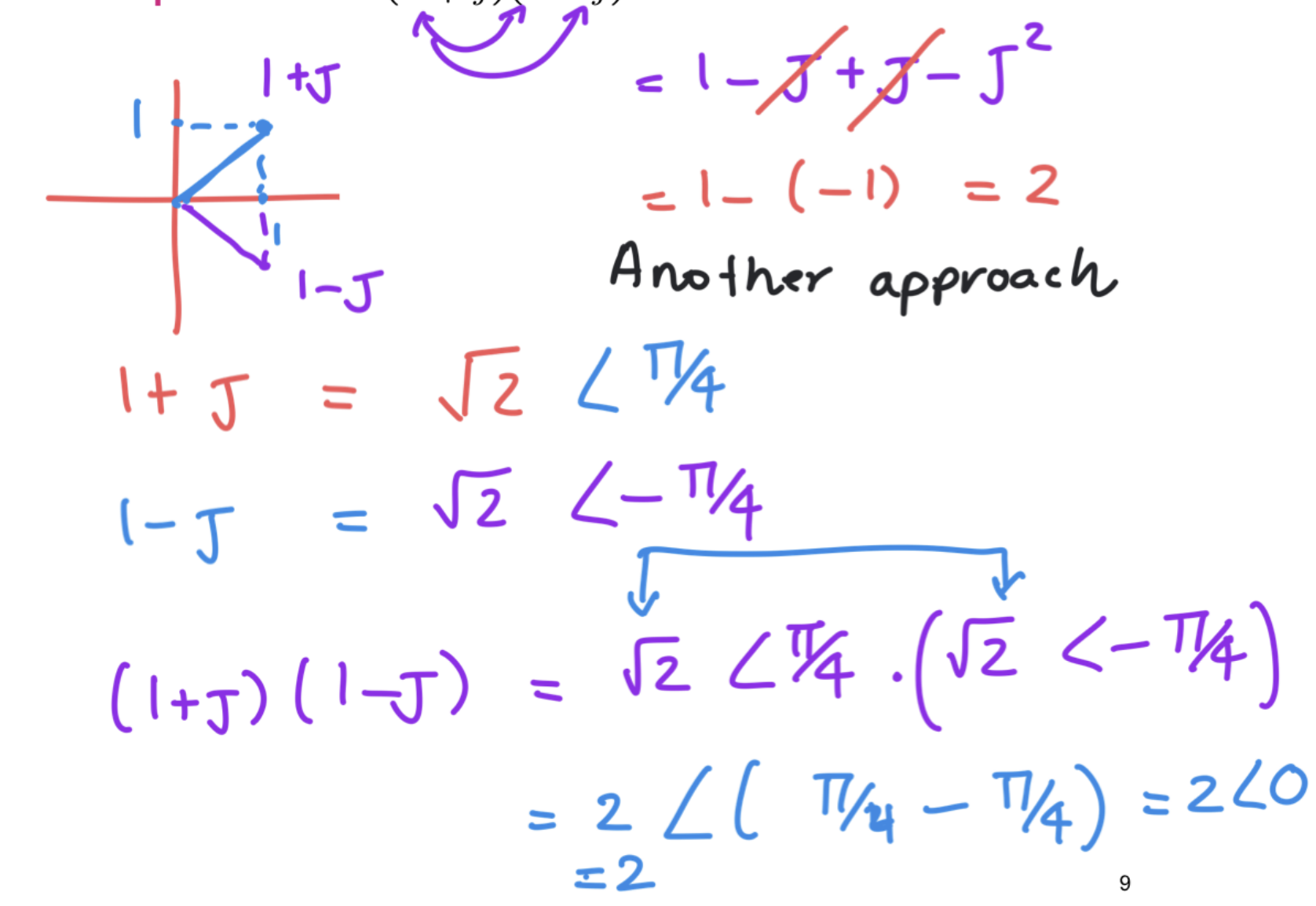
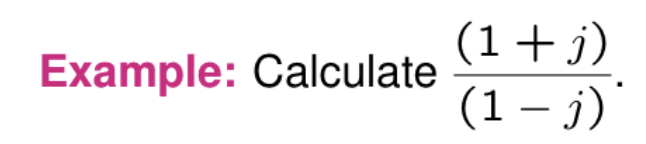

What is De Moivre’s theorem? Deduce how the equation got formulated.

Note: this theorem holds for number greater than or smaller than 0.


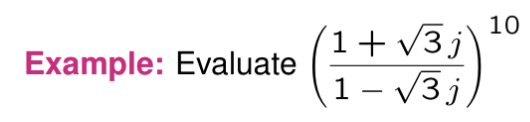

Note: the part where i circled with black ink - bascially im trying to say is use the nth roots formula found under complex numbers in the formula sheet.